
Updated at 10 a.m. ET on September 11, 2026
The dread that Americans felt during the weeks following the September 11 attacks stemmed less from the fear of death than from a collective loss of control—a sense of being dragged headlong into an apocalyptic future for which society seemed unprepared.
That future was delivered at a precise place and time—inside American Airlines Flight 11, a twin-aisle Boeing 767 that had departed Boston and was westbound for Los Angeles at 29,000 feet, near Albany, New York. This was the airplane that would hit the World Trade Center’s North Tower. Both pilots were at their accustomed positions in the cockpit. At 8:13:29 the en route air-traffic controller at Boston Center said, “American 11, turn twenty degrees right.” One of the pilots answered, “Twenty right, American 11.” It was the flight’s last routine transmission. Sixteen seconds later the controller issued instructions for a climb, and received no response, presumably because in that brief interval the hijackers had burst into the cockpit and with brutal efficiency had assumed command.
The controller did not suspect it at the time. Indeed, neither he nor others on the ground could have guessed that anything about the morning was extraordinary. In New York City, Sam Melisi, the fireman who would play an unexpected diplomatic role in the recovery effort over the following months, was sitting in the familiar engine room of the fireboat where he worked, studying for a ship’s engineer exam that he was scheduled to take at the end of the week. Kenneth Holden, the youngish commissioner of the city’s Department of Design and Construction, was in his Queens office preparing to leave for a regular meeting in Lower Manhattan, at City Hall. His lieutenant, Michael Burton, was headed to the same meeting, and was weaving impatiently as usual through traffic on the drive from his house in suburban Westchester County. At the same time, tens of thousands of office workers were streaming from the subways and commuter trains, and grabbing their customary coffees, or riding the elevators straight up to their offices in the World Trade Center towers. Workers all through the city were doing similar things. There were perhaps 18 million people in the vicinity of New York that morning, and later it seemed everyone had a story that started with a routine.
The routine held at Boston Center for eleven long minutes after the hijacking began. The weather was known to be bright, smooth, and clear. Air traffic was light. For the controller who had lost radio contact with American 11 there really wasn’t much to do. The airplane tracked steadily westward across the radar screen. The controller assumed that its continuing silence amounted to a simple communication failure—a relatively common occurrence—and he tried to re-establish radio contact, but without undue concern. He mentioned the problem to another controller, in charge of the adjoining airspace, and he continued to work the other flights in his piece of the New England sky—a Continental, a couple of Deltas, and two business jets that cruised by.
Then came the next step in the sequence of what would become a strange aerial ballet: at 8:23 the second 767 destined to hit the Trade Center came flying into the controller’s sector and as expected checked onto the frequency.
It was United Flight 175, running fifteen minutes behind American 11, and also bound from Boston to Los Angeles.
This was the airplane that would soon flow in a stream of molten aluminum down the South Tower’s side, but of course there was no hint of that now. The pilot sounded particularly relaxed. He said, “Boston, morning. United 175 out of 19 for 2-3-0.”
With a confirming glance at the altitude readout on the radar screen, the controller said, “United 175, Boston, ah, Center, roger.” The frequency was silent for nearly a minute and a half. Then the controller heard something in his headset, possibly just the hollowness of an empty “carrier” signal—a raw transmission without the modulation of spoken words. He radioed, “Is that American 11 trying to call?”
This time there was a voice, heavily accented. On the public air-traffic-control frequency, for all who were tuned in to hear, it said, “We have some planes. Just stay quiet, and you’ll be okay. We are returning to the airport.”
Little is known about the scene in American 11’s cockpit at that point. No “black box” recorder survived in the Trade Center’s ruins. It is possible, as was reported afterward, that one of the pilots had surreptitiously keyed his microphone to pick up the threats and warn air-traffic control. More likely, however, the pilots were already dead or disabled, and one of the hijackers had strapped himself into the seat behind the controls and was misusing an audio selection switch, unintentionally transmitting a message meant only for the cabin’s public-address system.
It had been fourteen years since the last airline hijacking in the United States. Understandably, the controller was taken aback. He radioed, “And, uh, who’s trying to call me here?”
Silence.
He radioed, “American 11, are you trying to call?”
Again the hijacker was heard. He said, “Nobody move. Everything will be okay. If you try to make any moves, you’ll endanger yourself and the airplane. Just stay quiet.”
The controller was quick enough not to radio him again. He notified his superiors that a hijacking was in progress. The United pilots must have understood this too. Like the other crews on the frequency, they maintained radio discipline. Not a word of comment went out over the air. Two minutes later the controller handed off the United flight to another sector within Boston Center’s airspace.
It was 8:28. American 11’s transponder beacon had been switched off, degrading its display on the radar screens and extinguishing its altitude readout. As an unenhanced “primary” blip, it turned sharply and began to move at high speed down the Hudson Valley toward metropolitan New York. As it busted through the various sectors and into the airspace belonging to New York Center, the Boston controllers continued to monitor the frequency—now cleared of other traffic. The flight downriver lasted eighteen minutes. A third of the way through it the frequency came alive with another unintentional transmission: “Nobody move, please. We are going back to the airport. Don’t try to make any stupid moves.” It sounded almost polite. People took the words at face value.
The destination appeared to be New York. Newark and Kennedy Airports prepared for a landing.
Then United 175 got involved again. The pilots had checked onto a new Boston Center frequency, and were level at 31,000 feet, when the hijacked airplane flew nearby. The controller wanted to verify its altitude, and he asked United 175 for help. He said, “Do you have traffic? Look at, ah, your twelve to one o’clock position at about, uh, ten miles southbound, to see if you can see an American 767 out there, please.”
Having heard the transmissions on the previous frequency, the United pilots must have known what this was about but again they maintained the expected calm. The view from their cockpit was superb. Looking downsun, they spotted the airplane ahead and several thousand feet below, crossing fast from right to left. “Affirmative. We have him, ah, he looks, ah, about 20, yeah, about 29, 28,000.”
Reflexively the controller directed them into the airspace above and behind American 11’s tail. He said, “United 175, turn five ... turn thirty degrees right. I want to keep you away from this traffic.” The encounter was later reported as a near collision between the two airliners—a gross if typical exaggeration. Ultimately, of course, the turn did neither airplane any good.
The scene inside American 11 was very rough. There were five hijackers aboard, Islamic militants armed with box cutters and small blades. They were led by an Egyptian named Mohammed Atta, the chief conspirator behind all four of the attacks that day. The cabin of American 11 was less than half full, with seventy-six hapless passengers and nine flight attendants. One of the flight attendants, a forty-forty-five-year-old woman named Betty Ong, dialed a seatback flight phone and reached a reservation agent on the ground. Ong reported the hijacking to the agent, who in turn established a communications link with American Airlines’ national operations center, in Fort Worth, Texas. The manager on duty there, an airline veteran named Craig Marquis, pulled up her records and, concerned that the call might be a hoax, asked for her employee number and nickname. Ong said that two of the flight attendants had been stabbed, one so severely that she was on oxygen, and that a business-class passenger had been killed by having his throat cut. She counted four of the hijackers, and reported their seat numbers. She said they had used a chemical spray that burned her eyes and made breathing difficult. Marquis asked Ong if there was a doctor on board. “No, no doctor’’ she said. As the airplane approached New York, he asked her if it was descending. She said, “We’re starting to descend! We’re starting to descend!” By then she may have felt more hope than horror. It was natural to assume that they were descending to land.
Apparently Ong could not see into the cockpit, which was just as well if the pilots inside it had been killed. Mohammed Atta was at the controls. Descending along the Hudson River, he pushed American 11 to over 500 mph, nearly twice the normal low-altitude speed, and hardly what you would expect from a 767 setting up for a landing. Still, no one yet guessed his purpose. At 8:40 he was six minutes out from the North Tower.
The pilots of United 175 had lost sight of him in the vastness behind their left wing. They checked onto a new frequency, now in New York Center’s jurisdiction, with an abbreviated call: “United 175, at Flight Level 310.”
The controller answered, “United 175, roger,” but his mind, too, was on the airspace behind them. He radioed to another crew who had been asked, like the United pilots, to spot American 11 to estimate its altitude. “USAir 583, do a favor. Were you asked to look for an aircraft, an American flight about eight or nine o’clock, ten miles, southbound, last altitude 2-9-0? No one is sure where he is.” USAir answered, “Yeah, we talked about him on the last frequency. We spotted him when he was at our three o’clock position. He did appear to us to be at 29,000 feet. We’re not picking him up on TCAS.”
The controller said, “No. It looks like they shut off their transponder. That’s why the question about it.” This was by then so obviously an inadequate explanation that the controller seemed to be talking in code—signaling that something very serious was occurring here. The frequency was quiet for a full minute, during which the United pilots apparently decided to drop any pretense that the problem was a communication failure only. Even so, when they radioed again their expression was tightly controlled. “New York, United 175 Heavy.”
“United 175, go ahead.”
“We figured we’d wait to go to your center. We heard a suspicious transmission on our departure from Boston. Sounds like someone keyed the mike and said, ‘Everyone stay in your seats.’” He was referring, of course, to American 11’s unintentional transmissions.
The controller said, “Okay, I'll pass that along.”
The pilot said, “It cut out.”
That was United 175’s final call. The time was 8:42. Just afterward a team led by a twenty-three-year-old citizen of the United Arab Emirates named Marwan al-Shehhi invaded the cockpit. The attack was so sudden that the pilots had no chance to alert the world. Nonetheless these 767s were big things with hidden spaces and lots of telephones, and word quickly got out: a mechanic on duty at United’s San Francisco center for in-flight complaints got a call from a flight attendant on board who, before the line went dead, blurted, “Oh, my God! The crew’s been killed, and a flight attendant has been stabbed! We’ve been hijacked!” The airplane held five hijackers, two dead pilots, seven flight attendants, and fifty-one passengers. United 175 turned and dove toward New York.
At about the same time, American 11 passed low over the George Washington Bridge. As best the last moments inside the cabin can be reconstructed, few passengers if any were looking through the windows, or were aware of the airplane’s ominous flight profile—the combination of ultra low altitude and high speed that characterized its final bombing run. The mood aboard must have been fearful but quieter now. In the back of the airplane another flight attendant was on the phone. Her name was Madeline Amy Sweeney. She had gotten through to an American flight-service manager in Boston, and with exceptional cool had given him a running account of the hijacking, fingering the terrorists and confirming much of Betty Ong’s account, including the slaughter of the passenger in business class. It is likely that she added important details about the terrorists’ techniques—how, for instance, they got into the cockpit—which for security reasons have not been made public.
Seconds before 8:46 and the impact she looked through a window to give a position report, and to her surprise saw the city flashing by. She said, “I see water and buildings!” She may have been the first person to understand the hijackers’ intentions. She said, “Oh, my God! Oh, my God!”
Across the East River, in an industrial section of Queens, in a converted Chiclets factory now used as the headquarters of the city’s Department of Design and Construction, Commissioner Ken Holden had been delayed by the usual round of morning telephone calls. At age forty-four, Holden was an observant quick-eyed man of medium height with close-cropped curly hair and a body gone wide after fifteen years of government service. As a registered (if ambivalent) Democrat in Mayor Rudolph Giuliani’s Republican administration, he was not a political operative in the conventional sense but a professional bureaucrat selected for command because of his willingness to stay in the shadows and accomplish routine but essential work: he was also known to be very smart. His intelligence gave him a presence, but not always to his benefit. He had an acerbic wit that he tried to restrain when around duller minds. The restraint required effort on his part. He was by nature amazingly verbose. He had a way of cutting short his sentences by saying “and whatnot” only to go on immediately to the next thought. Among his subordinates he had a reputation as a decisive and impatient manager with a strong instinct for self-preservation. Often he reveled in his job, and sometimes he did not. He had a badge and an official car with a driver.
He could be arrogant at times, especially with people like low-ranking cops who got in his way or slowed him down. But with his inner circle he was unpretentious. He made a comfortable middle-class living, near the top of the city’s pay scale, but as an appointee in an administration nearing its end, he worried openly about what would come next. He was not a construction man, and had few ties to the industry. He lived in a modest house in Queens with his wife, Frances McGuire, an artist, and their young son, Teddy, named after the first Roosevelt. Holden loved his family. He liked to read. He drove a Subaru station wagon. He liked to hike and cross-country ski. He liked his weekends off.
The agency he ran, the DDC, was practically unknown even within the city government. It had been created in 1996 by the Giuliani administration to oversee the generally thankless work of building and repairing the municipal infrastructure—sewers, sidewalks, station houses, and other whatnots that on the scale of New York City added up to a lot. Typically the DDC had about 800 projects under way, most of them very small. With its 1,300 employees and a $3.7 billion design and construction budget, it was a sizable organization, but it lacked the natural political clout of the uniformed services—fire and police—or the prestige of the city's small but highly visible Office of Emergency Management. Giuliani was widely thought to favor all the law-and-order types, because of his background as a prosecutor.
This may also simply have been a trait of his personality. He had a reputation for being dictatorial and vindictive. His detractors called him a terror. His admirers said he ran a tight ship. Either way, Holden had learned not to expect friendship from him, and to fear his attention rather than to court it. He had also learned to be on time. The mayor was not expected to attend this morning’s 9:15 meeting at City Hall, but his loyalist deputy Tony Coles was standing in for him, and Holden did not want to be late.
Holden tended to sweat when he moved fast. He was heading down the stairs in the atrium of the DDC headquarters, when one of his staff members came up to him and reported that an airplane had just hit the World Trade Center. Holden hurried outside to where his official car waited, and in the distance he saw the North Tower burning. One rush then turned into another, and endured.
Were it not for the scheduled meeting downtown, neither Holden nor his ambitious thirty-nine-year-old lieutenant, Mike Burton—the Trade Center site’s future “czar”—would have had any reason to get involved in the recovery from the disaster. The DDC was not meant to respond to emergencies.
But despite the morning’s confusion, the discipline of the schedule prevailed, and without giving much thought to why, each man headed independently toward City Hall—indeed, more intently than before. Actually, Burton was already almost there. He had been coming down the FDR Drive in his Jeep at the time of the first airplane’s impact, had noticed the ambulances going by, and had turned on the radio to find out why. After getting stuck in traffic by the Brooklyn Bridge, he pulled to the side, and proceeded through the city on foot. Holden had farther to go, but in a fast sedan with rights to the emergency lanes—a police-package Ford Crown Victoria with a special permit in the front window and a siren and flashing lights. The driver was a short muscular Dominican named Apollo Hernandez, a bodybuilder who flew small airplanes in his spare time and had a penchant for speed. He was completely dedicated to Holden, whom he referred to as “the Commissioner.”
Despite that formality, in the car they had established some of the patterns of a couple. Holden liked to sit in the front and give Hernandez driving advice. Today, for once, it did not involve slowing down. As they raced through Queens, they listened to the news radio station WINS, whose tag line was “You give us twenty-two minutes, and we’ll give you the world.” They lost reception briefly while passing under the East River in the Midtown Tunnel. When the station returned, in Manhattan, the world it gave them was news that a second airplane had come in, and that it had hit the South Tower. The implications were huge. Hernandez launched into an earnest explanation of the fuel capacity of small airplanes. Holden for once was almost silent. Though he had been raised in an observant Jewish family, and as a young man had given faith a serious try for a few months while living in Israel, he had become a thoroughly unreligious person—and also enthusiastically profane. True to himself now, he did not invoke the name of God, as so many others did on both sides that day, but reacted to the magnitude of the event by thinking Holy shit! as the car sped downtown.
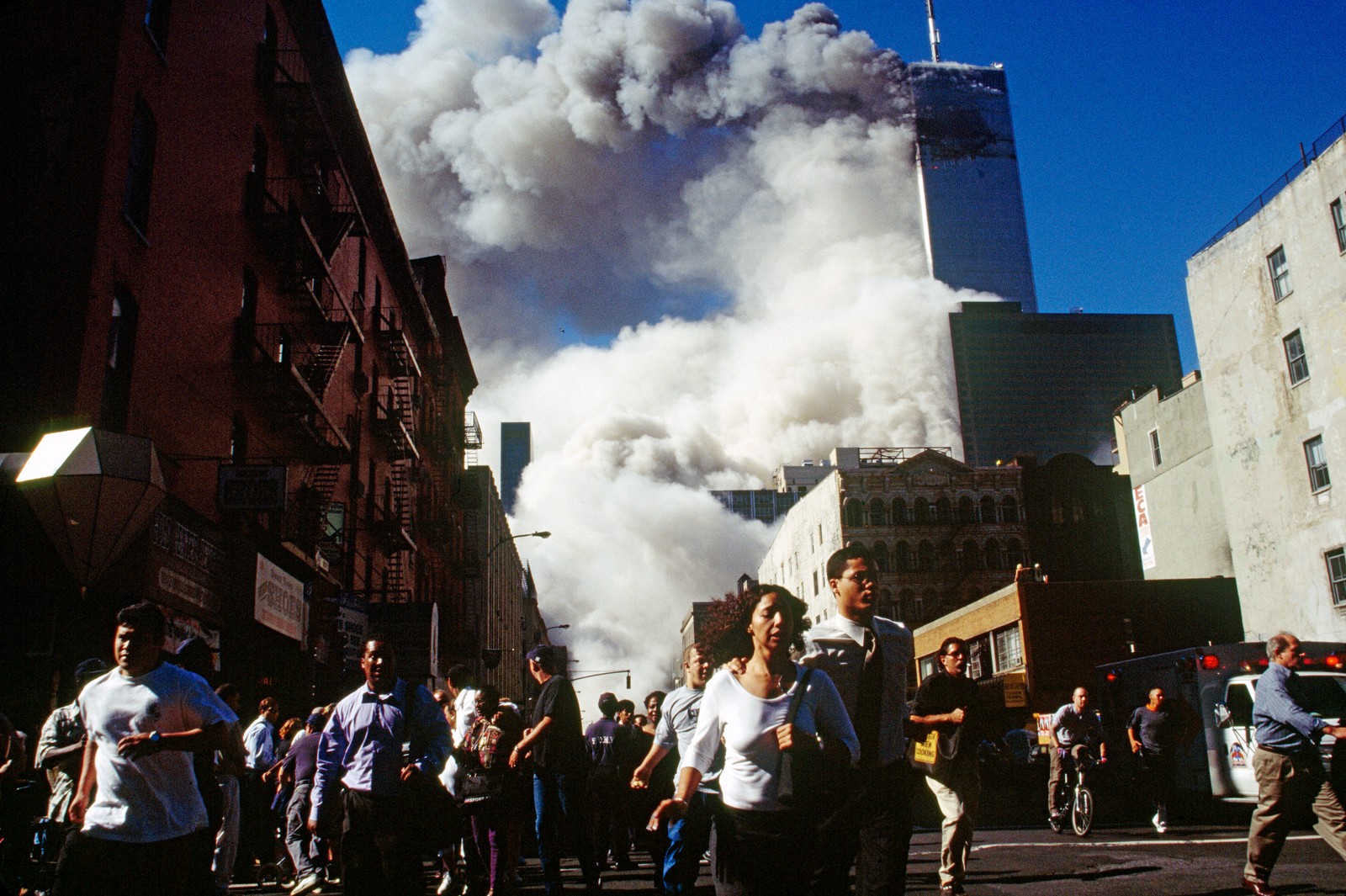
They parked beside City Hall, about four blocks from the burning towers. Holden jumped out and said, “Wait here. Don’t move. Wait here. I'll come back.” Those words haunted him later, after the buildings fell. In the uncertainty of the moment he couldn’t help but worry that Hernandez might have followed his orders too faithfully and died. Meanwhile, City Hall was locked tight. Holden gave up on the idea of a meeting, and stood idly outside. Burton had given up on it too, and had boarded a mobile command post—a bus belonging to the Office of Emergency Management—that was creeping west toward the Trade Center fires. Then the South Tower fell. Holden heard it as a growl, Burton as a roar. Both men were caught in the debris cloud, and each moved north among the crowds. When the North Tower fell Burton was caught in that cloud, too, and Holden was not. Because neither of them was injured, it amounted to a minor difference. Essentially they experienced the same dreamy confusions that were shared by a hundred thousand others in downtown Manhattan.
After a few hours Holden found a functioning phone and first called DDC headquarters, and then called his wife.
Later I asked him how she had been. He said, “Upset.”
I said, “Crying?”
“No. Very concerned about loss of innocence. ‘We’ve lost our innocence!’ she kept saying. I said, ‘Try to relax.’ I told her I didn’t think I’d be home for dinner.”
“And when she said, ‘We’ve lost our innocence’ did she mean America?”
“Yeah. Obviously she was watching TV.”
He was finally able to contact Hernandez, who indeed had remained loyally parked at City Hall through both collapses. Hernandez was apparently unscathed. He later described the experience to me in the most pragmatic terms, without bewilderment or self-pity, even though he had watched the towers fall from close by, had been hit by the successive debris storms, and had lost family in the attack. He said, “You go into that alert, that automatic alert. You’re just waiting to do the right thing. To me the right thing was to turn on all the flashing lights on the car. In case somebody needed help, they could come to the car. But I wasn’t going to move out of there until I heard from the Commissioner.”
Hernandez was thirty-nine years old. He had immigrated to New York from the Dominican Republic at age thirteen, in December of 1975, and despite the cold weather had immediately felt at home. He had become a citizen in 1994. He had led exercise classes at a Jack LaLanne gym, and had met his wife there. He had taken a job with the city for the security it offered. He was a good worker. He was willing and uncomplaining. He was very clean-cut. He did not drink or smoke. He had three little children, and was a good father. Now he was the perfect soldier, an American ideal. While hundreds of panicked people went running by, some in the wrong direction, he stayed at his post by his Ford Crown Victoria, and without fear.
Two women rushed up to him in terror, hugging each other and sobbing. “Oh, my God, the towers fell!” Hernandez calmed them down. They walked away. He spotted a couple of wounded policemen on their hands and knees, one of them bleeding from the head. He got them into the back of the car, and gave them a blanket with which to wipe around their mouths and eyes. They called him their guardian angel. The dust cleared. Attracted by the flashing lights, a woman approached who was shaking all over and could not speak. Hernandez found help for her and returned to the car. He noticed that his cell phone and radio links had been disrupted. After ninety minutes in position, he realized that Holden would no longer be looking for him here. He drove the policemen to the vicinity of a first-aid station, and then headed slowly uptown. Eventually the cell phone began to function, and Holden got through to him. They had a short, happy reunion on Carmine Street, in Greenwich Village. By early afternoon Hernandez had parked downtown again, and like a good soldier was waiting close to where he had waited before. Holden and Burton had met up in the police headquarters nearby, where a temporary command center had been established, and they were trying to marshal the DDC’s resources to help. Hernandez wanted to help too. He was not tired or bored. He was patient and proud. He felt love for his adopted country. He had never been in combat, but understood waiting as the experience of war. The streets were mostly quiet. Heavy smoke was rising into the sky.

Holden and Burton responded tactically, with no grand strategy in mind. At the police headquarters they discovered a telephone in a room off the temporary command center—a chaotic hall filled with officials struggling to get organized—and they began making calls. No one asked them to do this, or told them to stop.
One of the deputy mayors there had formally been given the task of coordinating the construction response, but with little idea of how to proceed, he had so far done nothing at all. Holden and Burton themselves were operating blind, groping forward through the afternoon with only the vaguest concept of the realities on the ground. The DDC’s previous experience with emergencies had been limited to a sinking EMS station in Brooklyn, caused by a water-main break, and a structural failure at Yankee Stadium, one week before baseball’s opening day. Burton could not now bring himself to believe that the Trade Center towers had completely collapsed. Imagining the need to protect people from falling glass, he phoned a scaffolding company and requested that they prepare to load a half mile of sidewalk bridging onto their trucks. Holden later told me this seemed to him like taking a Band-Aid to a gunshot wound—but at the time there were more important things to do than quibble. It seemed likely that hundreds of people lay trapped in the ruins, suffering and slowly dying. Holden arranged for a police escort to bring in twenty-five light towers from Queens for the coming night. Burton established an expanding “phone tree,” alerting the city’s heavy construction industry to ready itself for emergency requests later in the day.
As might be expected, the industry was something of an intimate circle, in which many of the top people had known each other for years. Burton himself was one of them, though he was currently engaged in a foray through government service. Faced with the urgent need to get crews and heavy equipment onto the job, he bypassed ordinary bidding procedures and made some immediate choices on the basis of personal and corporate reputations, asking AMEC, Bovis, Turner, and the family-owned Tully to send representatives to an initial meeting that afternoon at police headquarters. As it turned out, these were the four companies that ultimately would share the lucrative job of cleaning up, earning profits in the millions, though at considerable exposure to potential claims and lawsuits, because neither the companies nor the city were ever able to obtain adequate insurance for the Trade Center project. Cynics who later implied that the choice of these companies was in some way an insiders’ deal were only superficially right. The four companies were simply the first that came to Burton’s mind—and on the day of the collapse they responded altruistically in the face of enormous confusion, thinking at the most a few days ahead, without even the possibility of calculating gain. Holden agreed that they were some of the best in the business, and he signed off as well on bringing in the renowned engineering firm of Thornton-Tomasetti. Soon afterward the firm’s habitually well-dressed president, Richard Tomasetti, met up with some of the other chosen representatives, and rode in an escorted van to police headquarters downtown.
The first meeting didn’t amount to much, in part because police officials refused to give the group access to the site, forcing the construction men to begin planning their response on the strength of television images and secondhand news. It was understandable if the police were perhaps overly rigid, or were operating on the basis of suddenly obsolete concepts of public safety: they had seen thousands of citizens killed just a few hours before, and had lost twenty-three of their own people, and for the very reasons they had chosen the profession, many of them must have had great difficulty with America’s apparent loss of control. Nonetheless, crowds of unskilled volunteers were already swarming over the site, and forming the valiant but nearly useless bucket brigades. Holden and Burton believed urgently that their group had important capabilities to offer the search-and-rescue effort, and they felt increasingly frustrated as the day dragged toward night and they continued to be blocked. They also felt emotions that Holden could not admit to then but later described to me as only human—an urge to get to the center of the action, and a powerful curiosity about conditions at the site. The two men kept demanding to go in, and despite a short setback when World Trade Center Seven collapsed, they finally wore the police down. At 5:30 that afternoon they got permission for their nascent team of unbuilders to explore the ruins firsthand.
The walk they took became famous at the site because of the forces it unleashed. About fifteen people went along, including Holden and Burton, the engineer Richard Tomasetti, and a collection of tough construction guys. Though every one of these men was accustomed to grappling with problems on a very large scale, none was prepared for a disaster so vast and severe. Wading through paper litter and pulverized concrete, they tried to approach from the north, but were blocked by heavy smoke. Few of them had respirators. They moved upwind to the Hudson, and flanked southward again, cutting through the peripheral public areas of the heavily damaged World Financial Center, a high-rise complex that stood between the Trade Center and the river. Conditions there were so strange that Holden afterward had trouble knowing where they had been, though he did remember one surreal passage through a ruined atrium restaurant where all the fire alarms were blaring, wah, wah, wah.
Then, through an opening between buildings, they came suddenly upon the Trade Center ruins themselves—the skeletal walls and smoking hills of rubble where the towers had been, the boxy shell of the Marriott hotel, the heavy steel spears protruding from neighboring buildings, the collapsed north pedestrian bridge, the massive external column sections thrown every which way across the streets, and everywhere the fires. For Holden it looked like a scene from Apocalypse Now. He told me, “It was hallucinogenic—quasi-druggy, with flares shooting up and death in the air. There was a sense of crazed panic, people fighting to save lives, fire hoses cascading all over the place.” For the next ninety minutes they moved through a smoky twilight among the ruins. The ground was littered with hundreds of shoes, presumably from victims, but characteristically for this unusually imploded killing zone, not a single corpse lay in sight. Afterward Holden was nearly at a loss for words to describe what went on in his mind. He said, “Cars. I remember everywhere you’d walk there were crushed cars. Some that had burned. Sparks flying. Flames shooting. Smoke all over the place. People desperately trying to move the debris. The light was dim. It was just this really odd, frantic atmosphere. We were walking through twisted debris. It was completely startling—like a “Holy shit!’ experience. Every corner you turned was “Holy shit!’”
Mike Burton and Richard Tomasetti stayed together, each struggling to maintain an analytical frame of mind. It helped to confer with each other. Their focus was on lifting the steel to uncover survivors. It was obvious that large numbers of skilled workers were necessary, along with more heavy equipment than the two men could have imagined before. They needed not just the largest diesel excavators and cranes to pick up the pieces but, for lack of stockpiling space, a fleet of trucks to haul off the debris—and they needed it all right away. The first problem was access: a major effort would be required to clear a path down West Street just to get equipment to the ruins of the north pedestrian bridge. That bridge by chance was a Tomasetti design, and it was stout, but it had been hit with impossible force when the North Tower fell. Now it was blocking the best route to the pile.
The group moved south under the crackling flames of a burning building, a 1907 landmark at 90 West Street and they skirted a severed 767 wheel before heading back toward the center of the site by the severely wounded Bankers Trust building. Suddenly a fireman rushed up to Burton and Tomasetti, and said, “Listen, there’s a water-main break, and there’s no pressure to fight the fires. What we want to do is tap into the water tower at the top of this building.” He pointed to Bankers Trust. “I want to know if it’s safe.”
Was it because of their office clothes? The fireman did not know Burton or Tomasetti, but had clearly taken them for engineers. Burton looked at Tomasetti, who peered at the building through the smoke, and hesitated. The structure had been speared and torn open. The fireman mentioned that his people had already been in the basement, searching for victims. Tomasetti said, “Well, it’s kind of dark out, but the building seems to be missing only one column ….”
As the second-in-command of an obscure city agency in Queens, Burton had not the slightest authority here at the Trade Center site, but he was willing to assume it anyway. This was typical of him. Burton’s brashness was well known within the DDC, where people tended to be wary of him for his disdain of procedure, and for what many saw as his arrogance. Holden himself was wary of Burton, and said he felt the need to “cage” him regularly, but he recognized Burton’s effectiveness nonetheless. Burton was the DDC’s doer. And Burton had an agile mind. He was said to be a right-wing conservative but he was also surprisingly supple, and he understood now that conventional standards of safety simply did not apply to these ruins. To the fireman he said, “Listen. You’ve already been in the building. You’ve already risked your life once. It would take us a week in daylight to tell whether the building is safe or not. If you climb the stairs on the far side, it’s probably okay. That’s a guess. But it won’t be any riskier than where you’ve already been.” With that the fireman murmured into a walkie-talkie and disappeared. Burton exchanged glances with Tomasetti. He saw a group of firemen go running toward the building, and wondered about the wisdom of his advice. He did not waffle publicly, however, and it later turned out that he was right. Bankers Trust did not fall—and indeed, not a single person was killed during the nine months of the recovery effort that ensued. Burton had just made the first of his many quick decisions at the Trade Center site. He knew already what others soon discovered—that he had a particular talent for making up his mind.
The group returned to police headquarters after dark, and worked through the night, mobilizing columns of equipment and thousands of skilled laborers, considering the rudiments of a disposal program, laying out the role of engineers, planning the first rapid inspections of hundreds of neighboring buildings, and outlining a four-quadrant overlay that would divide the excavation work according to the simplest geometry. The four-quadrant pattern owed as much to the presence of the four companies on that evening’s tour as to a compelling operational logic, but while it endured, during the first urgent months, it functioned reasonably well. There was no time for refined planning anyway. Holden went home, and got two hours of sleep; Burton spent fifteen minutes dozing in his Jeep. Then they returned to the site and continued to work tirelessly. They were bit players at best, at least on the organizational charts, and did not pretend otherwise: the mayor’s Office of Emergency Management was supposed to be coordinating things, and the main response was overwhelmingly and appropriately the fire department’s. But to a degree that was surprising even to Holden and Burton, over the next few days they were able to bring New York’s enormous construction energies to bear. As individuals, they remained almost invisible, but their influence rapidly grew.
None of this reflected the normal operation of the U.S. emergency-response system. After natural and man-made disasters in the past—notably the 1995 bombing of the Murrah Building, in Oklahoma City—the efforts on the ground had rapidly been nationalized under the direction of FEMA and its operational allies in the Army Corps of Engineers, a branch of the military that calls itself the world’s largest public engineering, design, and construction-management agency. These people in turn dealt primarily with pre-assigned companies that specialized in the disaster-cleanup business (many based in Florida, along the hurricane tracks). The system was intelligently organized and charted—and given the frequency of destructive weather in North America, it was well exercised. It was not, however, quite prepared to operate with a speed and intensity equal to New York’s.
Ken Holden, for one, didn’t even consider turning to the outside for help. He was vaguely aware of FEMA and the Army Corps of Engineers, but with no previous experience in national emergencies, he neither knew nor wondered about the protocol. He might have assumed that ultimately the federal government would pay the bill, but afterward he had no memory that such questions crossed his mind. To me he said, “None of us wondered, ‘Should we contact the state? Should we contact the feds? The Army Corps?’ It was just ‘We’ve got a disaster here. Let’s fix it.’ It was instinctive. ‘Let’s give the fire department access. Let’s let the police see if they can rescue their own. This is not out of our realm.”
By “realm” he meant professional expertise, but he might as well have been talking about his beloved city. He was a typically proud New Yorker. He said, “As I kept explaining to FEMA later, this is not Oklahoma. We had the equipment. We had the connections. We could handle it. We just went in and did what we had to do. And no one said no.”
“Did anyone say yes?”
“No. But then again, we weren’t asking.”
More than pride was at play: Holden simply did not have the time to seek permissions. The rush to find survivors was hopeful at first, and then less so. Sam Melisi later described for me the wild-eyed urgency of the initial search. Speaking of the lost firemen, who throughout the months to come provided a focus to the recovery efforts, he said, “These were people you had worked with, and they were maybe alive. You knew they were trapped in there, and there was a sense of franticness, and it was personal. I remember crawling through the steel—it would have probably been by the hotel. There were some spaces that let you get below and take a look around, it wasn’t regulated at all. The first couple of days, anything went. It wasn’t like somebody was saying, ‘You can’t go in there, you can’t do this, you can’t do that.’ It was more like ‘Hey, if you think you can get in there, go ahead.’ All bets were off. It was just ‘Go and bring somebody home.’”
At age forty-three, Melisi was a small, wiry man who had a disarming way of suggesting his opinions rather than asserting them. He had a nasal voice and a big moustache. He was obviously somewhat shy. Within the wolf-pack world of the Trade Center site he became known at first simply because his diffidence was unique. Still, he was a fireman through and through, with strong allegiances to the department and a blue-collar history that was fairly standard for the type. He grew up on Staten Island as the son of a diver with a small marine-salvage business, and he excelled in high school before heading to college in Oregon, where, cut off from his roots, he floundered. After dropping out of school, he hired on at a sawmill for six months, and then returned to New York, went to work in heavy construction, and eventually became a licensed equipment and crane operator. At the advanced age of twenty-seven he joined the fire department because of the generous time off (“Like being on permanent vacation,” he told me) and only then discovered the job’s power to mold people’s lives, including his own. So far he had put sixteen years into the service—in various ladder and rescue companies, and most recendy as an assistant in the engine room of the city’s 1938 fireboat, called the Firefighter. Because of his heavy-equipment experience and additional training, he also served on a specialized collapsed-building team, which had responded to the 1993 bombing of the Trade Center and had been dispatched to the subsequent bombing in Oklahoma City and to a hurricane disaster in the Dominican Republic. He lived with his wife and two young children on Staten Island, in a surprisingly rural setting—a small wooden house from the 1840s with a large back yard bordering on a forest preserve and littered with old construction equipment, including a small crane. (One day at the site he said, “People here keep saying how strange it all looks, but I dunno, it kind of looks like my back yard.”) In a shed at the end of his yard he had built a welding and machine shop. The jobs he did there helped him to supplement his modest salary. Sometimes he moonlighted as an electrician. Sometimes he was a plumber, sometimes a carpenter, too.
When the first airplane hit, Melisi put down his reading in the Firefighter’s engine room, and prepared to get under way. When the second airplane hit, he understood it meant war, and he had a strange impression of feeling every possible emotion all at once. When the South Tower fell, the boat was plowing at full speed across New York Harbor, and the twin diesels were roaring. When the North Tower fell, the boat was pulling up to shore, and the diesels were still so loud that Melisi did not hear the thunder. The boat docked just north of the North Cove, along a riverfront promenade. Melisi emerged from the engine room and helped the deck crew drag hose to the fire-suppression teams on the northwest corner of the site. He returned to the boat and helped to engage its pumps, which delivered enormous quantities of harbor water to the ruins over the following two weeks. Aware of Melisi’s training in collapsed buildings and rescue operations, his supervisor then cut him loose. He said, “Just go. See what you can do.” This turned out to be more than a little thing. Melisi’s maritime career had come suddenly to a halt.
He joined the scramble through the smoke and debris, searching for cavities in which people might have survived. This was a collapse unlike any he had seen before, and not only in size. Though the top layer of the pile was jagged, it was also fantastically dense, and it offered little in the way of natural shelters, or of access to the underground. Melisi circled to the north side, where fires raged and Building Seven threatened to fall, but the devastation was less severe. Handicapped by the lack of a flashlight, he joined a rescue team that descended through a crater in Building Six and made multiple attempts on the North Tower basements, but was blocked each time by smoke and heavy debris. Back on the surface again, he moved down West Street squeezed under the ruins of the north pedestrian bridge between the hulks of crushed fire trucks, and spent the afternoon with a shovel, digging for survivors and uncovering only the dead. He arrived in the site’s southwest corner that evening at about the same time that Ken Holden, Mike Burton, and the unbuilding crew came walking through. Melisi neither knew nor needed them then, but he shared some of their construction expertise, and he had drawn conclusions similar to theirs—that the bucket brigades he saw operating on the pile were ineffectual, and that if victims were to be found alive, it was essential to bring in large cranes and grapplers that could lift the fallen steel columns and expose cavities below the surface. Typically, Melisi did something practical about it right away. He worked to clear an access route from the south, directing front-end loaders to shove cars and toppled lampposts aside, opening a path that detoured around the heaviest obstacles. A perverse pattern then prevailed: the fast-moving small equipment was the first to arrive, and time and again it had to be dismantled or laboriously moved out of the way in order to allow the larger and more effective pieces in; because of the quantities of debris, space was simply not available for both. The delays were frustrating for Sam Melisi, who through his actions and expertise was unintentionally already involved in the management of the site. The greater frustration came later, however, and it was the near total lack of survivors.

The lack was partly definitional, since it excluded the 15,000 people who were able to walk away, in some cases even after the buildings fell. Their survival, however, did not diminish the reality that thousands remained unaccounted for, or the terrible feeling in those first confused hours and days that time was running out. It went without saying that the survivors who mattered were the ones who might now be lying trapped in the debris. They turned out to be rare; over the subsequent months of retrieval it became obvious from the condition of the bodies that few if any of the victims had perished while awaiting rescue. By the final count, in a place where nearly 3,000 had died, only eighteen people were recovered alive. Two of them were injured policemen discovered on the first day in the underground concourse, a shopping area east of the South Tower that had been speared and pummeled by falling columns but not completely crushed. The remaining sixteen were all found among the ruins of the North Tower. Fourteen of them—twelve firemen, one policeman, and one civilian office worker—came through largely unscathed in an intact stairwell section between the second and fourth floors, sandwiched between collapses. When they were rescued, also on the first day, they emerged from the ground as if from the bowels of hell, and cheering broke out across the site.
But only two other people were ever found alive. Both were Port Authority employees caught at relatively high elevations in the North Tower. They did not “surf" the collapse, as a couple of Port Authority cops were falsely rumored to have done in the South Tower, but they lived through falls that should have killed them. The first of them worked with Peter Rinaldi, the Port Authority engineer then vacationing on the Outer Banks of North Carolina and destined to play an important role at the site. This survivor’s name was Pasquale Buzzelli. At age thirty-two, he was a staff engineer whose job was primarily to oversee work on the George Washington Bridge—including Rinaldi's project of decorating the span with lights. Buzzelli was riding an intermediate-stage elevator to his office, on the sixty-fourth floor, when the 767 slammed into the North Tower far above. The elevator shook violently, and briefly dropped before catching itself and returning slowly to its starting point, the “sky lobby” on the forty-fourth floor. When the doors opened, Buzzelli was confronted by a confusion of shouts and thick black smoke (presumably from burning jet fuel that had poured down other shafts). He retreated into the elevator and, with no way to go but up, instinctively pushed the button for his familiar sixty-fourth floor. It was a slow ride. When he got there, the floor looked well lit and calm, and it was almost smoke-free. Most of the workers had already left, but more than a dozen remained, and were dutifully awaiting instructions from the authorities below, as apparently they had been asked to do by Port Authority and fire-department officials on the phone. Because the group included Buzzelli’s supervisor, a man named Pat Hoey, Buzzelli decided to stay too. He said, “What happened, Pat?”
Hoey said, “I don’t know, but I was just about thrown out of my chair.”
“Really? I thought it was some kind of elevator thing.”
Hoey called downstairs to the Port Authority communications center, and was unable to get clear information. He seemed edgy, but more from frustration than fear. Buzzelli called his wife, who was seven months pregnant with their first child. He said, “Don’t be alarmed or anything like that. I’m okay. Just put on the TV. Tell me if something has happened.” He waited. After a while she came back and said, “Oh, my God, Pasquale! There’s a plane in your building!”
Buzzelli lived up to the reputation of engineers as unflappable. He said, “All right, all right. Don’t get excited.” (When he recounted the conversation later, he explained, “She was getting all worried and stuff.”) He said, “Just, can you please tell me where it is? Did it hit high, middle, or low?” (“Because she doesn’t really know the floors and stuff.”)
She said, “Well, it looks pretty high up in the building.”
This was of course good news. Buzzelli had been through the 1993 World Trade Center bombing, and was not overly concerned. He said, “Okay. Well, just so you know. I’m okay, and we’re here, and we’re going to figure out what to do.” It took them a while. They learned that the South Tower, too, had been hit by an airplane—but they neither heard nor saw the impact. Their offices occupied the northwest corner of the North Tower, as far from the South Tower as could be. They were surprisingly isolated, and were unaware that their upstairs neighbors were jumping from their windows and falling by outside.
They stuffed wet coats under the doors against the faint smoke that was drifting through the elevator lobby. Apparently their reactions were slowed by a sort of collective inertia: believing they had been told to stay, they worked the phones looking for someone who could give them a schedule for the evacuation. They delayed for more than an hour, during which a man who would have told them immediately to go, the Port Authority’s chief engineer, Frank Lombardi, climbed down the stairs from his office overhead, but of course without checking in on every floor. At 9:59 they heard muted thunder and felt the building vibrate. It was the South Tower collapsing, an unimaginable event; they attributed the commotion to something much less, maybe a piece of airplane breaking free and sliding down the outside. But the smoke in the elevator lobby was growing thicker. Buzzelli and another man unblocked the doors and went out to check the nearest stairwell, which they found clear and well lit. They returned to the office and reported the news. At last the group started walking down from the sixty-fourth floor.
There were sixteen of them. They moved at different speeds and eventually spread out over at least nine floors. The stairway descended with left turns, in a counterclockwise direction, and it was of course windowless and completely cut off from the outside. About a third of the way down (in the forties) Buzzelli began to encounter exhausted firemen, some of whom were sitting on the steps and resting. They knew no better than he that the South Tower had fallen or that their forces had been ordered to retreat. They were calm, and said, “Just keep going down, clear run. Keep going down, clear run.”
Buzzelli had just passed the twenty-second floor when the North Tower gave way. It was 10:28 in the morning, an hour and forty-two minutes after the attack. Buzzelli felt the building rumble, and immediately afterward heard a tremendous pounding coming at him from above, as the upper floors pancaked. Buzzelli’s memory of it afterward was distinct. The pounding was rhythmic, and it intensified fast, as if a monstrous boulder were hounding down the stairwell toward his head. He reacted viscerally by diving halfway down a flight of stairs, and curling into the corner of a landing. He knew that the building was failing. Buzzelli was Catholic. He closed his eyes and prayed for his wife and unborn child. He prayed for a quick death. Because his eyes were closed, he felt rather than saw the walls crack open around him. For an instant the walls folded onto his head and arms, and he felt pressure, but then the structure disintegrated beneath him, and he thought, "I’m going,’’ and began to fall. He kept his eyes closed. He felt the weightlessness of acceleration. The sensation reminded him of thrill rides he had enjoyed at Great Adventure, in New Jersey. He did not enjoy it now, but did not actively dislike it either. He did not actively do anything at all. He felt the wind on his face, and a sandblasting effect as he tumbled through the clouds of debris. He saw four flashes from small blows to the head, and then another really bright flash when he landed. Right after that he opened his eves, and it was three hours later.
He sat up. He saw blue sky and a world of shattered steel and concrete. He had landed on a slab like a sacrificial altar, perched high among mountains of ruin. There was a drop of fifteen feet to the debris below him. He saw heavy smoke in the air. Above his head rose a lovely skeletal wall, a lacy gothic thing that looked as if it would topple at any moment. He remembered his fall exactly, and assumed therefore that he was dead. He waited to see if death would be as it is shown in the movies—if an angel would come by, or if he would float up and see himself from the outside. But then he started to cough and to feel pain in his leg, and he realized that he was alive. He was trapped high on the altar, injured, and covered with a slick powdery dust. He shouted for help and called out the names of the people who had accompanied him down the stairs, but heard only silence in response, and saw no movement of a human kind. Where the Twin Towers should have stood he saw only smoke and sky. Somehow an entire huge building had passed him on its way to the ground. Somehow also he had landed just right. Buzzelli was a Catholic but not a theologian. He was also always an engineer. For nearly an hour he sat trapped on the altar trying to reason things through.
Conditions were still precarious. The altar itself was unstable, threatening to topple or collapse. Buzzelli was too badly injured to climb down. He worried that if he rolled off his perch—simply allowed himself to drop—he would be impaled by the twisted steel below. Increasingly he had trouble staying calm. He was alone. He was helpless. And when the silence was finally broken, it was not by people coming to save him but by the crackle of an approaching fire. The fire came from an area behind him. which from his position he could not see. He worried that the fire would weaken the steel and cause the wall to topple onto him—or, worse, that the fire would burn him alive. Judging from the sound, the danger was growing rapidly. Then he heard someone call, “Richie!” It was a fireman climbing unseen through the rubble nearby, attempting to locate the eleven stairwell survivors, one of whom had established radio contact and was guiding in the rescuers.
Buzzelli started shouting. “Help, help! I’m up here!”
Eventually the fireman materialized below the altar. He looked up at Buzzelli and said, “Oh. Do you need a rope to get down?” He seemed to think Buzzelli was an errant rescuer who had gotten stranded during the search.
Buzzelli said, “I’ll jump if you want me to, but I can’t climb down alone.”
This was not what the fireman expected to hear, He did a double take and said, “Oh, my God. Guys, we’ve got a civilian up here!”
Other firemen arrived and began to discuss how to get Buzzelli down. It was not an obvious thing. They were worried about the instability of the debris slopes as well as the obvious precariousness of Buzzelli’s perch. They were also worried, of course, about the fire. Indeed, the flames then flared up, and began to come on so aggressively that the firemen retreated. As they disappeared, one of them yelled, “Hold on! We’ll get back to you!” The promise was of little comfort to Buzzelli, who figured, probably correctly, that the firemen would not have left him if there was any way they could have stayed.
Buzzelli by now was thoroughly terrified. The fire was roaring, popping, and setting off small explosions just behind the altar. He still could not see the flames, but he could feel their searing heat. Now he heard a new, more intimate sound, which he took to be the groaning and sizzling of metal. This was the end. Desperate to assume control over his fate, he groped around and found a scrap of sharp steel with which to slash his wrists. He was about to cut himself open when, strangely, just as suddenly as the fire had grown, it subsided and died. A few minutes later the firemen reappeared. One named Jimmy said, “All right, we’ll get to you somehow.” He circled clockwise around the altar, disappeared for a stretch of dangerous climbing, and pioneered a route to an alcove high in the rubble mountains above and behind Buzzelli. Somehow he clambered down to the altar. Three others followed. The firemen then fashioned a rope cradle, got it around Buzzelli, and lowered him to the debris slope below.
The group still had 400 yards of difficult terrain to go. Despite the severe pain in his leg, Buzzelli walked about halfway before beginning to lose consciousness. The firemen put him onto a plastic stretcher known as a Stokes basket, and they passed him down the pile in the manner of the bucket brigades. In the ambulance a kindly attendant lent him a cell phone to call his wife. She was at home, surrounded by friends and family. It was 4:00 in the afternoon. She said, “Oh, my God, I can’t believe … ” He heard an uproar in the background. He said, “Yeah, I'm alive.” He was taken to Saint Vincent’s Hospital, where the other patients were firemen or cops who had been lightly injured after the buildings came down. The staff assumed that Buzzelli was just another one. He had some cuts and bruises, and a broken right foot—that was all. They told him to go home or sleep in the cafeteria if he liked, because they were still thinking triage then, and standing by for a rush.

The last survivor found was Genelle Guzman, a thirty-one-year-old Port Authority clerk of Trinidadian origin, who delayed with Buzzelli and the others on the sixty-fourth floor, but had gotten ahead in the descent, and was on the thirteenth floor when the building boomed and broke apart around her. She was with a friend named Rosa, and had stopped to adjust her shoe. She had put her hand on Rosa’s shoulder. As the building crumbled, she felt the shoulder pull away, as if Rosa were running up the staircase. She was hit, and felt the acceleration of the collapse around her. All was darkness. When the roar stopped, she heard a couple of calls from a man who then grew silent. Her head was jammed under a load of debris, but eventually she worked it loose. She was in a dark cavity in the inner world of rubble. Her legs were pinned and crushed. She felt a dead man beside her. It turned out that he was a fireman, and that there was another one, also dead, lying nearby. For twenty-seven hours Guzman lay trapped and seriously injured. She spent some of that time bargaining for her soul, pleading with God to show her a miracle. Early the next afternoon she heard a search party, and when she yelled out, a voice answered. The voice said, “Do you see the light?” She did not. She took a piece of concrete and banged it against a broken stairway overhead—presumably the same structure that had saved her life. The searchers homed in on the noise. Guzman wedged her hand through a crack in the wall, and felt someone take it. A voice said, “I’ve got you,” and Guzman said, “Thank God.” She spent the next five weeks at New York’s Bellevue Hospital, undergoing reconstructive surgery on her right leg. She was the last person to emerge alive from the ruins.
Of course, that was not at all obvious on September 12—and probably even less so at the site than elsewhere. Experience with earthquakes and earlier bombings suggested that a significant percentage of people caught in the collapses would still be alive. This had been true even with Hiroshima. Sam Melisi said, “All we knew was that time was of the essence. It was just really important that we get to people as soon as possible, because the longer we delayed, the less the chance of survival was. We knew that from other collapses we’d gone into.”
I asked him an academic, almost nonsensical question. “What’s the rule on that? Is there a known interval?”
Melisi said, “Sometimes people write about the ‘Golden Hour’ and this and that. But it depends on their injuries.” Are they crushed? Can they breathe? By any chance do they have water? Victims have been known to last a week trapped in rubble. Victims have been known to last longer. Melisi said, “It was hard to be sure of anything. We knew we were looking for people, and we knew they were there somewhere.”
It was a grim sort of hope, therefore, rather than specific knowledge, that inspired the early rush at the site. Having lost its headquarters bunker with the collapse of Building Seven, the city’s Office of Emergency Management (OEM) was showing surprising flexibility—a mature recognition by some of its senior staff members that their plans and procedures had been overtaken by events, and that their organization lacked the capability to direct the response at the site. They knew that their most useful role now would be to help with some of the logistics—office space, food supplies, press briefings, and so forth—and to coordinate between the myriad governmental agencies that were starting to crowd forward and jump into the fray. With those finite goals in mind, the OEM moved fast. By the second day it had set up an emergency command center in the ground-floor cafeteria of the abandoned Public School 89, two blocks north of the main ruins.
For the first several days the scene in the cafeteria was frenzied. A marine-construction manager named Marty Corcoran told me early on about his attempts to make sense of the chaos. Corcoran was a tall, powerfully built man who looked as if he might enjoy crumbling concrete with his bare hands, but who also turned out to be a sensitive observer of the Trade Center response. He had arrived the day after the attack on behalf of his employer, Weeks Marine, a New Jersey–based concern that, having rallied in heartfelt reaction to the disaster, had also quite rationally understood the need to set up a big barging operation. In the long run the company’s motivations were probably about typical for the Trade Center site—neither as altruistic as they were over the first few days, nor as mercenary as some later liked to insinuate. After three hours of wandering the site in astonishment and confusion, Corcoran found his way into the headquarters at PS 89, where he assumed he would discover a traditional chain of command. He said,"It was unbelievable. There are ten thousand meetings going on. Equipment is being mobilized to different places. The OEM has lost everything—it’s like all their preparations were thrown out the window. Now you have OEM, you have the fire department, you have EMS, you have Salvation Army, you have all these billions of people involved, and you’re sitting at a cafeteria table trying to discuss something with all these distractions going on around your head. It was insane.”
Corcoran heard that the site had been divided into quadrants, and that they had been assigned to four companies—every one of which struck him as an unexpected choice. To me he said, “Who’s AMEC? Who’s Bovis? Oh, we knew Turner, but they’re construction managers—they don’t even do the work themselves. The only company here with equipment was Tully, and Tully is well connected with the city, I guess. That’s how they … ” He hesitated, worried possibly that I would interpret this as an allegation of impropriety, which in context it certainly was not. He said, “I never quite understood how it happened, but it was kind of moot at that point. If these were the rules of the game, you just had to figure out how you were going to play by them." It turned out that the only rules that mattered were those related to speed and physical progress, and Corcoran was good at them. He heard about an obscure city agency called the DDC. that for unknown reasons was emerging in an unscripted leading role. A couple of guys there were said to be making decisions. Apparently the one to see was a man with a moustache and narrow shoulders, named Mike Burton.
Corcoran found Burton under full assault on the far side of the cafeteria. Later he said, "He was just being bombarded by people. I tried to explain to him what we do and don’t do. I can remember the look on his face. It was like … ” Corcoran pondered the memory. “Like he was a deer caught in headlights. Like 'Where’s the next shot coming from?’ And I felt embarrassed, because it was like I was speaking another language to him. The last thing he wanted to hear was some marine contractor coming in with ideas and schemes.”
But the scheme Corcoran had in mind was important. Already by that second day huge volumes of steel and debris were emerging from the site as AMEC fought its way down West Street toward the north pedestrian bridge, and Bovis came in from the south, both companies working furiously to clear room for the cranes and heavy equipment that might help in the search for survivors. Tully was cranking up too, over in the southeast corner. Something had to be done with the resulting material, and right away, or it would start to clog the rescue operation. But this was not Oklahoma City, where cattle still graze close to downtown, and empty space is everywhere. In New York there was neither the space to pile the stuff nearby nor the inclination to go looking for suburban pastures. Confronted with the need for an immediate solution, the Giuliani administration decided to reopen the city's recently retired Staten Island landfill—a famously unpopular dump more than twice the size of Central Park, which rises along a saltwater channel and is known (from the Dutch) as Fresh Kills. City trucks began rolling there the very first night, each carrying its dusty little load along a congested route through much of New York—by tunnel to Brooklyn and expressways across the borough, then over the Verrazano Narrows Bridge and down the length of Staten Island. One way alone, that trip could take two hours or more. What Corcoran proposed instead was using barges—equipment that Fresh Kills was already set up to accommodate. The use of barges would keep the Trade Center ruins off the roads, and limit the spread of noxious dust. More important, each barge was capable of carrying fifty to a hundred truckloads of debris, and the barges could be lashed into rafts of four before being pushed across the harbor and up the channels, twenty-six miles to Fresh Kills. The capacity of the barges was so large that with merely two loading points in Lower Manhattan, Corcoran believed he could keep the transportation of the debris from ever bottlenecking the efforts at the site. The loading points would have to be dredged to give the barges sufficient depth at low tide—and because of environmental regulations, this would require permits. But Corcoran had tugs and dredges standing by, and he could set up the operation fast.
For a deer caught in headlights, Burton was impressively decisive. It turned out that he had heard everything Corcoran had said, and he asked him to start setting up the barge operation right away, and to get back to him as soon as possible on the permit process. Nonetheless, Corcoran’s memory of Burton’s condition over those first few days was about right. Burton was functioning almost entirely without sleep, and reeling at the increasingly evident size and complexity of the project that he and Ken Holden seemed somehow to have taken on. With several thousand people missing inside the rubble, and volunteers still swarming across the burning pile, the pressure was relentless—and there was no end of it in sight. For reasons of personality, Holden and Button had not had an easy relationship over the previous few years, hut in the cafeteria now they forgot their differences and stood back-to-back, inventing solutions to problems as they arose, and sharing the simultaneous feelings of urgency and fatigue that characterize the battlefield experience. They were not the only ones. After a few days at PS 89, Corcoran, too, was walking around with a thousand-yard stare.
There was a significant moment after three days when Holden and Burton left the cafeteria crowds, and moved their operation one floor up to the kindergarten space—the incongruously childish classrooms, with their alphabet posters and diminutive chairs, from which the two men would direct the operation for months to come. The mood there remained as urgent as before, but because the clamor was reduced, a raw form of organization was able to take hold. It happened almost spontaneously. Holden and Burton assembled a small team from DDC headquarters in Queens, and supplemented it with a few outsiders—notably Peter Rinaldi, the Port Authority engineer, and a hard-nosed construction executive named Bill Cote, who had been Burton's roommate in college, and arrived now to serve as his right-hand man.
No one had time to ponder options and write plans. It was action, pure action, that was called for. Because of the need for clear communication. Burton instituted large twice-daily meetings in one of the kindergarten rooms—a simple, low-tech management system that proved to be particularly well suited to the apocalypse outside. Burton’s reasoning was lucid as usual. To me he said, “’The only way we can get control of the situation is by having everyone here. There’s no time for distributing memos or waiting for the chain of command. Everybody has to hear what the problems are. The decisions have to be made, and everybody has to hear those decisions. We have to keep everybody moving in the same direction.”
The men and women who crowded in every morning and every night were the envoys of their respective organizations. They came to the meetings in groups of two or three. At least twenty government agencies were represented (in an alphabet soup of acronyms), but primarily the participants were construction men, a few wearing suits and ties, but most in the industry standard of jeans or brown canvas coveralls, and steel-toed lace-up boots. They had helmets and hardhats and yellow Rite in the Rain all-weather field books, and by the second week they were carrying astonishing quantities of cell phones, beepers, and two-way radios—some of which, inevitably, had not been muted.
“Hey Vinnie, where ya at?”
The participants sat on the windowsills and kindergarten desks, and crowded around a cluster of folding tables at the center of the room. The meetings were informal, and unusually frank. To encourage honest expression, electronic recording devices were banned, and the only minutes kept were of a sketchy, checklist variety—essentially just a schedule of problems to be solved. People were expected to propose solutions even at the risk of seeming foolish, and to swallow their pride when their ideas were dismissed or their performance was bluntly criticized. This happened often. Some of the participants were accomplished people with impressive résumés, but within the inner world of the Trade Center site it hardly mattered what they had done before. However temporarily, there was a new social contract here, which everyone seemed to understand. All that counted about anyone was what that person now could provide.
Mike Burton usually arrived last of all, along with the DDC team from the kindergarten room across the hall. He presided over the meetings perched on the seatback of a folding chair. He kept his yellow field book stuck into his waistband against the small of his back. He was efficient and to the point, and became known for making decisions fast and keeping the discussion on track; in one hour he could cover a lot of ground. Moreover, rather than getting worn down by the responsibilities, he seemed to be thriving on the stress, like a runner gaining confidence as he progressed. Part of that no doubt was purely physiological. Burton had found quarters nearby, and he was getting some sleep now, and growing accustomed to the rhythms of working eighteen hours a day. More significant however, was the luck of suddenly finding himself in a starring role.
Burton had grown up in modest circumstances in a suburb called New City, just upriver from the city. His mother was a nurse. His father was a New York precinct cop, who after retirement became a security guard at a suburban hotel—a job he continues to hold today. Burton had one brother and two sisters. He was an unremarkable, inexperienced kid, lost somewhere in the middle of his class, and so unmotivated that he did not consider going to college until his parents told him late in high school that he would. He went off to Manhattan College, a Catholic school in the Bronx, because it was nearby, and he chose engineering there because he was never much of a reader. His roommate, Bill Cote, had a wider, more promising intellect, and they had good times together, but Burton seemed destined for an unexceptional life. Somehow then that changed: Burton’s spirit did not necessarily widen in college, but he became alert to the possibilities of wealth and success. By graduation he wanted more than an engineering job could give him, and he went to work in the New York construction industry, and eventually earned an M.B.A. by taking night classes at a branch of Fordham University, in Manhattan. He worked hard, and began to make a good salary. It was the classic American story of a man’s pulling himself up through sheer determination. When he went to work for the DDC, in 1996, it was not to take refuge, as so many do in government, but to gain experience in wielding power. He married a smart woman with a flourishing career in the telecommunications industry, and they had a child. By the time the Twin Towers fell, they were expecting a second child, and living in the wealthy Westchester community of Chappaqua, near the Clintons, in a beautifully remodeled schoolhouse—a showcase of elegant living that Burton had created largely with his own hands. They had a live-in nanny and a vacation house at a ski resort in Vermont. They chartered sailboats in the Caribbean and Greece. They scuba-dived, played golf, and toyed with the idea of learning to fly. They threw catered parties, and sipped fine wine. It was not always easy to have to answer to Ken Holden, a bureaucrat who lacked Burton’s technical training and shared neither his values nor his drive. But that was a temporary condition, which Burton could soon leave behind. He was a confident man. He believed that every move he had made so far had been right. And if by his own measure the success he enjoyed still seemed a little thin, he was certainly off to a good start.
Now came this attack. Burton’s reactions in the first few days were patriotic, compassionate, and completely unselfish; he had not the slightest thought of advancing his career. Nonetheless, by the end of the first week it was impossible to ignore that a great opportunity had arisen here. People already were calling him a “czar,” and the press had picked up on the metaphor, and at the twice-daily meetings he was wielding more power than he had ever thought possible before. In immediate terms the experience was exhilarating. Burton had a hard time not showing it. He gave some self-aggrandizing interviews to the press, most notoriously to the premier heavy-construction journal, a publication called Engineering News-Record. Holden thought the resulting article implied that the City of New York had hired Bill Cote and selected the four main contractors essentially because they were Burton’s friends. Holden called Burton into an empty kindergarten room and threatened to fire him if he ever gave such an interview again. Holden pointed out that there were other people who could handle the job. Burton acted contrite, and may truly have appreciated Holden’s warning. He was not just a runner with stamina to spare. He was a mountain climber with a route in sight.
Holden was something very different, and much harder to categorize. He was a generalist, a reader, the product of a liberal life. He grew up in a big house in Connecticut with several brothers and sisters, and a father who was a doctor and a mother who was a nurse. They were relatively religious, and regularly invited the needy from their synagogue to share their meals. They contributed to charities. They contributed to the Democratic Party. They had a lot of books, some philosophical, many about the Holocaust. Upstairs in the house the children were allowed to scribble graffiti on the walls. Holden’s father preferred almost any activity to watching TV. He called Star Trek “Star Drek” and limited the kids to one hour of TV a week. He liked to play with words. He could finish the New York Times crossword puzzle in five minutes flat. He had a weakness for sayings like “Blackberries are red when they’re green.” When Holden was six, he had no idea what this was supposed to mean. When he was eight, his father began to make him do fractions in his head. When he was ten, his father started giving him essay assignments on such subjects as “jams, jellies, and preserves” and “pirates, privateers, and buccaneers” and “Cornwallis’s surrender at Yorktown.” These punishments fell on Holden through no fault of his own. When his parents vacationed in the Caribbean, he had to brief them with “Jamaica.” When the neighbor’s house burned down, he penned the classic “Spontaneous Combustion.”
Holden escaped to a Jewish summer camp, which he enjoyed, and where as a teenager, at the end of his final year, he was caught in bed with a girl. To avoid expulsion he had to write yet another essay, this one on self-reform, but of course he did not feel repentant. His father was openly proud. Holden went off to Israel for a year, came back, graduated from high school, went to Columbia, floundered, worked as a bike messenger, went back to Israel, where he farmed and carried a gun, and finally returned to Columbia, ready to study. He earned a degree in history, and for several years afterward lived the bohemian life of New York, briefly working for Columbia’s alumni association and controller’s office and then going deeper into the city, as the manager of a SoHo print shop. He was anti-establishment, and he despised the military-industrial complex. He became a quasi-punk, and by the mid-eighties wore six earrings and had his hair in a modified Mohawk, dyed black. For additional effect he paid a tattoo artist on Long Island to engrave an image from the first Sex Pistols single onto his back. It was of two buses, one going to “Nowhere,” the other to “Boredom.” Years later, when his son, Teddy, would ask what the tattoo was about, it was hard to explain: this was from Daddy’s nihilistic period, in the pre-dawn of history, not long ago. In 1986 Holden was fired from the print shop, unfairly, and he spent six rough months on unemployment, doing a lot of reading. Desperate for a job, he snagged a low-level administrative position with the city’s Parks Department. Then something unexpected happened. He began to put in long hours and apply the considerable power of his mind, learning such esoterica as the budgeting process, and producing top-quality work. Within the city’s defiantly lethargic bureaucracy he soon stood out. Holden’s co-workers demanded that he slack off, and he refused. After a year the brilliant and eccentric parks commissioner, Henry Stern, sent word that he wanted Holden to clean up his image: the message was, he wanted Holden's hair “in a box.” Meanwhile, Holden had gotten involved temporarily with an alluring secretary, a woman from the wild side of life, who wore red boots and ended up working in a topless bar, and whose most recent husband, a biker, was threatening Holden with violence. So Holden was ready for a change in direction. He did not send Henry Stern his hair, but he cut it off, and dropped his earrings, and began his rapid rise. Such was the unlikely but necessary formation of the man who emerged from the Trade Center chaos to guide the recovery effort through wildly emotional times, and to keep the equally necessary ambitions of Mike Burton in line.
The two men could never have been friends, but in PS 89 it didn’t much matter: they had a job to get done. Holden did not attend the twice-daily meetings but stayed in the background, across the hall in the headquarters room, where he worked the cell phones incessantly. The goal was narrowly defined at first—to bring in equipment and move out debris in order to help with the search. There was no golden moment in which Holden and Button were placed definitively in charge. Rather, there was a shift of power in their direction that was never quite formalized and, indeed, was unjustified by bureaucratic logic or political considerations. The city’s official and secret emergency plans, written before the attack, called for the Department of Sanitation to clean up after a building collapse. The woman who was involved in the writing of the latest versions—a mid-level official in the Office of Emergency Management—mentioned to one of the contractors a week after the Trade Center collapse that she still did not quite know what the DDC was. This may explain her attitude when she found her way to the headquarters room on the second door of PS 89, where Holden and Burton were talking one afternoon during the first week. She came up to them and said, “Who told you to get involved?” Holden was exhausted. He said, “We’re kind of busy now. Why don’t you come back in six months and ask that question.” Holden and Burton were having a particularly difficult time because of the growing suspicion that the ruins now contained only the dead. That possibility in no sense eased the urgency. The pile out there remained so vast and wild that no one could quite yet give up hope that in some undiscovered pocket people might still be trapped alive.
The hope remained, if only as a glimmer, when, three weeks into the effort, the south face of the foundation hole’s huge and protective “slurry wall” began to bow inward under soil and groundwater pressure from the outside. The wall was a reinforced concrete shell—eighty feet deep from street level to the bottom of its bedrock socket, and 3,500 feet around—that enclosed the Trade Center’s ten-acre foundation hole and for thirty years had kept it from being inundated by the tidal waters that permeated the surrounding ground. It had been built by an injection technique, in which a slushy bentonite slurry was used to stabilize a deep trench (essentially a mold) before a steel lattice was lowered into it and the bentonite was displaced by a heavier mixture of concrete. The result was a buried wall whose inner face was exposed one level at a time, and then drilled through and stabilized with steel tentacles, known as “tiebacks,” that were anchored into bedrock under the nearby streets and buildings. The tiebacks were temporary devices, subject to corrosion, but they kept the slurry wall securely in place during the years of construction. After the foundation hole was completely dug, the six levels of basement structure that rose within it served to brace the slurry wall from the inside, and, as planned, the tiebacks were cut and abandoned. All this elaboration was necessary because of the unnatural permeability of the Trade Center site: although the surface looked as solid as the rest of Manhattan, the land there consisted mostly of loose Colonial-era fill (garbage, shipwrecks, rubble, and so forth) through which New York Harbor and the Hudson River continued to seep, rising at high tide to within five feet of West Street. In essence the Twin Towers had been built inside a rectangular cofferdam—and now that dam was in danger of breaking.

The consequences of a break were disturbing to contemplate. In the worst case tidal waters would flood into the foundation hole so fast that even the largest emergency pumps would be overwhelmed, and any survivors still trapped on the lowest levels would be drowned. Moreover, the waters would gush uncontrollably through the entrances to the twin PATH commuter-rail tubes—cast-iron tunnels that penetrated the slurry wall near the lowest (B6) level, and sloped under the Hudson to a slightly lower station in New Jersey, at Exchange Place. Such a flood would perhaps not be as destructive as the cataclysmic surge feared from a gigantic rupture of the tubes themselves, but it would likely have the same sequential effect, spreading through the New Jersey rail connections and back into New York around Greenwich Village, where it would pour into the West Side subways and cause unimaginable havoc with the functioning of the city. Spurred into action by this very real possibility, the Port Authority was hurrying to seal the tubes with concrete plugs. The plugs were to be built with man-sized portals, giving access to the tubes but designed to be slammed shut in the case of inundation. When the slurry wall began to move, however, the work was still days from completion. For the Trade Center site itself there were other concerns as well. If the Port Authority did manage to plug the PATH tubes, and the slurry wall subsequently failed, the water would have nowhere to drain, and the foundation hole would fill up nearly to the level of the street—an immense and debris-choked bathtub seventy feet deep. Because of the chaos and instability of the pile, the effects of such an inundation were impossible to predict, but they would certainly include enormous new complications and risks, and would mean at the least that the recovery effort would end up being measured in years instead of months. Three weeks after the collapses, therefore, the sudden movement of the south slurry wall posed an urgent new concern.
It was not, however, a surprise. Indeed, the site’s principal consulting engineer, Richard Tomasetti, had begun to worry about the slurry wall immediately on the evening of September 11, during the first walk-through with Burton and Holden, and that night he had enlisted the help of another renowned engineer, an underground specialist (known proudly as a “mole”) named George Tamaro, who decades before had helped to oversee the construction of the slurry wall for the Port Authority. Tamaro was thought to understand the technology better than anyone else alive. He had prospered, and by now was the senior partner of the New York foundation firm Mueser Rutledge. At age sixty-four, he was a balding, avuncular man, urbane and charming, and as rumpled and self-deprecating as Tomasetti was dapper and proud. The two engineers entered the site together on September 12, and Tamaro, after surveying the ruins, quickly sketched a cartoonish map of the Trade Center's underground vulnerabilities for immediate distribution to the rescue operation—an outline of the slurry wall and also the location of four six-foot-diameter cooling intakes to the chiller plant, through which the Hudson would surge at high tide until the valves could be found and closed.
The destruction was of course impressive to Tamaro, who commented with his usual verve that Dante himself would have been unable to describe such a place. Miraculously, however, the slurry wall seemed to have held. The evidence for this was indirect, because conditions on the pile precluded inspection even by the firemen, but it was persuasive. One day after the terrorist attack the PATH tubes were serving as massive drains for the foundation hole, with New Jersey (as usual) on the receiving end. The north tube had completely flooded at the mid-river low point, and both tubes were flowing heavily with brackish water. The Port Authority had set up powerful emergency pumps at Exchange Place and was extracting up to 6,000 gallons a minute to keep the station from flooding. Nonetheless, on the scale of possibilities this was still pretty small stuff—a flow easily accounted for by the surges through the cooling intakes, minor leaks in the slurry wall, water-main breaks, and the multiple streams of river water (much of it pumped by Sam Melisi’s boat) that were being directed against the fires. In relative terms, therefore, the slurry wall remained watertight.
Tamaro did not celebrate, in part because he realized that the wall’s survival was by no means assured. Indeed, it seemed intuitively obvious that the reserves of luck had already been used up. The Twin Towers happened to have fallen with incredibly tight vertical focus, each floor on top of the one below, a pattern that had lessened the direct hits against the wall. More important, while demolishing the basement structures that normally braced the wall against the outside water pressure, the catastrophe had crammed the foundation hole with two times 110 floors of debris—a chaos of steel and concrete that coincidentally also worked to brace the wall. But that was the extent of the good news. As a bracing system, the rubble was frighteningly arbitrary, and judging from the constant collapses within the pile, it was also unstable. Now heavy equipment was heading toward the site, including huge self-propelled cranes (some, at 1,000 tons, the biggest ever seen in New York) that even without a shift in the debris could trigger a failure of the slurry wall, merely by burdening the soil nearby.
Tamaro was worried for another reason, too. For all the unexpected support provided by the debris pile, there was an exception on the south side of the foundation hole, and it was huge—a yawning crater sixty feet deep that had been blown through the basement structures by the collapsing South Tower, leaving ledges of broken concrete slabs hanging from the slurry wall, which for most of its length along Liberty Street now stood completely unbraced. Every calculation of the pressures that were acting on the south wall indicated that it should have fallen inward soon after the South Tower’s collapse—and it will forever be a mystery why it did not. Convinced that the wall sooner or later simply had to fail. Tamaro waited impatiently for nearly two weeks while access was cleared, until finally he was able to start into a two-sided plan of salvation. First, a string of “dewatering” wells would be drilled through the ruins of Liberty Street parallel to the slurry wall to reduce pressure from the outside. Second, the hard-driving crew from Tully would attack along the wall’s front face with hundreds of truckloads of dirt which they would dump and bulldoze into the crater in an emergency “backfill” operation to buttress the wall from the inside. Tamaro knew he was involved in a race against time, and he was not at all confident that it could be won.

Nearly as great a concern was the west wall, which, though better braced by the ruins inside the foundation hole, was considered to be especially critical because of its proximity to the open waters of the Hudson River. A major failure there (whether spontaneous or triggered by a break of the vulnerable south wall) could produce the sort of immediate deluge that would threaten the workers on the pile. Once the backfill operation was under way, Tamaro decided to send an engineering team through an unexplored area of the underground in the ruins below the Marriott hotel, and along the west wall just north of the crater. Its purpose was to check the integrity of the structure, and particularly to look for heavy leaks, the existence of which could serve as an early warning of collapse. The team included, among others, the laconic fireman John O’Connell, as usual with cigar, and also Tamaro’s duo of front-line engineers—the brainy and ironic Andrew Pontecorvo and his giant Ecuadorian partner, the voluble Pablo Lopez. I went along too, following Lopez through the tight spots.
We climbed down through a hole in the surface of the pile, descended a ruined stairway beneath the hotel, and for several hours worked carefully through a dim and broken labyrinth, retreating occasionally to the filtered daylight along the jagged inner edges of the crater before returning into the darkness and continuing to probe through collapsed passageways toward the west wall. Lopez was the man who finally got through, half a floor up from the black floodwaters at the bottom of the foundation hole. He found the slurry wall on the far side of a twisted steel fire door, in a long, narrow space full of the sound of falling water. We edged along it, playing flashlight beams into the streams that were cascading down from overhead and squirting under pressure through the rusting old tieback connections.
Lopez said, “This is nothing. What we’re looking for is Niagara Falls.” He used a variety of terms for the leaks, mostly dismissive. Some he called “drips,” some “pissers,” and some, with just the beginning of admiration, “real criers.” On that trip he found only one leak worthy of a compliment. It arced from the wall about forty feet below river level, at a rate that Lopez estimated to be 100 gallons a minute. He called it “a genuine gusher.” It did not, however, qualify as an indication of real trouble on the west wall. When later that day he got a worried radio call about a new leak on the exposed south wall, he diagnosed it as just another pisser, and didn’t even bother to go see it. He radioed, “Here, take an aspirin, and call me in the morning if it still hurts.” Judging from the silence on the other end, the message was clear.
Lopez just naturally thought big. At one point, as he supervised the punching of a “mouse hole” through a ruined slab, I mentioned that his “mouse” was about the size of a truck. He said, “Bro! This is New York! So it’s a rat hole!” He was thirty-eight years old. Sometimes he wore a moustache, sometimes the scrub of a beard. He'd had two wives and two children, and he lived where he had grown up, in a tough part of Washington Heights, in Upper Manhattan. His father had been a teamster, his mother a test-tube cleaner in a lab. He attended Catholic schools, and was an altar boy, but lost interest in religion. When he was in high school, he wanted to get a part-time job. His mother, who was the strong one in the family, said, “You stick to your studies. The minute you get a taste of money, you’re going to want to buy a car. After that there is no end.” Lopez eventually learned to drive, but he never did see the need to buy a car. He was such a city boy that when he rode the subway to college in the Bronx, he thought it was like taking a train to the country. The destination was Manhattan College, the same institution attended by Peter Rinaldi, Mike Burton, Bill Cote, Richard Tomasetti, George Tamaro, and, for that matter, Rudolph Giuliani. There were so many Manhattan College graduates at the Trade Center site that people referred to the work there as a school project, and someone posted an alumni sign-in sheet outside one of the kindergarten rooms at PS 89, which rapidly filled up. Pablo Lopez studied at Manhattan College on a full scholarship. He told me he was given the scholarship because he had applied to study engineering and the admissions people figured they wouldn’t have to pay out much money, because no Ecuadorian from Washington Heights would be able to maintain the required grades. Eventually he earned a master’s degree, and taught there, too. He liked to joke that he had played the system for a fool. He was proud of of his humble background, and his connection to the streets.
One day at the Trade Center site he went for dinner at the Red Cross feeding station, and he had salmon for the first time in his life. I asked him later if he liked it, and he said sure, it was fine. He was not a fussy eater. The next day he returned to the feeding station, and for lack of choice had salmon again. He wolfed the fish down without giving it much thought. On the third day, after emerging from the underground, he and I went there together—and this time again the offering was salmon, only stuffed. Lopez decided to speak up. To the woman behind the counter, one of the Red Cross volunteers, he said, “Hey. don't you guys have anything like hamburgers?” His tone was affable. He was unshaven. He had a hardhat and a respirator. His hands were washed (a requirement for getting in), but otherwise he was streaked with the Trade Center’s stains—its mud and ever-present dust.
She smiled at him. “Don’t you know salmon is good for you?”
“Yeah, but I’m a poor guy. I’m used to ground beef.”
She kept smiling, and said, “I’ll put in a special order.”
Lopez half believed her. The Red Cross volunteers were unusually gentle with people in the food lines—presumably because they had been told that conditions on the pile were traumatic, and they believed that the workers required comfort. But when Lopez went back on the fourth day, the choice again was salmon. He’d had enough. On the fifth day he left the Trade Center and strolled down Chambers Street to a dinner at McDonald’s. He said it was the best meal he’d had in ages. He did not mean to exaggerate. We had been three weeks at the site, but it felt much longer.
And then, early one morning before dawn, under the harsh white illumination of emergency lighting, an ominous crack spread through the ground along Liberty Street, because the south slurry wall had begun to fail. During the days that followed, the Trade Center site teetered on the edge of a second great disaster. Peter Rinaldi was the first to report the trouble to Mike Burton. The crack lay thirty feet south of the wall, and was two inches wide. Though it didn’t look like much yet, Rinaldi believed it meant the worst. He was extremely calm about this, in the style of a grown man talking about problems with his car. Burton, too, was calm—though obviously very concerned. At the morning meeting he said, “It may not mean anything, but the something it could mean would not be a good thing.” People laughed. There was other business to take care of too. For instance: There had been a near fatality the night before on the pile, when a cable snapped and dropped a sixteen-ton beam into a hole that a fireman had just climbed out of—so people needed to be more careful about suspended loads. There had been a fire in Bankers Trust, ignited by the sparks of a cutting torch—so firemen would have to accompany the cutters there now. A piece of landing gear had been found on the roof of 90 West Street, and the owner wanted it off—but the FBI had not released it yet, so there was no point in trying to retrieve it. There was dangerous mold in the ruins of the Borders bookstore—so people needed to wear their respirators if they went inside. The EPA was insisting that workers had to use the new boot wash-down stations before leaving the site—so this would have to be done. The FBI, on the other hand, was insisting that the loads on the departing trucks could not be washed down, because they might contain “evidence”—but this seemed so out of touch that certainly for now the directive could be ignored. And finally, the Department of Health was demanding an effort to fight the growing population of rodents at the site—so who here had always wanted to be a rat king? Again, people laughed. Burton had exhibited the appropriate Trade Center aplomb.
Afterward Burton donned a hardhat and went with Rinaldi directly to the south wall. The crack was lengthening and widening; it seemed to be deep, too, because with a flashlight you could not see to the bottom. Rinaldi ventured that the crack represented a “classic shear failure,” the back of a wedge of soil that was dropping and filling the space created as the top of the wall crept inward. The movement was confirmed by survey points—and it amounted so far to about four inches. At the first sign of trouble earlier that morning Rinaldi had briefly stopped the backfill operation in the crater, worried that it might be inflicting rotational forces, inducing the failure by pushing the base of the wall outward; but after rethinking the problem he had decided this was unlikely and had asked that the operation continue. He had also considered the possibility that the drilling under way for the dewatering wells, which paradoxically required the use of water around the drill bit, might actually have recharged the groundwater in the area, increasing the pressure on the wall. Burton himself did not bother to theorize. He immediately ordered all equipment, including the drilling rigs, away from the wall, and asked the dewatering contractor to activate the five wells already in place, despite the lack of a permit. Then he ordered an all-out acceleration of the backfill operation. The days passed in a blur of roaring machinery and impromptu meetings in the smoke and dust of the pile. Tully rushed in truckload after truckload of fresh dirt, and bulldozed it hurriedly against the wall. But the wall continued its glacial advance. It was inexorable. Again suspicion arose that the backfill itself was causing the trouble—not by inducing rotation but more simply, by burdening the wall’s attached ledges and slowly dragging the structure down. George Tamaro visited frequently to ponder the scene. On the third day of the crisis, with no improvement in sight, Burton said, “George, what assurance do you have that the fill is not causing the collapse?”
Tamaro said, “Why don’t you ask me when I’m going to die?”
Rinaldi said, “The problem is the wall shouldn’t even be standing.”
Tomasetti was there too, well dressed as usual in a suit and good shoes. He said. 'The question is, why is the collapse happening so slowly? The fill does seem to be having some positive effects.” But he didn’t seem at all sure of that.
By this time the top of the wall had moved six inches and was continuing to drift. In New Jersey the Port Authority had just completed the PATH tube plugs and now had the option, if necessary, of closing the Trade Centers drain. Tamaro thought it might have to be done. He said, “I don’t want to be an alarmist, but … ”
Burton said, “We know from the PA there’s no increase in the outflow.” This meant there was no increase in the inflow, either.
Tamaro said. "Yet.”
Indeed, the pumping was accelerating in New Jersey, and the water was turning more brackish, as it would if the slurry wall were failing, allowing in the tidal waters—but word of this took a while to arrive.
Tomasetti said, “Can’t we anchor the wall?
Tamaro answered, “No. How? Struts? Tied off to what?
Rinaldi said, “There’s no clean, easy solution.”
The earth shuddered underfoot, as structures collapsed far below. Burton did not allow it to distract him. He assumed a position that became familiar through the worst of the crisis, standing by the drifting wall with his arms folded across his narrow chest and a frown of concentration on his face. His reputation was on the line: if the wall collapsed and later it turned out that the backfill operation itself was the culprit, he would be pilloried for years to come. Word arrived that people at City Hall were requiring the sort of assurances that no one could give them. Holden was running defense, trying to steady their nerves. Privately Holden was pessimistic. His reputation, too, was on the line. To me he said, “We’re caught with our finger in a dike.” But he was too shrewd a manager to second-guess Burton now. Here was a case in which Burton’s faith in his own decisions might work to everyone’s favor. He did not waffle as others did. He just said, “Keep the backfill going.” He was very tough. People thought he was secure with himself, but that was not quite it. He had a climber’s need to prevail. And this time, once again, he turned out to be right. There was no great skill involved. The dirt kept piling higher. On the fourth day the movement of the slurry wall began to slow, and on the fifth, having drifted an incredible twelve inches without failing, the wall finally stopped. Burton allowed himself a beer.
By then a month had gone by since the attack, and twenty-eight days had passed without a single victim’s being found alive. The sense of urgency remained strong, but people knew what they now began privately to express—that the effort amounted only to a search for the dead. It was going to be sad, frustrating work, and all the more disheartening because it seemed clear that many of the victims must have been obliterated without a trace, atomized by the collapses or cremated in the infernos that ensued. Indeed, by the end of the unbuilding and recovery effort, this past summer, fewer than half of the people presumed killed had been found and identified—and many of those only through the most ambitious program of DNA matching ever attempted in the United States.
Nothing about that search was easy. Even when they were whole and fresh, the corpses did not wait tidily on the surface to be collected. They lay crumpled and deeply intertwined with the debris. Near the top of the pile, where the compaction was less, intact bodies were uncovered by diesel grapplers lifting heavy beams, only to prove difficult to extricate from the tangled debris. Firemen formed most of the recovery teams, and they directed the procedures. Affected no doubt by the isolation of the site as much as by their grief, they treated their own dead with a reverence not afforded others. Because they controlled the emotion-laden retrieval process for the entire site, their attitude bred factionalism on the pile, and in October led tea an argument over the body of a Port Authority policeman that foreshadowed more serious confrontations to come. The policeman was discovered in the ruins of the Trade Center’s plaza, and although his body was intact, one leg was pinned under a chaos of heavy steel that would obviously take hours to excavate. Because of the instability of the ruins, the excavation would also require shutting down other recovery operations in a wide area at the center of the site. The firemen who were gathering around had a better idea: they would free the body instead by cutting off the leg. Amputation may have been the right decision to make, but it was seen by the Port Authority police officers who were arriving on the scene as a solution based on the firemen’s relative disregard for non-firemen, and their desire at all costs to keep searching for their own. This was probably unfair. But the police maintained that no dead fireman would have had his leg cut off. Still, the firemen were unwilling to change their minds. The dispute never got physical, but it took a while to resolve, and it was not forgotten. In the end the Port Authority police won, and the center of the site was shut down for eight hours while they extracted their man. The shutdown became an act of tribute in itself. But increasingly within the inner world of the Trade Center site the dead were seen as members of different tribes.
The nature of the search for human remains necessarily underwent changes as the geography of the pile itself did. But a basic template for the process was established early. Normally there were seventy-five firemen on recovery duty at a time, supplemented by small numbers of police officers. They came in on one-month tours, and worked twelve hour shifts according to a schedule that gave them every third day off, resulting in a pattern by which each searcher worked a total of twenty days. Though a few firemen signed on for multiple tours, most did not. This created a visible cycle at the site, between the overeager and incautious searching by teams at the start of their tours and the calmer, more efficient work that was performed later. Sam Melisi was one of the few who were present the entire time, on a relentless schedule of fourteen hours a day, six days a week, and in his self-effacing way he helped to steady the newcomers and teach them the necessary skills.
It was not complicated work, but it was tedious and grim, and because of the heavy equipment and unstable conditions on the pile, it was unsafe. For the most part what it required was patience. The searchers stood hour after hour in small groups by each of the diesel excavators that, one bite at a time, were tearing apart the ruins. They carried rakes and shovels, which they used to stir and probe the loose debris. As the operation matured, it settled into a two-stage inspection process, by which the searchers carefully examined each fresh load on the pile itself, and then took a second look at a debris-transfer point that was established at the southeast corner. The goal was to intercept remains at the earliest possible moment, on the pile in order to keep from scattering them and hindering the already difficult problem of identification, and at the debris-transfer point to spare the dead from what was seen as the indignity of being trucked and barged to the landfill at Fresh Kills—where, however, a third and particularly painstaking inspection was carried out.
The search imposed a reversal of normal sentiments about the dead, so the toughest days were those in which none were found. The firemen concentrated their efforts first on the debris where their colleagues were likely to lie, and as expected, they found pockets in the ruins of the stairwells in which the dead were piled on top of one another. But the site never yielded the large concentration of victims—“the mother lode,” Sam Melisi called it—that everyone was hoping for. Most of the dead were instead found “in dribs and drabs,” as a discouraged fireman told me—meaning in ones and twos, and distributed all over the place. The best predictor turned out to be the nature of the materials being excavated—at one extreme the intensely compacted and burned- through ruins that hardly merited a glance, and at the other extreme the relatively loose jumbles of heavy steel, where intact bodies continued to be found until nearly the end. I remember a startling moment late in December in the “donut hole” crater of Building Six, when a grappler lifted a beam and uncovered a man in a suit and tie who had fallen from Cantor Fitzgerald, in the North Tower, and was sitting upright, now somewhat shriveled but whole, with his wallet in his pocket. His condition was surprising particularly because he had been sitting almost in the open for a few months, and had not been entombed in the pumicelike Trade Center powder that helped to preserve others. Generally, the bodies that endured best were those of firemen, because they were wrapped in equipment and heavy clothing, whereas the most devastated were those of women, whose stockings and blouses offered poor protection during the collapses and after death. But, of course, decay began to set in for all of them from the first day, and the unseasonably warm winter weather sped the process along. By January the intact bodies being found were falling apart, with heads in particular becoming detached, and at one of the morning meetings an official from the Medical Examiner’s Office of the City of New York made a private plea to take greater care with the exhumations, because of the obvious undesirability of having to identify the same victim multiple times.
But most of the human remains were already in pieces; the force of the aircraft impacts and of the ensuing collapses had seen to that. Indeed, of the 1,209 victims identified within the first ten months of investigation by the Medical Examiner’s Office, only 293 were nearly whole bodies, and the others were identified from among 19,693 parts. Of course, some of these parts were clustered, and some were collected at Fresh Kills, but the great majority of them were excavated, mapped, and tagged one by one in the chaos of the pile. Many of the pans found during the first few weeks were easy to distinguish. I saw bones scoured by fire, and a section of vertebrae with tissue hanging off, and a single severed arm with no sign of other remains nearby. It was the weight of the parts that made them seem most real. After the arm was placed in the standard red biohazard bag, it stretched the plastic as a fireman lugged it to an all-terrain “Gator,” trying to hold it away from his body to keep it from bumping into his thigh.
After the first few weeks work at the site settled into a certain rhythm. The fires continued to burn, water was poured onto the pile, the backfill operation delivered dirt to the south side to shore up the slurry wall, and the contractors began pushing in roads of finely ground asphalt, known as millings, which they laid on top of the rubble. All this and the passage of time meant that the scattered body parts began to look like lumpy cakes, and similar to the ordinary debris into which they were mixed. The only way to spot them was to stand practically on top of the places where the grapplers were working. The placement of the night lighting was very important: without multiple angles of illumination shadows were created; and in those shadows entire lives could be missed. The safety officials at the site announced an exclusion zone of fifty feet around the machines, a rule so obviously impractical that people assumed it was merely for the record: Here are your orders (now please ignore them). Sam Melisi said, “Fifty feet? You might as well be two hundred feet away with binoculars. You might as well not even go into the pile.”
He himself frequently reminded the other searchers about the dangers of working near these machines. But in practice it was usually a subtlety that gave the body parts away—a shred of clothing, the texture of striated muscle, a certain brownish color that was just a shade out of place in the gray-black mud of the pile. More important still, there was the smell—and you had to be close, with your respirator off, to pick it up. The human nose seemed to be correctly calibrated for the work on the pile, largely because of its insensitivity. Only once in my memory, in early November, was a large area enveloped in the stench of death. Otherwise the smell of rotting meat meant that a remnant lay practically under foot, and with a rake or a shovel could quickly be found. Because of the Trade Center's restaurants and cafeterias, not every remnant was human. Word came from the forensic anthropologists working off the site that among the recovered materials were cuts of beef and chicken, and a significant number of hot dogs. This caused hardly a comment on the pile, where the difficulty of distinguishing one kind of meat from another was accepted by the recovery teams matter-of-factly.
At the receiving end of their effort, in a building uptown known informally as the Dead House, sat a master of the matter-of-fact, the Medical Examiner's principal liaison to the Trade Center site. He was David Schomburg, a bald, middle-aged man who had been the butt of predictably macabre jokes of the “Igor” variety, and who indeed was pale, but who also possessed a lively intelligence and a necessarily unsqueamish approach to death. Though he rarely spoke at the meetings at PS 89, Schomburg turned out to be an impressive monologist. I went to see him one winter day, and asked him about the normal functioning of the Medical Examiner’s Office. He looked me in the eyes and began to talk. What he said, in shortened form, was “We are an independent finder of fact. Our duty is to take and conduct independent investigations of deaths under our jurisdiction. We serve all of New York City. We have jurisdiction over anyone who has a death arising out of casualty or injury. Trauma, for example. What you have to understand is there is a difference between cause of death, mechanism of death, and manner of death. Cause of death is the disease and/or injury that is responsible for the mechanism of death. Mechanism of death is the pathophysiologic means whereby the disease and/or injury exerts its lethality. Manner of death is a classification system—and it's like death is a multiple-choice event. We have six manners to choose from. One, we have natural death, which means it’s caused exclusively by disease. Two, we have accidental death, which means it’s a death arising out of an injury that came from an unplanned sequence of events: basically, we learned what ‘accident’ was the second time we spilled the milk at the breakfast table. ‘Gee, Mom. it was an accident.' Three, we have homicide, which is death at the hands of another with degree of intent. Four, we have suicide, which is death at one’s own hands with degree of intent; self-homicide, if you would. Five, we have therapeutic complication, which is a little complicated, but basically the easiest way to understand it is the ‘but for' logic test, as in ‘But for the therapy, the patient would be alive.’ Six, we have undetermined, which is when we cannot decide the manner of death with reasonable medical certainty.”
He took a breath. ‘‘Overall, our mission is to determine the cause of death and certify the dead with their manner of death. I guess that’s why people think the Medical Examiner’s Office is just the Dead House. In one door, autopsy, and out you go with a certificate. But it’s more complicated than that. There are parts of the death certificate that are opinion, and there are parts that are fact and legally binding. One of the legally binding parts is, Who died? Where and when? It’s our responsibility as certifiers to say that this is in fact the person who died. And we do that via a variety of ways. Sometimes it’s easy. If you were to drop dead and people know you, they could look at you and say, ‘Yeah, this is my friend Bill!’ However, there are times when we have to realize that people are kind of like bananas. You buy a bunch of bananas, they sit on the counter, you eat a few, and there’s always a couple that hang around, get a little freckled, and pretty soon they're not too appetizing. You stick them in the refrigerator to make banana bread later, and they get shoved to the back. Several months go by, you discover them back there, ‘What the heck is this?' It’s a rotted banana, and it looks like every other rotted banana. People are a lot like that. Left dead, unattended in warm environments, you can't tell them apart. Also, injury can take and disfigure or remove people’s identifying features, make it very difficult. So we have to rely on other means—fingerprints, dental records, x-rays that were taken prior to death, and DNA analysis. It’s embarrassing to have somebody you certify dead show up on the beach in the south of France enjoying the insurance money with a girlfriend. Or boyfriend. We routinely process twenty thousand deaths a year. But when it comes to IDs we generally don’t rely on just one method. We’re kind of fussy. That gets us to our involvement in the World Trade Center, which is interesting because our approach has been different. We felt early on it was unfair to make families wait years to have somebody declared dead, and that at some point we should be allowed to issue a death certificate even though we may not have been able to confirm the presence of a body. So we have actually two channels of certification going on. We have the real one, where we find somebody, identify who they are, and issue a death certificate. And we have this other side, which is a death certificate based on court declaration. And then when we do find somebody, we replace that [court| certificate. It’s a long, tedious process, but the goal is still to identify as much of the material as we can and return it to families.”

What Schomburg meant, in Dead House terms, was that he, too, was improvising in response to the Trade Center attacks, and pioneering new ground. We walked through the uptown processing facility to the end of the line, a large white tent where the remains were stored in twenty refrigerated trailers, and we stood there and talked. The discussion was clinical at first, it was about procedure, forensics, and physical conditions on the pile. For both of us it was all by that time rather routine. But then I asked him a question for which there was no simple answer: What is it in the bewilderment of loss that drives people to want so desperately to retrieve the bodies of their dead and, in the extremes of this case, to retrieve those bodies even after they are unrecognizable and torn to shreds? Schomburg was a specialist in death, and deeply involved in precisely that process, but even he was unsure. He said, “It’s everywhere, I’d guess. The body becomes like the ultimate symbol. It represents the person we knew, the person we loved. And when that body no longer reacts—when it’s dead—in our minds, now we have to accept that this is so. We’ve seen it with our own eyes.” True enough, I thought, but if that was the extent of it, if that was the justification for such an enormous effort of retrieval, there was a legitimate question of how far a healthy society should go along. Schomburg seemed to have anticipated my doubt. He said, “Or maybe it’s just that every culture, every society, has its own kind of funeral rite.”
The next afternoon it snowed, and by evening the site was transformed, covered by a tentative blanket of white, though muddy still along the access roads, and black amid the hot debris near the North Tower ruins, where the pile still smoked and vented steam. The workers had been anticipating the challenge of snow nearly from the start, and they spread salt to keep the trucks from slipping, and eagerly maintained the pace of the excavation. The snow continued to fall, filling the air under the emergency lights with a density of crystals. It was a Saturday night, and out beyond the perimeter Manhattan was returning to a normal life, and no doubt enjoying the weather. People here were enjoying the weather too, and profoundly, because it deepened the sense of inhabiting a special world. I ran into Sam Melisi on the pile near a recovery team, standing next to freshly turned debris; he looked like a northern woodsman with snow on his moustache. Pablo Lopez came over and complained about the cold as if it was an affront to his heritage. Late in the night Bill Cote and I walked the site; for a while we simply stood and gazed at the ruins. They seemed impossibly beautiful. In the morning four inches covered the pile, smoothing its surface. I followed footpaths across the slippery steel, and broke a trail high into the ruins of Building Six for a better view. Below, the footpaths wove like little veins across the terrain, and joined the main access roads at the center, where the heavy equipment was hard at work. I figured a thousand people must have been there overnight, tearing into the debris with their ferocious machines, but such was the scale of the scene that in the fresh snow now the ruins seemed hardly to have been visited. We’d come a distance nonetheless. The attack was still vivid in people’s minds, but it was drifting into a category of memory assigned firmly to the long ago. I perched on the edge of a fallen steel column, and for a while did nothing more than let time pass. One of the grappler operators, a man I knew, came up and sat beside me for a cigarette break. He was taken by the sight of the ruins, and said that it calmed him strangely. Neither of us spent words on it. There was something about the snow—perhaps its very indifference to human events—that provided perspective on the efforts under way. Maybe it was just that we had become residents of such an intense private place. After so many weeks, whatever calm the snow could provide was welcome.
As explained further in the author’s postscript, this article has been updated to remove references to the emotional state of the flight attendant, given conflicting records at the time of publication, and to correct a statement regarding protocol for removing the body of a fallen fireman.