
Say you’re at a football game (fun!), in large part for the food (correct!). You have spent your time at the stadium successfully curating an alfresco fine-dining experience: the pregame amuse-bouche (popcorn, maybe, with a swirl of let’s-agree-to-call-it-butter), the first-quarter aperitif (a frosty can of beer), the second-quarter appetizer (a plate of fries, doused with ketchup), the third-quarter entrée (nachos, obviously, washed down with a second beer). It’s now the fourth quarter, and although the game has gone as planned (probably? you haven’t been paying tons of attention), your dessert course has not. The menu options before you—churro, cotton candy—are leaving you stymied. That is possibly because, you come to realize, you are unexpectedly drunk.
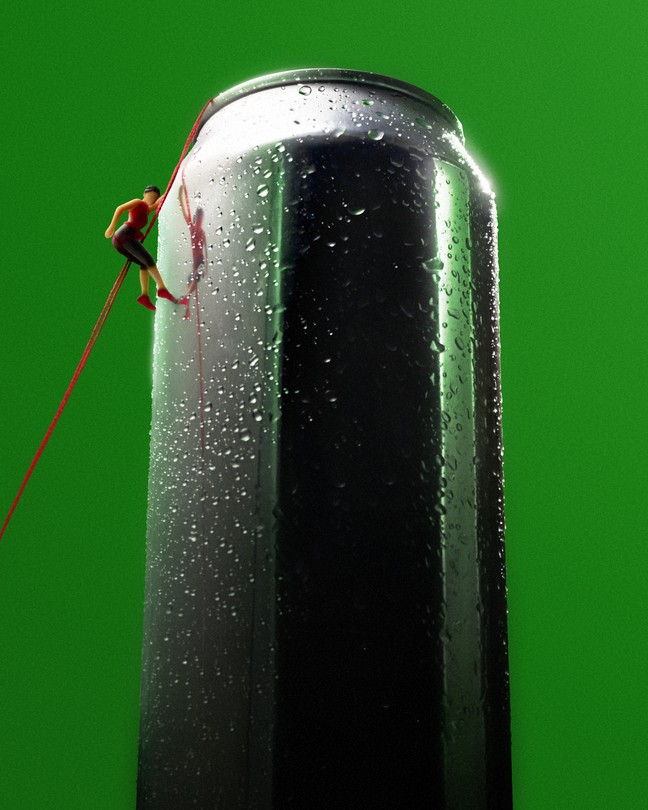
It might have been the beer. But it also might have been the beer’s packaging: the vessel sometimes called a pint can and sometimes called a pounder but typically known as a tallboy. Tallboys resemble everyday cans—they definitely are everyday cans—but they are also sneaky in their canniness. Instead of the standard can’s 12 ounces of liquid, they hold 16. And in sports stadiums around the country, they are becoming ever more common. The beer, like so much else, is getting bigger. One result: Even if you’re having just two cans of the stuff, you could be getting much more booze than you bargained for.
Tallboys have their reasons. At sporting events in particular, larger servings—of drinks, of food, of whatever—tend to mean fewer trips to the concession stand, a convenient thing if you happen to be attending the game to watch the action on the field. And tallboys give distributors, be they brewers or store owners or stadium operators, a similar bang for their buck. Though the larger cans cost only marginally more to produce than the typical 12-ouncers, their added capacity means that sellers can offer them at a much higher price. And because tallboys were for a long time associated primarily with microbrews, they retain some of the latent cachet of craft beer, whether the beverage inside is a malty masterpiece or (and I say this with love) 16 ounces of musty hop water.
The cans themselves are going macro: “Hundreds of thousands of tallboys will be brought to the stadium each week,” Nebraska Public Media reported last year, as the University of Nebraska Cornhuskers—and their fans—prepared for the coming season. The shipments included both local craft beers and decidedly less local domestic ones; Molson Coors and Anheuser-Busch, the respective makers of Coors and Budweiser, offer their own brews in 16-ounce formats.
The triumph of the tallboy is in one way unsurprising. (If you’re an American marketer, you’ll rarely go wrong assuming that bigger products are better products.) But the cans’ ubiquity has also exposed the many flaws in what you might call the tallboy user experience. Some are blandly logistical. At the stadium, the same thing that might help minimize lines at the concession stand (more liquid per can) can also lead to, uh, longer lines at the restroom. And the larger cans, unless you resort to guzzling, nearly guarantee that the ice-cold beer you’ve bought at a stadium-friendly premium—your amber waves of grain, your American dream in a pop-top can—will end in a tepid nightmare. These may be divisive times, but one of the few things Americans can still agree on is that we deserve better than warm beer.
Those design flaws pale in comparison, however, to a bigger one: Tallboys are containers for alcohol that offer one-and-a-third times the alcohol most consumers are used to. If you’re aiming for inebriation, their size—their undeniable efficiency as booze-delivery vehicles—works in your favor. (It works especially well when the tallboys are vessels for craft beers, which typically feature a higher alcohol content than Bud and Coors.) If you’re not looking for drunkenness, though, the tallboy could lead you there anyway, and quite unexpectedly. It could create a situation in which, say, the ballpark banquet you’ve been enjoying ends not with a Cracker Jack bang but a slightly slurred whimper. Beer connoisseurs may pay attention to the alcohol content listed on cans; for everyone else, though, a can tends to imply a single serving, whatever the numbers say.
No wonder tallboys are becoming, as one blog put it, “infamous.” With booze as with so much else, even small changes in packaging and design can have cascading impacts on consumers. The 12-ounce can was never the only option, beer vessel–wise (see: the pixie-size, 8-ounce can known as the “stubbie”; the 19.2-ounce “stovepipe”; the 24-ounce “silo,” also known as—yep—the “tallerboy”). Still, for decades, it has been the default. The earliest beer cans, created in the 1930s and made of coated steel, were 12-ouncers. Their design evolved over the decades (the shift to aluminum, the advent of ring-pull openers), but their size, for the most part, did not. And their size—no can is an island, John Donne might have said—shaped everything else, including national supply chains (shipping pallets, calibrated to move cans roughly 4.8 inches tall) and Etsy-fied cottage industries (beer koozies, made to wrap snugly around cans 2.6 inches wide).
Along the way, the cans’ size has also affected Americans’ expectations of what a single serving of beer entails. Since the 1980s, the U.S. government’s dietary guidelines have defined a “standard-size drink” as 5 ounces of wine, 1.5 ounces of distilled spirits, or 12 ounces of beer.
Tallboys bring chaos to the whole system. They take that basic premise, a can of beer, and make it a little less straightforward.They’re similar, in that way, to other containers—a tub of Ben & Jerry’s, for example, whose literal pint size tends to belie the multiple servings contained therein. The main difference, of course, is the alcohol. And that’s another reason tallboys are becoming a bit infamous. They assume that people want a little more when many, in this age of rising sobriety and GLP-1s, want a little less. They’re repackaging alcohol when drinking, for a wide share of consumers, is losing its appeal.
But they are also signs of the times. Tallboys may be gaining traction, in part, because they lend themselves so nicely to sales beyond the stadium. Even as overall alcohol consumption declines, the venues selling alcohol are expanding. Recent years have seen a growing number of grocery, convenience, and big-box stores adding alcohol to their offerings. The extended marketplace has turned beer cans, even more than before, into branding opportunities. Whatever the brew inside might have to offer, the beer’s packaging (neon coloring! punny names!) is a big element of the pitch. Because of that, for the people who sell them, tallboys are bigger cans that may really amount to better ones: larger canvases that are more likely than their smaller cousins to catch consumers’ eyes.
The bigger cans also bring a certain literalism to the idea of the single-serving beer. Tallboys mimic the pint glass—the 16-ounce serving you’d typically get at a bar. And though they are sometimes sold in packs (four cans, typically, as opposed to the traditional six), many stores offer them for individual sale: convenient grab-and-go options meant to be bought, and consumed, one by one. Six-packs? Cases? Those are packaging options meant for parties. The solo tallboy assumes that you’ll be getting your buzz on alone, something that more Americans—among those who still drink—are doing.
Maybe that’s another reason for tallboys’ encroaching infamy. These tall cans are tidy metaphors: for little changes that become big ones, for casual maximalism, for a culture contending with rampant isolation. They are, in other words, single-serving containers that capture something about the way we live now—even if they contain a product that tastes better in company.