The Bogus 'Free Speech' Argument Against Unions
The latest attempt to use the Supreme Court to eviscerate a key liberal constituency seems like a thoroughly partisan operation.
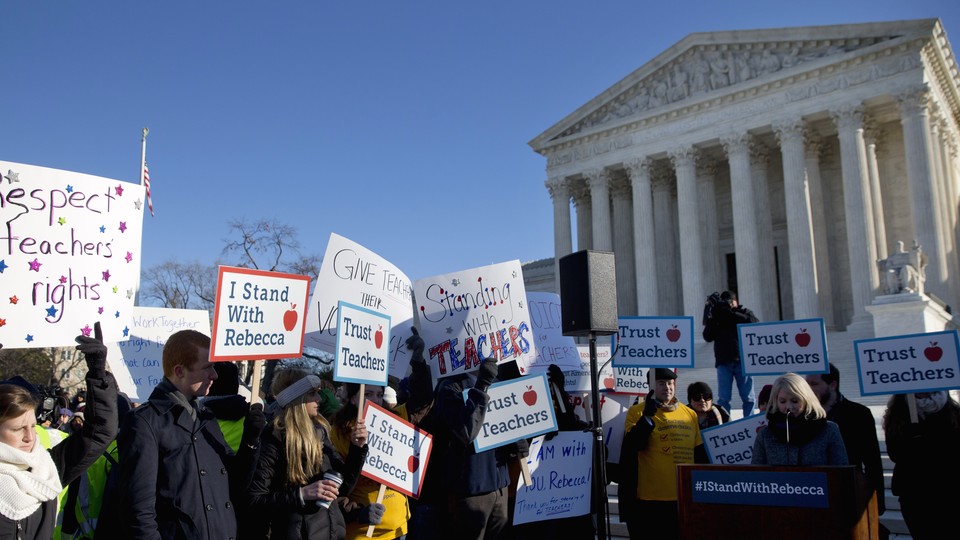
Free speech has no fiercer advocate than Professor Eugene Volokh of the University of California at Los Angeles. As a teacher of First Amendment law, director of a First Amendment amicus brief clinic, and a founder of the libertarian-leaning Volokh Conspiracy blog, Volokh lets almost no free-speech sparrow fall anywhere in the U.S. without weighing in, usually against government and in favor of free speech objectors. Supreme Court justices have cited his opinions six times. From personal experience, I know him to be merciless when he deems a fellow academic insufficiently militant in defense of speech values.
So when Volokh weighs in before the Supreme Court in opposition to a free-speech claim, that fact should spur a careful look on all sides. Last month, Volokh filed an amicus brief in Janus v. American Federation of State County, and Municipal Employees, the pending First Amendment challenge to “agency fee” agreements between government and public-employee unions. Volokh’s brief, in support of the union, argues that the fees are fully constitutional—that, in fact, the First Amendment simply doesn’t apply to this case.
Recommended Reading


The brief was co-authored by Professor William Baude of the University of Chicago, a constitutional wunderkind and former clerk to Chief Justice John Roberts. (Justice Neil Gorsuch cited his scholarship during oral argument last month in a Fourth Amendment case, Byrd v. United States.)
Alas, there seems little chance that the justices will heed the Volokh-Baude brief; since 2011, Justice Samuel Alito has been on a mission to take down public employee unions. He seemed to be on the verge of victory in 2016, with a case called Friedrichs v. California Teachers Association. The death of Justice Antonin Scalia, it seems likely, deprived Alito of his fifth vote, and resulted in a 4-4 decision affirming the fees. Scalia’s replacement, Neil Gorsuch, seems likely to be the fifth anti-union vote.
The issue in Janus is this: federal law allows (but does not require) state governments to recognize state employees to form unions; it allows (but does not require) states to bargain collectively with those unions; it allows (but does not require) states to permit workers to choose a union as the “exclusive representative” for “bargaining units” of employees such as teachers, correctional officers, or child-protective service workers. Under federal law, a public-employee union contract can’t require the workers to join the union; but an “exclusive representative” must represent all workers in a bargaining unit, members or not. Workers who don’t wish to join may (if the state so decides) be required to pay an “agency fee,” designed to compensate the union for the expenses of representation—not just bargaining for a contract but often administering grievance, health, training, and other programs.
Under a 1977 case Abood v. Detroit Board of Education, a union cannot use fees for political, lobbying, or litigation activities that go beyond the scope of representation. To allow the union to spend such monies, the court held, would violate objectors’ First Amendment rights against “compelled” speech; on the other hand, compelling the union to represent workers who paid it nothing would encourage “free riders”—and undermine the state’s lawful choice to use collective bargaining to ensure harmonious relations with its workers.
Th Abood precedent (despite fierce criticism from the right) was reaffirmed by the court many times; but in 2011, Alito, in an opinion called Knox v. Service Employees International Union, proclaimed that Abood had been wrongly decided. In the public employee context, he argued, even bread-and-butter union issues (wages, health benefits, pensions, work rules) are “political” issues, and thus any payment of fees was “compelled speech.”
Picking up on his cue, such groups as the National Right to Work Foundation have begun a quest to overturn Abood. They came close with Friedrichs; Janus, which will be argued on February 26, poses the identical question. Most of the briefing on the union side has argued that Abood struck the right balance—that is, that the advantage to the state and to workers of effective collective bargaining outweighs what Abood called the incidental “an impact upon [objectors’] interests,” as long as the union rebated that part of the fees used for purposes like “legislative lobbying and in support of political candidates.”
Volokh and Baude are bolder. They argue that the agency fees paid by objectors simply do not implicate their First Amendment rights at all. Yes, they argue, Abood was wrong; but the error was “not in how it applied the new First Amendment objection [to the fees] it recognized. Rather, Abood erred by recognizing that objection in the first place.” Agency fees paid to a union, even when required by the government, are simply a requirement that individuals pay for speech activities designated by the government. And, they argue, “[c]ompelled subsidies of others’ speech happens all the time, and are not generally viewed as burdening any First Amendment interest.”
As examples, the professors cite caselaw permitting the government to fund pre-natal clinics but refuse to fund clinics that perform or advocate abortions; allowing the government to enact requirements that National Endowment for the Arts grants take into consideration “general standards of decency”; and allowing states to issue special license plates honoring some civic and recreational groups while refusing to issue them for groups like the Sons of Confederate Veterans. Governments, under the First Amendment, are allowed to engage in “government speech” on behalf of, say, health and safety, school vaccination, and patriotism—and need not refund tax dollars to taxpayers who object because they favor sickness and accidents, vaccine-free lifestyles, or treason.
In the “agency fee” context, of course, the government itself is not speaking; it is requiring employees to make a direct payment to a private group engaged in speech. Volokh and Baude argue that doesn’t make a constitutional difference: “[T]he government frequently conditions important activities on the purchases of speech-related services from private entities or individuals.” As examples, they cite rules requiring licensed professionals to purchase privately offered education and training services to keep their licenses, or (as some states do) requiring real estate purchasers to hire a lawyer to close a purchase of real property. “These and other instances of private speech funded by government mandate need not be viewpoint-neutral, nor must they be justified by a compelling governmental interest.” Indeed, they say:
Stripped of Abood’s unfounded First Amendment concerns, this is an easy case. The government has determined that collective bargaining is the best way to negotiate contracts and settle disputes with public employees. The government would undisputedly be free to establish a public collective bargaining agent, or to pay a private one directly from the public fisc. That it has chosen instead to pay its employees and then require them to hire the collective bargaining agent does not change the constitutional analysis.
The professors’ brief is elegant and probably right; but I doubt that their counsel will slow the court’s stampede to overturn Abood. As the late Justice Thurgood Marshall once said of an egregious Rehnquist-court turnabout, “Power, not reason, is the currency of this court’s decisionmaking.”
The effects of a loss for the union respondents in Janus will be felt in every state that allows collective bargaining. They will include a loss of negotiating power for the unions, benefits and protections for the workers—and, not coincidentally, effectiveness for the Democratic Party. Janus seems like a thoroughly partisan operation.
Not mentioned in the professors’ brief is this: if Abood is overturned, anti-union activists will next surely target “exclusive bargaining” contracts in the private sector as well. At present, their argument is that public employment contracts are “inherently political” because they are contracts with government. But any second-year big law associate could write a brief describing the “political” nature of private union contracts. Indeed, Justice Felix Frankfurter, writing in 1961, elegantly made that argument for them: “The notion that economic and political concerns are separable is pre-Victorian,” he wrote.
Frankfurter was dissenting in a 1962 case called International Association of Machinists v. Street. That case is the source of Abood’s premise that “agency fees” or union dues raise a First Amendment issue.
Street concerned a contract between a private employer, the Southern Railway System, and the Machinists’ Union. The government had no involvement other than through enforcement of the Railway Labor Act, which required employers to bargain with a union that had won the right to represent its workers. Six Justices nonetheless assumed that dissenting workers’ First Amendment rights were involved when the union used dues to lobby for legislation or support political candidates; five of the six rescued the union contract only by adopting a creative reading of the act. Though it said so nowhere, they reasoned, the act compels the union to reimburse objectors for their share of funds expended “for the support of political causes.”
Justice Hugo Black, a First Amendment absolutist, dissented from that (relatively tortured) reading; he thought Congress really had authorized the collection of dues for political causes—but that the entire union contract thus violated the First Amendment by requiring “workers to associate with people they do not want to associate with, or to pay their money to support causes they detest.”
Frankfurter (joined by Justice John Marshall Harlan) dissented as well, but from the other side; like Volokh and Baude, he argued that the First Amendment issue, assumed by the majority, was a chimera. “Plaintiffs here are in no way subjected to ... suppression of their true beliefs or sponsorship of views they do not hold,” he wrote. Their argument was “too fine-spun a claim for constitutional recognition.”
Expect to hear a lot more “fine spun” arguments about Street if Abood goes down, and to read about the breathless discovery that private union contracts are also “political speech” that must be blocked by the all-new First Amendment.