The Complexity of Being Richard Nixon
Often remembered as a brooding, vengeful, and almost cartoonish figure, his life was far more complicated than its caricature.
Richard Nixon liked to be alone. He rarely used the Oval Office, preferring his hideaway office in the Old Executive Office Building. A poor sleeper, he would wander from cabin to cabin at Camp David, looking for a place to write on his ubiquitous yellow pad, which his aides called his “best friend.” From time to time, he would write inspirational notes to himself, about the need for “joy in the job,” “confidence,” and “serenity.”
Writing a biography of Nixon, I was surprised by how hard he tried to be an optimistic, upbeat leader. He was always trying to “buck up” his staff, and, I suspect, himself. We have a cartoon version of Nixon in our heads—the dark, pathological figure, vengeful and scheming. Nixon did have a terrible dark side, and it wrecked his presidency. But he was a far more complex—and tragic—figure than we assume. Though he gave off every sign of being a man who totally lacked self-awareness, he was, I believe, engaged in a terrific, if only dimly understood, battle within himself to overcome his fears and agonies. He ultimately failed, but his struggle is a compellingly dramatic story, and it made me want to learn more about what it was like to actually be Nixon.
Egged on by his aides, he liked to play the tough guy. “God, I hate spending time with intellectuals,” he once said. “There’s something feminine about them. I’d rather talk to an athlete.” Nixon was blustering. He was himself an intellectual who read widely and deeply in political philosophy, who could be truly original in his thinking and who was drawn to intellectuals as advisers. He professed to hate Harvard. “None of those Harvard bastards!” he bellowed to his aides. But as his principal foreign and domestic advisers he chose Harvard professors Henry Kissinger and Daniel Patrick Moynihan. Working with Moynihan, Nixon advocated welfare reform that was twenty years ahead of its time. Nixon also proposed healthcare reform that closely resembles the healthcare act passed by Barack Obama. Opening up China was Nixon’s idea, not Kissinger’s. Told in 1969 that Nixon intended to go to China, Kissinger responded, “Fat chance.”
Recommended Reading


Nixon was a sports fan—on the White House tapes, you can hear him yelling at ball games playing on the TV. But he was a poor athlete himself, famously clumsy when he was nervous. Throwing out the first pitch on Opening Day, he dropped the ball. At military awards ceremonies, Nixon would drop medals and sometimes stab the recipient with the pin. (Brent Scowcroft told me that, as a Nixon White House military aide, he had to take the pins off the backs of the medals and replace them with clip-on devices.) Nixon loved pomp and ceremony but he couldn’t get it quite right; his pant legs always seemed to be too short and he once ordered the White House guards dressed in uniforms that made them look like extras in a comic opera. Nixon was helpless at small talk and spilled soup on himself at state dinners. (Seeing a chance to kill two birds with one stone, he ordered the soup course eliminated and was relieved to reduce the time of the dinners to 58 minutes, measured on a stopwatch. “Real men don’t like soup,” he explained.)
Nixon was notoriously ill-at-ease in social situations. At Martin Luther King’s funeral in 1968, he bumped into Jackie Kennedy Onassis and awkwardly blurted, “Mrs. Kennedy, this must bring back many memories.” But with foreign leaders, he was usually cool and steady, always well prepared, and, importantly, he did not preach at them. He was practical; he spoke in terms of interests, not ideology, which is one reason why he was respected by world figures from Charles de Gaulle to Chou En-Lai and why he was able to negotiate the first-ever nuclear arms control treaty with the Soviet Union.
This most-introverted man was an astonishing success in an extrovert’s business. He was one of the most successful politicians of the 20th century, running on five national tickets, winning four times, the last time reelected president by one of the largest landslides in history. He knew how to peel away disaffected Democrats—he won 35 percent of Democrats in 1972. Though Reagan gets the credit, Nixon was in many ways the creator the modern Republican Party that has so effectively played on populist resentments of the liberal-media elite. On the White House tapes, Nixon can be heard ranting like an out-of-control rightwing radio talk show host who thinks the microphone is off.
On the other hand, he was not afraid to govern. It is a little known fact that President Nixon integrated the public schools of the South. When Nixon took office, only 8 percent of African American students attended integrated schools in the six states of the Deep South. But by 1972, 70 percent did—thanks largely to effective behind-the-scenes jawboning by the White House, with Nixon’s personal engagement and participation. (“Desegregation,” Nixon told his aides, “that has to happen now.”) Nixon’s instincts were conservative, and he hated government bureaucrats, but he liked to confound his Big Government enemies. It was Nixon who created the Environmental Protection Agency in 1970, partly to outflank Senator Edmund Muskie, the leading environmental lawmaker who was emerging as the likeliest Democratic contender for 1972. (In an act of pettiness, Nixon refused to invite Muskie to the signing ceremony of his own bill, the Clean Air and Clean Water Act.)
Nixon was regarded as a cold fish by many voters, who pitied the First Lady. “Plastic Pat” tired of campaigning and it showed in her face. But her relationship with Nixon was, for most of their marriage (though perhaps not during the brutal final days of Watergate), warmly solicitous and even tender. Aides would sometimes spot the First Couple holding hands when they thought no one was looking. Henry Kissinger, who could be observant about Nixon’s gentler side, told me a story about a time Nixon invited him to dinner at the Residence with Pat. As they walked over from the West Wing, Nixon self-consciously asked Kissinger to tell the First Lady a bit about the president’s foreign policy achievements. At dinner, as Nixon excused himself to wash up, Kissinger dutifully started extolling Nixon’s diplomatic accomplishments. Mrs. Nixon smiled wearily and said, “Oh Henry, you don’t have to.”
Nixon’s chief of staff, H.R. Haldeman, once remarked that Nixon was “the strangest man I ever met.” Haldeman was smart enough to ignore some of Nixon’s intemperate orders, though he also tolerated Nixon’s seemier side, especially his anti-Semitic blurts. Haldeman generally ran a tight ship, but he failed to overcome Nixon’s fatal aversion to confronting his subordinates. Nixon, who did not know about the Watergate break-in in advance, could have survived Watergate if he had forced his lieutenants to tell the truth. But he could not bear to face his attorney general and campaign manager, John Mitchell—so he never asked Mitchell what he knew about the break-in or the cover-up. Discussing Watergate on the White House tapes with counsel John Dean, Nixon does not sound so much Machiavellian and diabolical as he does confused and rambling.
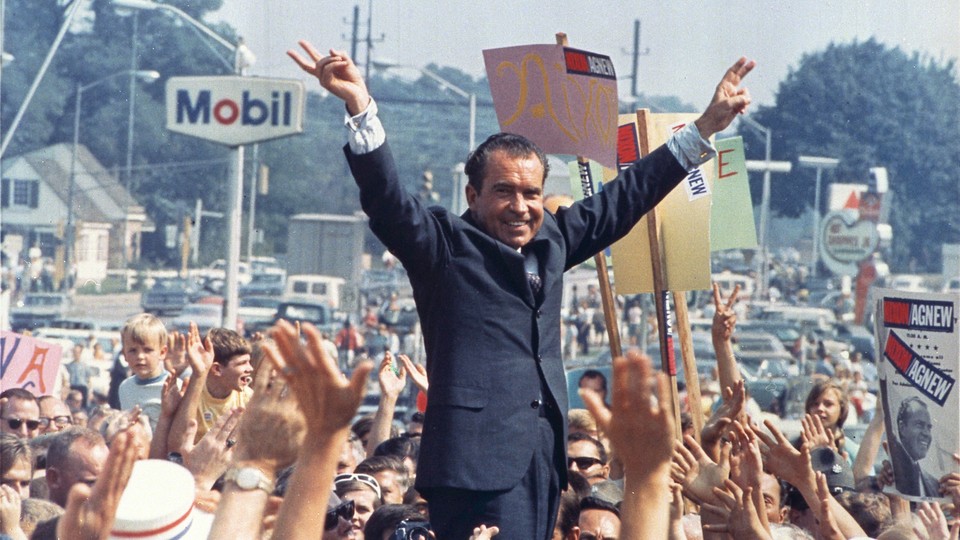
Haldeman’s diary reveals Nixon’s quirkier, mischievous side. The president liked to bait anti-war protestors by holding out his arms and making the V-for-victory sign with his fingers. Nixon, who had borrowed the World War II-vintage pose from Winston Churchill and Dwight Eisenhower, knew it “knocked ‘em for a loop” when he taunted the “peacenicks,” who had adopted the split-fingered “V” signal to mean “Peace.”
Campaigning in late October 1970, Nixon started a small riot in San Jose, California, by flashing the V-sign at protesters. “I couldn’t resist,” Nixon confessed in his diary. Late that night, Haldeman, who was always on call, was summoned to Nixon’s home in San Clemente. Nixon “laughed,” wrote Haldeman, “and said the house had caught fire from the den fireplace.” Haldeman continued:
Told me to come on over. Place full of smoke, hoses, firemen, and water. Not too much damage. P [Haldeman referred to the president as ‘P’] took me in his bedroom (he was padding around the patio in pajamas, slippers, and a weird bathrobe when I arrived), and said there was no problem. It was full of smoke, I could hardly breathe. He said he loved smoke and would sleep there. I talked him into the guest house. We went over there, had a beer and talked about the day. Finally to bed about 1 a.m.
Nixon loved the movies, and his favorite, contrary to myth, was not the heavy, bellicose Patton but the light, fanciful Around the World in 80 Days. (“Watch! Here comes the elephant!” he’d exclaim, bouncing in his chair, at his favorite scene.) Nixon sat for over 500 movies at Camp David and in the White House theater during his five and a half years as president, and the eager moviegoer depicted in a memoir by his daughter Julie bore no resemblance to the brooding Rex more commonly imagined. “No matter how terrible the first reel is, he always thinks it will get better,” Julie told William Safire when he was working as a presidential speech writer. “Give it a chance, he’ll say. Oh, we sat through some real lemons. Bebe [Rebozo] would fall asleep, Mother and Tricia would tiptoe out, but Daddy would stick with it, ‘Wait,’ he’d say. ‘Wait—it’ll get better.’”
During Watergate, everything got worse. By lashing out at his enemies, Nixon doomed his presidency, and only at the very end—too late—did he realize what he had done. “Always remember, others may hate you, but those who hate you don’t win unless you hate them, and then you destroy yourself,” he told his weeping staffers in his final speech in the East Room of the White House. Then the soon to be ex-president boarded Marine One, turned, and thrust out his arms in the V-for-victory salute.
This article has been adapted from Evan Thomas’s forthcoming book, Being Nixon: A Man Divided.
About the Author
Evan Thomas was the editor-at-large of Newsweek until 2010. He teaches writing at Princeton University and is the author of First: Sandra Day O’Connor.