The States Where Democrats Have the Most to Gain
The party is trying to take maximum advantage of the moment.
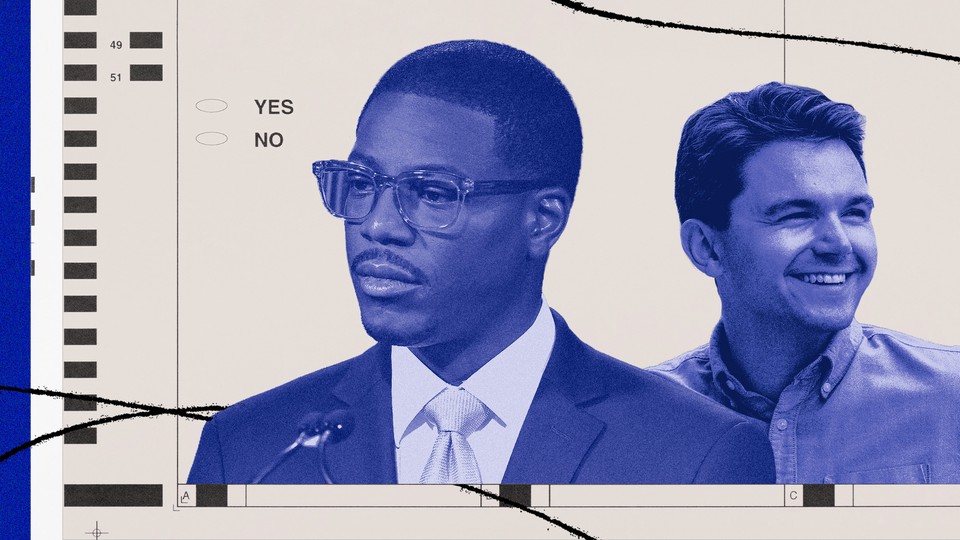
David Crowley had every reason to exalt as he bounded into a campaign rally at the University of Wisconsin at Whitewater on Thursday. The night before, the Milwaukee County executive’s hometown Brewers won the World Series for the first time in their 56-year existence. A new poll released the same day found Crowley to be in a strong position to make his own history next week, by becoming the first Black governor of Wisconsin. But it was an even bigger potential victory that prompted Crowley, wearing a Brewers pullover and sneakers the color of Wisconsin cheddar, to declare to the crowd: “This is where I get a little giddy!”
Democrats in Wisconsin have begun to imagine that they can not only retain the governorship but also capture control of both chambers of the state legislature for the first time since 2008. “Think about what we’re going to be able to do with that,” Crowley told the crowd of students who cheered the possibility. Such a sweep would cap a remarkable comeback for Democrats in Wisconsin, a swing state at the presidential level where, until recently, Republicans have maintained a tight grip on the legislature. Unified government would allow Democrats to undo a raft of conservative policies first enacted by former Governor Scott Walker and reverse years of budget cuts imposed by GOP lawmakers.
The Democrats’ drive for a trifecta in Wisconsin is part of a broader effort to take maximum advantage of what seems to be one of their most favorable national electoral environments in decades. They have a chance to win full control in states including Arizona, Pennsylvania, Michigan, and Minnesota while cutting into Republican majorities in many others. “We’re looking at what could be a generational shift in state legislative power,” Heather Williams, the president of the Democratic Legislative Campaign Committee, told me.
Sweeps at the state level could yield more immediate policy changes than even Democratic victories in the battle for control of Congress, because a split federal government would likely result in legislative gridlock during President Trump’s final two years in office. Full Democratic control in more states could also upend the nationwide redistricting wars, giving the party fresh opportunities to counter Trump’s red-state gerrymandering push.
For years, Republicans devoted far more attention and money to state legislative races than Democrats did. In 2010, that focus paid off when a GOP wave during President Obama’s first term not only swept Republicans into the House majority but helped them flip 20 state legislative chambers across the country.
Democrats have spent years playing catch-up, trying—occasionally in vain—to convince a donor base obsessed with presidential politics that spending money on cheaper but less sexy downballot races is a more cost-effective investment. That message is finally getting through. In early 2019, I wrote about an organization called Future Now, one of a constellation of Democratic groups that formed with a focus on building state-level power in the aftermath of Trump’s first win. At the time, Future Now was hoping to spend about $10 million to help Democrats flip state legislative races in 2020. The group has since changed its name to the States Project, and it has raised $100 million to spend this year. “So we’ve made a lot of progress,” its co-founder Daniel Squadron told me. But he noted that Republicans are still outspending Democrats in many states, which could limit the party’s gains: “I do believe that we are leaving seats on the table.”
Nowhere has the Democrats’ renewed focus on state power proved more consequential than in Wisconsin, where a years-long drive to loosen the GOP’s stranglehold on the legislature has resembled a slow-motion game of dominoes. A decade ago, Republicans held the governorship and near-supermajorities in the legislature. In 2018, Tony Evers narrowly ousted Republican Governor Scott Walker, and that same year, Democrats began chipping away at the conservative majority on the state supreme court through a series of judicial elections that drew tens of millions of dollars in spending from both sides. In 2023, liberals won a majority on the court, which soon overturned the Republican-drawn legislative map after ruling that its jumble of disconnected territory violated the state constitution. New district lines took effect for the 2024 election, and even though Trump narrowly carried Wisconsin over Kamala Harris, Democrats picked up seats in the state Senate and assembly. Those wins, in turn, put them in position to seek a trifecta this year.
Wisconsin Democrats kept gaining momentum as 2026 began. The new, fairer legislative maps prompted a slew of longtime Republican incumbents to retire rather than face much tougher reelection bids. And they attracted stronger Democratic candidates, such as Trevor Jung, the 30-year-old director of transit for Racine, a deindustrialized city on the shores of Lake Michigan. Jung, who previously served on Racine’s city council, is campaigning for an open state-Senate seat that could determine which party holds the majority.
“This is the tipping point,” Jung told me last week. We were sitting inside the local Democratic headquarters, where a cardboard cutout of a smiling Barack Obama behind a podium served as a reminder of the party’s last, brief run of dominance in Wisconsin. (Obama carried the state by nearly 14 points in 2008, a landslide by Wisconsin standards that helped Democrats win majorities in the legislature as well.) When I asked Jung whether he would have run in the old version of his district, which contained less of Racine and more deep-red rural areas, he laughed in a way that suggested the question was a bit foolish. “No,” he replied. “That is how bad these gerrymandered maps were. It was crazy.”
Jung has been the beneficiary of good fortune before. Born in Krasnodar, a Russian city across the Black Sea from Crimea, he was a 2-year-old orphan when a gay hairstylist looking to start a family in Racine flew almost halfway across the world to adopt him. Had he grown up as part of the underclass in Vladimir Putin’s Russia, Jung reflected, “I very much would have been part of the war machine now.”
Instead, he was raised in a blue-collar section of Racine, and when he returned to the city after studying urban affairs in college, he saw the effect of years of austerity budgets imposed by the GOP-controlled legislature. Cuts in state funding have forced local governments across Wisconsin to hold repeated referenda to raise property taxes just to keep schools open and maintain municipal services, including police departments. “There has just been a concerted effort from legislative Republicans to go after areas that Democrats live in,” Jung said, “so that they don’t have the political power of a growing, successful population. That has been their approach.”
That has continued, he said, even though Wisconsin has had, in Evers, a Democratic governor for the past eight years. Evers has described himself as “the goalie,” using his veto power to hold back the Republican legislature. With majorities in the assembly and the Senate, Jung argued, Democrats would be able to play offense instead of defense.
Jung told me he’s been volunteering for Democratic campaigns since Obama’s first election—when he was 12 years old—and that the vibe he’s encountered while knocking doors this time is distinct from years past. “People are just so sick of the way that politicians have treated voters, with the way that government has been ineffective, with the drama and the craziness out of Washington,” Jung said. When he tells people he’s a Democrat, often the response is I’m going Democrat this year. “You hear the words this year, and you catch it, and you’re like, ‘Okay. This is interesting,’” Jung said.
State legislative campaigns have traditionally been low-budget operations, a contest of which candidate can knock on more doors and turn out more voters. But as spending on these races has surged, they’re beginning to resemble hard-fought congressional campaigns, complete with dueling negative ads on TV. Republicans are running ads calling Jung “Tricky Trevor” and accusing him of campaigning on the public dime while serving as Racine’s transit director (a charge that Jung laughed off).
About a half hour’s drive north of Racine, I met with Dan Bukiewicz, the longtime mayor of Oak Creek, who is running to flip a Republican-held seat in the state assembly. As in Racine, the GOP incumbent decided not to seek another term. Bukiewicz is, at 61, a generation older than Jung, but they’re both campaigning on their experience in local government and, along with most Democrats across the country, addressing voter angst about affordability. “Everybody’s upset about rising costs,” Bukiewicz said. “People are screaming for change.”
Independent analysts believe the party is poised to pick up the two seats they need to capture Wisconsin’s state Senate. They need to gain five in the assembly, but a good night tomorrow could get them there. As they seek the trifecta, Democrats are focusing on proposals that could have a direct impact on voters’ lives—lowering health-care and child-care costs, lowering gas prices, and boosting funding for schools. They’re talking less about an issue that gives national stakes to the Wisconsin elections: redistricting. The state is perhaps the most closely divided in the nation; five of the past seven presidential elections here have been decided by less than a percentage point. But thanks in part to a Republican-drawn gerrymander, the GOP controls six out of Wisconsin’s eight House seats.
Because of court challenges, the legislature may have to revisit Wisconsin’s congressional map no matter which party controls the majority next year. But if Democrats control the legislature and the governor’s office, some in the party want to redraw the lines right away and thrust Wisconsin into the nationwide redistricting war that Trump launched in red states last year. “We have congressional maps that are gerrymandered,” Greta Neubauer, the Democratic assembly leader who is in line to become speaker if the party wins the majority, told me. “We would be looking at the maps and considering whether to redraw them.” Crowley was more circumspect; he told me that he wants to see the court cases play out before deciding whether to redistrict.
Other factors could complicate the debate. A large enough Democratic wave tomorrow might overcome the GOP’s attempt to fortify its majority through gerrymandering, and that could dampen Trump’s interest in expanding the battle to other states. And in Wisconsin, Democratic victories in two competitive House races would create an even split of the state’s congressional delegation, making it harder to argue that the current maps are unfair.
When I asked Devin Remiker, the Democratic Party chair in Wisconsin, about this scenario, he joked that he didn’t “want to count my congresspeople before they’re elected.” He and the party as a whole are trying to guard against overconfidence heading into Tuesday’s elections—both in Wisconsin and across the country. They’ve been burned by overly rosy polls before. Still, Remiker couldn’t quite help himself. “In Wisconsin, usually we’re some version of cautiously or nauseously optimistic,” he told me. “But this year, I will drop the qualifier and say that I’m optimistic.”