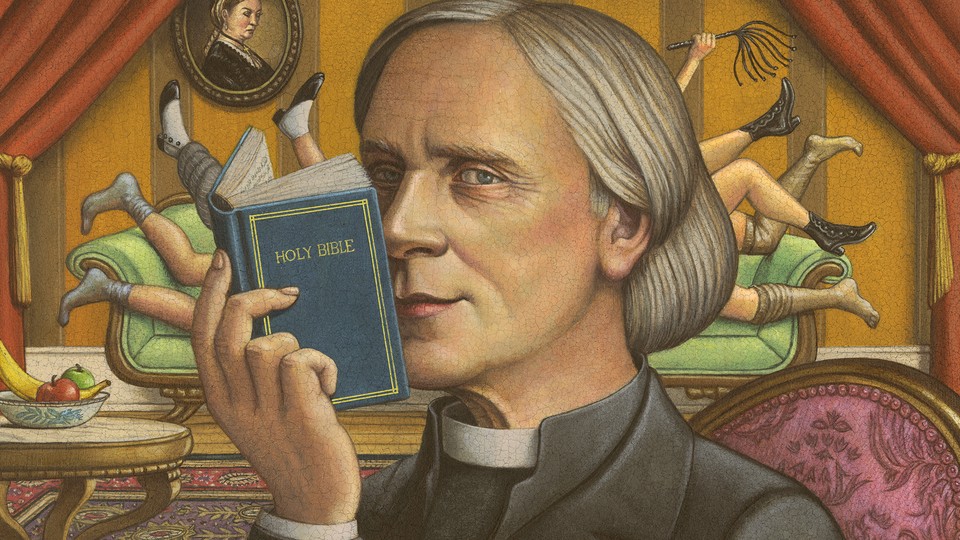
Even by the formidable standards of eminent Victorian families, the Bensons were an intimidating lot. Edward Benson, the family’s patriarch, had vaulted up the clerical hierarchy, awing superiors with his ferocious work habits and cowing subordinates with his reforming zeal. Queen Victoria appointed him the archbishop of Canterbury, the head of the Anglican Church, in 1883. Edward’s wife, Minnie, was to all appearances a perfect match. Tender where he was severe, she was a warmhearted hostess renowned for her conversation. Most important, she was Edward’s equal in religious devotion. As a friend daringly pronounced, Minnie was “as good as God and as clever as the Devil.”
All five of Edward and Minnie Benson’s adult offspring distinguished themselves in public life. Arthur Benson served as the master of Magdalene College at Cambridge University, wrote the lyrics to Edward Elgar’s hymn “Land of Hope and Glory,” and was entrusted with the delicate task of co-editing Queen Victoria’s letters for publication. His brother Fred was a best-selling writer, well known today for the series of satirical Lucia novels (televised for the second time in 2014, on the BBC), which poked good-natured fun at the pomposities of English provincial life. Their sister Margaret became a pioneering Egyptologist, the first woman to lead an archaeological dig in the country and to publish her findings. Even the family’s apostate, the youngest brother, Hugh, a convert to Roman Catholicism, was considered a magnetic preacher and, like his brothers, was an irrepressible author of briskly selling books. All told, the family published more than 200 volumes.
An exemplary Victorian family, or so it seems. But let us borrow one of Charles Dickens’s favorite literary devices and pull the roof off the Benson home to take a peek inside. It is 1853. Edward is 23 years old, handsome, determined, and already embarked on a promising career. Perched on his knee is his cousin Minnie, a pleasingly childish 12-year-old. Edward has just kissed Minnie to seal their engagement. Wait 40-odd years, lift the roof again, and we find grown-up Minnie tucked in her marital bed with Lucy Tait, the daughter of the previous archbishop, who has been living with the Bensons at Edward’s invitation. At the Sussex home where Minnie and Lucy moved three years after Edward’s death, they were joined by Minnie’s daughter Margaret, the Egyptologist, cohabiting with her intimate lady friend. As for the Benson boys, well, none of the three married, and contemporaries in the know had a pretty good understanding of their romantic feelings for men, in all likelihood never acted upon. The Bensons were, as Simon Goldhill writes in his subtle, smart book, a very queer family indeed.
Wresting the Victorians from the prison of dour, prudish stereotypes to which their children and grandchildren consigned them is a project that has occupied scholars for more than a few decades now. Goldhill, a professor at Cambridge, has produced an insightful contribution to that effort. But even more resonant for our own times of sexual and gender heterodoxy—when ambiguity is the new frontier—is what the Bensons can tell us about the prehistory. As a great deal of queer history has by now demonstrated, the strictly defined categories of “homosexual” and “heterosexual” are relatively new: bright lines drawn across the late-20th-century sexual landscape that made “coming out” a dichotomous choice.
For the Victorians, the situation was much more fluid. A woman’s romantic interest in another woman could be seen as excellent preparation for marriage. Though sex between men was a criminal offense (in Britain, lesbianism was invisible before the law), there was, as yet, hardly a homosexual identity defined by same-sex desire. Until the early 1950s, a man could have sex with another man without thinking himself in any respect “abnormal”—as long as he steered clear of the feminine dress or behavior that marked a so-called pouf or queen. To pry off the Benson roof is to ask the question: What was it like to live before and during the invention of modern sexuality?
Of all the doings in the Benson household, the most discomfiting to our own sensibilities is Edward’s romance with Minnie. She was just 11 when Edward decided to make her his wife, though at her mother’s insistence, he agreed to delay the wedding until Minnie turned 18. In opting for a child bride, Edward was calculating as well as passionate: It would be a few years before he had enough money to marry, and here was an opportunity to mold his future wife to suit his own pious requirements. For her part, Minnie was girlishly eager to please.
Domineering, moody, given to fits of displeasure, a fiend for detail, Edward was a cartoonish Victorian patriarch. His children were frightened of him. “He brought too heavy guns to bear on positions so lightly fortified as children’s hearts,” his son Fred wrote. Minnie put up with Edward’s bullying, accommodated his ambitions, soothed him when he was depressed, entertained the hordes of guests that high clerical office entailed, and only occasionally lapsed into bouts of ill health.

Explore the March 2017 Issue
Check out more from this issue and find your next story to read.
But there was much more going on in the archbishop’s marriage than a simple story of feminine acquiescence. Minnie’s intimate friendships with other ladies frequently tipped into romances, one of which—with a Miss Hall—caused her to prolong a trip to Germany, away from her husband and six children (ages seven months to 11 years) for half a year. Even allowing for the extravagant language in which Victorian women conducted their female friendships, Minnie’s letters to her favorites were unremittingly romantic: “Did you possess me, or I you, my Heart’s Beloved, as we sat there together on Thursday and Friday—as we held each other close, as we kissed.” Another letter to the same woman closed with equal rapture: “My true lover, my true love, see, I am your true lover, your true love.”
Edward Benson clearly understood, and to a certain degree accepted, his wife’s longings for other women. The subject was discussed by the couple, not hidden. Edward took Minnie on his knee to pray together about these stirrings. “Ah, my husband’s pain, what he bore, & how lovingly, how gently,” she wrote years later in a journal. And it was of course Edward who invited Lucy Tait, 15 years younger than his wife, to live with the Benson family. Paying homage to Edward’s generosity and to the “fullness and strength of married love,” Minnie worked to reconcile her sexual and spiritual longings. If “Love is God,” as she came to believe, then passion could exist without physical expression—though, as she acknowledged, with Miss Tait lying beside her, the bed continued to be their “own region of mistake.”
If all of this sounds bewildering, that, for Goldhill, is precisely the point. Absolute as Victorian moral certainties appeared to be, they nonetheless permitted a great deal of ambiguity in matters romantic and sexual, even in the most respectable of families. The marriage of Minnie and Edward—“intricate, sensitive, caring, and deeply committed,” as Goldhill describes it—ran alongside her love for women. True, the complications of the Benson marriage caused some anguish on both sides and undeniably left their children confused as to the state of their parents’ feelings for each other. But to his credit, Goldhill doesn’t attempt to tidy up the Bensons’ complexities.
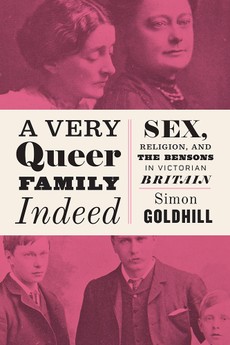
Like the best writers working in a biographical vein recently (many of whom eschew the conventions and certainties of biography), he uses the inner conflicts of his subjects to immerse his readers in an unfamiliar and disorienting world. He doesn’t diagnose the Bensons retrospectively and anachronistically as a family of repressed homosexuals. Instead, he dwells on the equivocations and the accommodations that could be made “within the tramlines and travails of a very conventional life.” Not least, Goldhill appreciates the Bensons’ own feat of simultaneously probing and withholding as they churned out all those books, many of them devoted to their family relations.
The Bensons’ memoiristic zeal was phenomenal—from Arthur’s two-volume, 1,000-page biography of his forbidding father, to Fred’s three volumes of memoirs and book about his mother’s life after his father’s death, to Hugh’s autobiographical musings. And that is merely a sampling of the family’s output (Arthur’s diaries ran to 180 volumes), and leaves out the novels in which they most freely worked over the incidents of family life. Yet the Bensons’ loquacity was remarkable chiefly, as Goldhill notes, for its reserve.
Arthur’s biographical avalanche gave away almost nothing about how he felt about his august parent: “His heart and mind remained, and still remain, a good deal of mystery to me.” In one of Arthur’s novels, by contrast, a small boy named Arthur writes “I hate papa” on a scrap of paper, which he buries in the garden. About the vexed marriage of the elder Bensons, Arthur and Fred were equally inscrutable. Fred managed the feat of making Minnie and Edward sound almost ordinary, describing his father’s courtship of the 11-year-old girl as a “little authentic Victorian love story.” Arthur, while acknowledging marital tensions, took refuge in constrained understatement. After Minnie got married, he wrote, she “began to experience a certain fear as to whether she could give my father exactly the quality of affection which he claimed.”
Above all else, Arthur and Fred, the two main memoirists of the family, were cagey about sex. Today, we name sexual orientations and gender identities in order to live freely; confession is the mode of liberation. By contrast, the Bensons cultivated what Goldhill terms a “highly articulate indirectness.” One way of understanding their reticence is as a queerness that was writing itself, falteringly, into being. In Arthur’s case, that seems an apt description of discretion exercised, paradoxically enough, at great length and over many volumes.
“Anyone might think they could get a good picture of my life from these pages, but it is not so,” Arthur mused in his diaries, noting (without naming) the subjects he kept in his “carefully locked and guarded strong room.” Although he dilated on the pleasures of sentimental friendships with the boys in his care, he studiously policed their platonic boundaries, rejoicing in the bronzed bodies at the swimming bath but skirting anything that smacked of lust. Was it possible, Arthur wondered, that he had “the soul of a woman in the body of a man”? Even though the term homosexual was coming into currency, he did not use it until 1924, the year before he died. And when he did use it, after a theoretical conversation on the subject with Fred, he wrote the word out—“the homo sexual question”—in a way that suggested unfamiliarity.
There’s another way of understanding reticence, though, which Fred, Arthur’s sunnier brother, supplies. Although Fred lived to see the new mores of the post–World War I world (he was the last of the family to go, in 1940), in a curious fashion he clung to his Victorian inheritance. He saw the virtue—and, perhaps more important, the utility—of reserve. It laid the groundwork for a person’s privacy. What wasn’t said and couldn’t be named allowed a latitude for action.
Fred’s enigmatic judgment about his mother’s marriage was characteristic: “If her marriage was a mistake, what marriage since the world began was a success?” Writing in 1930, Fred thought the much-deplored “Victorian reticences and secrecies” needed defending in an increasingly confessional era. They were “profitable as well as prudish.” The same year, Virginia Woolf (who had both a husband and a female lover) lamented the erosion of sexual ambiguity. Unlike Fred Benson, she was unsentimental about her Victorian upbringing, yet as the dichotomy between homosexual and heterosexual solidified, she could see what had been lost: “Where people mistake, as I think, is in perpetually narrowing and naming these immensely composite and wide flung passions—driving stakes through them, herding them between screens.”
As ambiguity and in-betweenness have rolled around again, they inevitably look different than they did to the Victorians. The Bensons expended millions of words questing after the building blocks of identity. Today, Edward, Minnie, and the kids would log on to Facebook, make their choice from an extensive ready-made menu—everything from pangender to the plain-vanilla cis man—and share the result with an army of “friends.” The irony of all this is something that no gay liberationist would have thought possible when the campaign for homosexual rights was regarded as a grave threat to the social order. Sandwiched between the fluidity of the Victorian years and the proliferating sexual and gender identities of the new millennium, the late 20th century’s straight-gay paradigm looks decidedly old-fashioned—maybe even a little stodgy.
When you buy a book using a link on this page, we receive a commission. Thank you for supporting The Atlantic.