
Updated at 10 a.m. ET on September 11, 2026
When the Twin Towers collapsed, on the warm, bright morning of September 11, 2001, they made a sound heard variously around New York as a roar, a growl, or distant thunder. The South Tower was the first to go. At 9:59 its upper floors tilted briefly before dropping, disintegrating, and driving the building straight down to the ground. The fall lasted ten seconds, as did the sound. Many people died, but mercifully fast. Twenty-nine minutes later the North Tower collapsed just as quickly, and with much the same result. Somehow a few people survived. For an instant, each tower left its imprint in the air, a phantom of pulverized concrete marking a place that then became a memory. Prefabricated sections of the external steel columns tumbled down onto lesser buildings, piling onto terraces and rooftops, punching through parking structures, offices, and stores, inducing secondary collapses and igniting fires. The most catastrophic effects were eerily selective: with the exception of Saint Nicholas, a tiny Greek Orthodox church that dissolved in the rain of steel, the only buildings completely wrecked were those that carried the World Trade Center label. There were seven of them, and ultimately none endured. Not even the so-called World Trade Center Seven, a relatively new forty-seven-floor tower that stood independently across the street from the complex, was able to escape the fate associated with its name. Though it did not seem seriously wounded at first, it burned persistently throughout the day, and that evening became the first steel-frame high-rise in history to fall solely because of fire.
There was wider damage, of course, and on the scale of ordinary disasters it was heavy. For thirty years the Twin Towers had stood above the streets as all tall buildings do, as a bomb of sorts, a repository for the prodigious energy originally required to raise so much weight so high. Now, in a single morning, in twin ten-second pulses, the towers released that energy back into New York. Massive steel beams flew through the neighborhood like gargantuan spears, penetrating subway lines and underground passages to depths of thirty feet, crushing them, rupturing water mains and gas lines, and stabbing high into the sides of nearby office towers, where they lodged. The phone system, the fiber-optic network, and the electric power grid were knocked out. Ambulances, cars, and fire trucks were smashed flat by falling debris, and some were hammered five floors down from the street into the insane turmoil erupting inside the World Trade Center’s immense “bathtub”—a ten-acre foundation hole, seventy feet deep, that suffered unimaginable violence as it absorbed the brunt of each tower’s collapse.
The energy released within that wild, inaccessible core lit fires that cooked the ruins for months afterward. Outside of each tower’s footprint, and still within the foundation hole, it demolished most of the six-story subterranean structure—consisting largely of parking garages that were either pulverized or badly broken and left to hang. Deep underground it also destroyed part of the Port Authority Trans-Hudson (PATH) commuter line—a railroad from New Jersey that, having passed in a single-track tube through the watery muck of the rivers bottom, emerged into the foundation hole and traveled to a station on the far side before looping back to a parallel tube and returning under the river to New Jersey. The PATH tubes were century-old cast-iron structures, probably brittle in places, and now at immediate risk of failure. If either of them broke catastrophically, the Hudson River would flood into the foundation hole, filling it at high tide to a level just five feet below the street, and drowning unknown numbers of trapped survivors. Moreover, on the far side of the river a wall of water would flood the Jersey City station, and from there, via connecting rail links, would circle uncontrollably back into Manhattan, rush through the passages beneath Greenwich Village, and take out the West Side subways from the southern tip of the island nearly to Central Park. Vulnerability to sequential flooding was a known weakness of the PATH system, and it had been highlighted in a report circulated discreetly among government officials after the earlier World Trade Center attack: the parking-garage bombing of February 26, 1993. But maybe because such flooding was also something of an apocalyptic vision—and therefore somehow unreal—no defenses were erected against it. Of course now it was too late. And immediately as the Twin Towers collapsed, it became obvious that even in America apocalypses could come to pass.
On the surface the scene was just as rough. At the southwest corner of the World Trade Center complex the twenty-two-floor Marriott hotel was transformed into a raw, boxy thing three stories high. Just to the north, across West Street, a pedestrian bridge gave way, killing groups of firemen and office workers who had sheltered beneath it. The streets buckled under heaps of smoking steel. So much heavy debris fell across the access routes that rescue vehicles were rendered useless. Major fires ignited in all directions. Simultaneously, air-pressure waves shifted small cars and shattered windows for several blocks around, blowing powdery World Trade Center remains into apartments and across the chest-high partitions of corporate offices. The powder was made primarily of crushed concrete. The waves generated winds that pushed it through the streets in dense, choking clouds and lifted it to mix with smoke and darken the morning. Then all the white paperwork floated down on the city as if in mockery of the dead.
The suddenness of the transformation was difficult to accept. It had taken merely one brief morning, merely twenty seconds of collapse, and now all that remained standing of the Twin Towers was a few skeletal fragments of the lower walls, the vaguely gothic structures that reached like supplicating hands toward the sky. After the dust storms settled, people on the streets of Lower Manhattan were calm. They walked instead of running, talked without shouting, and tried to regain their sense of place and time. Hiroshima is said to have been similar in that detail. The site itself remained frightening because of the confusion of ruins and the possibility of further attacks or collapses. But a reversal soon occurred by which people began moving toward the disaster rather than away from it. The reaction was largely spontaneous, and it cut across the city’s class lines as New Yorkers of all backgrounds tried to respond. A surprising number of stockbrokers, shopkeepers, artists, and others got involved. For the most part, however, it was the workers with hardhats, union cards, and claims to a manual trade who were able to get past the police checkpoints that had been established earlier that morning after the first airplane struck. Few of these workers lived in Manhattan, though typically they were there that morning on jobs. They hailed from Staten Island, Brooklyn, the Bronx, Queens, and New Jersey, and most had accents to prove it. From the start, therefore, the recovery site was what it remained: an outerborough New York blue-collar scene—overwhelmingly Irish, Italian, and male, terribly unrepresentative by social measures, and yet authentic.
Arriving at the site over the first few hours, the volunteers joined with the firefighters and the police, who by then were shaking off their disbelief and struggling to take effective action. By afternoon thousands of people in these combined forces were searching through the ruins for survivors, attacking the debris by hand, forming bucket brigades, and climbing over the smoking pile that in some places rose fifty feet above the street. At 5:20 World Trade Center Seven collapsed tidily in place, damaging some adjacent buildings but killing no one. By dark the first clattering generators lit the scene, and an all-American outpouring of equipment and supplies began to arrive. The light stuff got there first: soda pop and bottled water, sandwiches, flashlights, bandages, gloves, blankets, respirators, and clothes. Indeed, there were so many donations so soon that the clutter became a problem, hindering the rescue effort. Eventually a trucking operation was set up just to haul the excess away.
People who came to the site in those early days often had the same first sensation, of leaving the city and walking into a dream. Many also felt when they saw the extent of the destruction that they had stumbled into a war zone. “It's like something you’d see in the movies,” people said. Probably so, but my own reaction was different when I first went in, soon after the attacks. After years of traveling through the back corners of the world, I had an unexpected sense not of the strangeness of this scene but of its familiarity. Wading through the debris on the streets, climbing through the newly torn landscapes, breathing in the mixture of smoke and dust, it was as if I had wandered again into the special havoc that failing societies tend to visit upon themselves. This time they had visited it upon us. The message seemed to be “Here's a sample of our political science.” I was impressed by how faithfully the effects had been reproduced on the ground.
But you could never confuse New York with a back corner of the world, and the ruins did not actually look like a war zone either. There was sadness to the site, to be sure, and anger, but there was none of the emptiness—the ghostly quality of abandonment—that lurks in the aftermath of battle. In fact, quite the opposite quality materialized here: within hours of the collapse, as the rescuers rushed in and resources were marshaled, the disaster was smothered in an exuberant and distinctly American embrace. Despite the apocalyptic nature of the scene, the response was unhesitant and almost childishly optimistic: it was simply understood that you would find survivors, and then that you would find the dead, and that this would help their families to get on with their lives, and that your resources were unlimited, and that you would work night and day to clean up the mess, and that this would allow the world’s greatest city to rebuild quickly, and maybe even to make itself into something better than before. From the first hours these assumptions were never far away.
For a few days the site was out of control. The bucket brigades were ineffectual, and barely scratched the surface of the ruins—not through lack of trying, God knows, but because of the overwhelming weight of the debris. In the end it probably didn’t matter, because, as later became apparent, the dead did not die lingering deaths. At the time, however, this was neither known nor knowable. Indeed, very little was. Rumors swept the exhausted crowds of workers, and on multiple occasions caused dangerous stampedes away from the imagined reach of One Liberty Plaza, a sound building that was said to be falling. People were hurt in those panics. There were too many volunteers and too few heavy machines.
But then, rather quickly, a crude management structure was agreed upon, and most of the volunteers were eased out to the ruins’ periphery, to be replaced at the core by a professional labor force that might loosely respond to direction—firemen and cops on overtime, structural and civil engineers, and up to 3,000 unionized construction workers. The city government ran the show, The agency charged with managing the physical work was an unlikely one. It was the Department of Design and Construction (DDC), an obscure bureaucracy 1,300 strong whose normal responsibility was to oversee municipal construction contracts—for sidewalk and street repairs, jails, and the like—and whose offices were not even in Manhattan but in Queens. The DDC was given the lead for the simple reason that its two top officials, a man named Kenneth Holden and his lieutenant, Michael Burton, had emerged from the chaos of September 11 as the most effective of the responders. Now they found themselves running a billion-dollar operation with the focus of the nation upon them.
Nearly everyone at the site was well paid. The money for the effort came from federal emergency funds, and it flowed freely. But despite some serious cases of corruption and greed, money was not the main motivation here—at least not until almost the end. Throughout the winter and into the spring the workers rarely forgot the original act of aggression, or the fact that nearly 3,000 people had died there, including the friends and relatives of some who were toiling in the debris. They were reminded of this constantly, not only by the frequent discovery of human remains, and the somber visits from grieving families, but also by the emotional response of America as a whole, and the powerful new iconography that was associated with the disaster— these New York firemen as tragic heroes, these skeletal walls, these smoking ruins as America’s hallowed ground. Whether correctly or not, the workers believed that an important piece of history was playing out, and they wanted to participate in it—often fervently, and past the point of fatigue. From the start that was the norm. There were some who could not stand the stress, and they had to leave. But among the thousands who stayed, almost all sought greater involvement rather than less.
The truth is that people relished the experience. It’s obvious that they would never have wished this calamity on themselves or others, but inside the perimeter lines and beyond the public’s view it served for many of them as an unexpected liberation—a national tragedy of course, but one that was contained, unambiguous, and surprisingly energizing. Was this not war, after all? Probably it was, though at some early and entirely willing stage of the fighting: people believed wholeheartedly that they were righting a wrong, and that it was their duty to act quickly. The urgency of the job swept away ordinary responsibilities and the everyday dullness of family life, and it made nonsense of office paperwork and tedious professional routines. Traditional hierarchies broke down too. The problems that had to be solved were largely unprecedented. Action and invention were required on every level, often with no need or possibility of asking permission. As a result, within the vital new culture that grew up at the Trade Center site even the lowliest laborers and firemen were given power. Many of them rose to it, and some of them sank. Among those who gained the greatest influence were people without previous rank who discovered balance and ability within themselves, and who in turn were discovered by others. The unexpected ones were front-line firemen and construction workers, young engineers, and obscure city employees. Their success in the midst of chaos was an odd twist in the story of these monolithic buildings that in the final stretch of the twentieth century had stood so visibly for the totalitarian ideals of planning and control. But the buildings were not buildings anymore, and the place where they fell had become a tabula rasa for the United States. Among the ruins now, a large and unscripted experiment in American life had gotten under way.
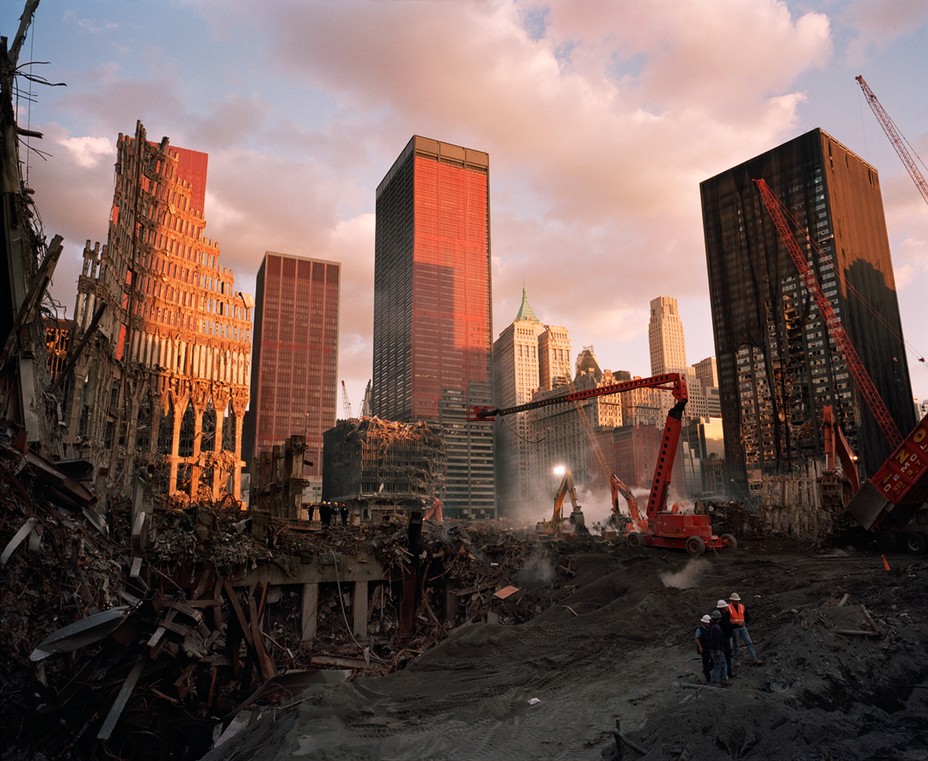
The site roared twenty-four hours a day for eight full months and beyond. From autumn through winter and into spring the crews labored in twelve-hour shifts, got some sleep, and came back for more. The enormous scale of their workplace is difficult to convey. Under Mayor Rudolph Giuliani’s insistence that New York return quickly to normal, the restricted zone had shrunk by late September to forty downtown blocks bounded by Chambers, Broadway, Rector, and the Hudson River—which was still a large area to be out of commission. At the heart of it, under the skeletal walls rising to 150 feet above the street, the debris spread across seventeen acres in smoldering mounds. It was dangerous ground, of course. Workers at the site called it simply “the pile.” In detail the topography was complex, with strange craters and caves, unstable cliffs, and unexpected remnants of the World Trade Center as it had been before—the torn sculptural sphere on the ruined plaza, the amputated stores with their displays of goods no longer for sale, a row of bicycles still securely chained to a rack, a lamppost here or there still standing.
Passersby peering at the ruins from afar, from beyond the perimeter fences along Broadway or Chambers, were sometimes confused because of their lack of direct involvement: many expressed amazement that two 110-story buildings could collapse into a mass that was relatively so small. But there was no mystery to the dimensions. Because the Twin Towers had been as much as 90 percent air and 10 percent structure, they had contained the equivalent of approximately eleven solid stories of steel and concrete—and beneath these uneven mounds, which stood five stories high and spilled into the streets, their remnants filled the foundation hole to bedrock, six levels down.
Indeed, from the workers’ close-in view, the ruins accounted for the former buildings all too precisely. It became apparent that the initial release of powdered concrete into the air, however large it had been, had amounted to an insignificant proportion of the total weight, and that almost every pound of the original structure remained to be extracted, inspected, and hauled away. So the ruins were not small at all. On the scale of people at the site they were in fact gargantuan—not mounds but mountains that reduced the expeditions venturing out across them to ant-sized columns traversing steel slopes. More than 1.5 million tons of heavy steel and debris lay densely compacted there, tied together like steel wool and complicated by the existence of human remains.
The weight alone defied imagination. What does a chaos of 1.5 million tons really mean? What does it even look like? The scene up close was so large that no one quite knew. In other countries clear answers would have been sought before action was taken. Learned committees would have been formed, and high authorities consulted. The ruins would have been pondered, and a tightly scripted response would have been imposed. Barring that, soldiers would have assumed control. But for whatever reasons, probably cultural, probably profound, little of the sort happened among these ruins, where the learned committees were excluded, and the soldiers were relegated to the unhappy role of guarding the perimeter, and civilians in heavy machines simply rolled in and took on the unknown.
The most effective of these machines were giant diesel excavators—tracked monsters with hydraulic arms and grappler claws that could tear tangles of concrete and steel rods from the surface, or close around sections of heavy beams and worry them clear of the pile’s embrace, one by one. They were voracious, incautious, ignorant, and unstoppable. Soon there were dozens of them in action, painted orange or yellow, working in tandem to “daisy chain” the debris out to the trucking operation in the streets, straining and rocking precariously under their loads, with smoke and heavy dust boiling out around them, and flames licking their claws. For months this was how the unbuilding went— like a dance of dinosaurs in a volcanic land of steel with men there too, moving through, restlessly searching for their kind. The effects were astonishing. Though the enormousness of the ruins made the final goal of “a clean hole” seem remote and difficult to imagine, the surface features of the pile changed so fast that time itself was compressed, and memories just a week old grew faint. People got caught up in that. Many of the core group were camped in hotels or temporary apartments nearby. The smart ones reminded themselves that they had recently led ordinary lives, and that they would return to them. But weeks felt like months, and months felt like years, and as winter came, it was ordinary life, and not the site, that began to seem dreamlike and far away.
Early on I found a piece of high ground from which to watch the changes. It was inside the severely damaged and deserted Bankers Trust building, a black steel structure forty floors high, which stood across Liberty Street from the ruins and was eventually draped in dark safety netting and hung with a large American flag. In 1999 the German company Deutsche Bank had absorbed the Bankers Trust Corporation, and with it had acquired this building, whose offices it had occupied until the attack. During the South Tower’s collapse steel spears and column sections had plunged into Bankers Trust, tearing a huge gash in its north face, destroying a load-bearing column for ten floors, spilling tons of office innards, and leaving the partially demolished floor slabs to sag like hammocks over a deadly void. In a crater at the base a mound of rubble lay laced with the remains of people who had been killed in the South Tower or on the street. There was serious concern at first that the building would not stand, but it did, and sturdily, because of redundancies in its design. The back offices, away from the Trade Center, were fine. And apparently no one had died inside. Firemen checked the spaces quickly, leaving their fluorescent-orange graffiti—SEARCHED—on each floor. In the dust that coated one wood-paneled wall someone, maybe from the Boston Fire Department’s team, drew a sad face and scrawled,
9-11-01
B.F.D.
Then for a long time the Bankers Trust building was left alone.
Out of curiosity I went there one afternoon, and climbed a broken escalator to a ruined entranceway that was lit through blasted walls and shattered windows, and strewn with rubble. The air inside was hazy with smoke from the fires across the street. Wearing gloves and a rubber respirator mask, I stirred through the rubble like an archaeologist on contaminated ground, searching for traces of its former inhabitants—in this case the bankers of just a few weeks before. The search was disappointing, because the forces of destruction had swept the entranceway clear of their presence. But then I climbed a dead dark stairwell, and several floors higher emerged into a scene richly preserved from their lives.
It was the Deutsche Bank executive dining area, torn open at one end, and covered in the gray Trade Center dust, but otherwise intact—a narrow hallway, hung with art, giving onto a string of small private dining rooms that were acoustically damped and intended to facilitate privileged conversation. In a foyer, by a vase of plastic flowers, a menu dated September 11, 2001, showed the morning’s breakfast: smoked-salmon omelets and chocolate-filled pancakes, among other offerings. The business cards of the host, a man named Mohamed Idrissi, lay on a countertop next to a telephone and a closed reservation book. I explored the hallway, moving carefully out of respect for the museumlike quality of the scenes, some of which, judging from the pristine condition of the dust, had remained untouched since the Trade Center's collapse. Each little dining room was furnished austerely with a table and four straight-backed chairs, a button for summoning service, and a telephone. Most of the rooms had been unoccupied at the time of the attack, and were set for lunch—with fresh place mats, plates and utensils, and sets of stemmed glasses, some of which had been capsized and broken by the pressure waves and lay now as they had fallen, like everything else here, under a feathery gauze of the Twin Towers’ remains.
Down the hallway I discovered a dining room that had been in use, evidently by two people, whose breakfast still sat on the table as they had left it. At the center of the table was a platter of fruit—oranges, apples, and a stem of withering grapes. Beyond it lay the remains of the meal in progress—an omelet mostly eaten, a bowl of cereal mostly not, pastries in a napkin bed, two nearly finished coffees (one creamy, one black), two types of sugar cubes (both brown and white), a toasted English muffin, four little unopened jars of jam, a display of artfully overlaid butter patties, and two glasses of orange juice, half drunk and now darkening with age. The former occupants had a ghostly presence there that was hinted at by the patterns they had left behind. They seemed to have maintained their poise at the time of their escape. The silverware was laid carefully aside, the napkins were on the table, the chairs were pushed back just slightly. It looked as if they had slipped politely away. It appeared to be a mutual thing, as if they had encouraged in each other a sense of decorum and calm.
The opposite was true at the end of the hall, where in a conference room I came upon a scene of mass panic and flight. It was the remnant of a breakfast meeting for about twenty people—a U-shaped array of tables facing a display board, and a varied buffet with the food looking almost still edible. Somehow the attendees must have known that the evacuation was no drill. In their haste to escape they abandoned their briefcases and overnight bags, and even dropped some car keys and purses. I poked through the detritus, knowing from the disturbed dust that I was not the first visitor to have done so. Indeed, it became obvious from the traces where laptops had been, and from all the opened bags, that the room had been systematically rifled for valuables—whether by errant firemen, policemen, or construction workers hardly mattered. All three groups were at various times implicated in a widespread pattern of looting that started even before the towers fell, and was to peak around Christmas with the brazen theft of office computers from this very building. The psychology involved was complex, and had more to do with the breakdown of the social order—a sense of crisis and of special privilege— than with any particularly criminal inclination to steal. People urinated on the carpets in Deutsche Bank as well. And presumably the same people who had robbed this room had also written “Fuck Bin Laden” on the display board, because a righteous sense of war was part of the package too.
But to me none of that seemed important anyway. Whether they had been violated or remained pure, the Deutsche Bank dining rooms were artifacts from an event that, within the inner world of the World Trade Center, seemed already to exist in distant history. Through the winter I kept returning to them, these set pieces from the past and with every visit I felt satisfaction that they remained untouched. The pastries petrified, The juices slowly evaporated and, like the coffee, turned into black crusts. The fresh fruits fermented. For a while they were infested with gnats and other bugs, and then not. I never found out why the rooms were neglected, in part because Deutsche Bank responded to the September 11 attacks in a cowed Neither-we-nor-our-employees-will-comment style. The City of New York eventually shored up Bankers Trust for the safety of the streets below, but otherwise the building was left alone. No one was sure whether ultimately it would be torn down or restored; stories flew back and forth, and settled finally on a rumor about an insurance standoff over mold.
Fine. Bankers Trust was at its best as a ghost building anyway. You could use it to go back in time to a little bridge that spanned a sudden change in the story of the United States—not the grand “loss of innocence” proclaimed that fall in the press but, more modestly, a shift from an era of complacency preceding the attack to a period of creative turbulence just afterward. You could also then go upstairs, stand in the building’s open wound, and look out at the turbulence in action across the magnificent smoking terrain of the Trade Center site—this ever changing American geography. If there were others standing beside you, the conversation would often be about memory. Do you remember when the pile was high, and then higher than now? When all the skeletal walls stood, or when one or another came down? When the upper road was built, or the lower road, or the first Tully ramp, or the second? When the Liberty Street wall sagged, or when the outline of the foundation hole became visible from above, or when we dove underground along the east wall by the escalator box—where is that now? Do you remember the day when there were twenty bodies, and the week when there were none? Or even, Do you remember the Twin Towers themselves? Can you really quite imagine them anymore?

The underground, beneath the pile, was a wilderness of ruins, a short walk from the city but as far removed from life there as any place could be. It burned until January, and because it contained voids and weakened structures, it collapsed progressively until the spring. From the start its condition dictated the nature and location of the work on the surface. Specific knowledge was necessary not only to protect the people on the pile, particularly from cave-ins, but also to maintain the integrity of the now precariously supported “slurry wall,” a seventy-foot-high concrete shell that enclosed the foundation hole to keep the tidal waters of New York Harbor from flooding in. The job of mapping the chaos fell to a small team of about six engineers who did some of the riskiest work at the site, climbing through the crevices of a strange and unstable netherworld, calmly charting its conditions, and returning without complaint after major collapses had occurred.
The engineers finished the initial surveys in a couple of months, which was fast, given the size of their domain—six levels of ten acres each within the foundation hole, and an adjacent two levels of six acres each in the Trade Center complex to the east, all lying in confusion. By mid-November only one important underground area remained to be explored—a place people called “the final frontier,” located deep under the center of the ruins, at the foot of the former North Tower. It was the main chiller plant, one of the world’s largest air-conditioning facilities—a two-acre chamber three stories high that contained seven interconnected refrigeration units, each the size of a locomotive and capable of holding up to 24,000 pounds of dangerous Freon gas.
Freon is a manufactured product containing chlorofluorocarbons (CFCs), and its use has been restricted by international accord because of the damage it does to the atmosphere’s protective ozone layer. The threat it posed at the Trade Center was more immediate, and stemmed from the fact that it is a heavy gas and it aggressively displaces the oxygen in the air that people breathe. With the huge quantities potentially involved here (as much as 168,000 pounds, under pressure, if the tanks remained intact), a sudden leak would fill the voids underground and spread across the surface of the pile, suffocating perhaps hundreds of workers caught out on the rough terrain and unable to move fast. To make matters worse, if the Freon cloud came in contact with open flames, of which there were plenty here, it would turn into airborne forms of hydrochloric and hydrofluoric acids and also phosgene gas, related to the mustard gas used during World War lI.Then it would go drifting. Evacuation sirens were installed around the edges of the pile, but in tests they often failed. Evacuation maps were printed with elaborate routes and mustering points, but of course they were not read. People accepted the danger. The standard advice, “Just run like hell,” was delivered with a little shrug. Everyone knew that if the Freon came hunting for you at the center of the pile, you would succumb.
So for two months the Freon lurked like a beast inside the ruins, hiding in its den deep among channels that were venting noxious smoke and steam. By mid-November it seemed that the diesel excavators, which were digging in a valley of ruins between the mounds of the Twin Towers, would soon be encroaching on the chiller plant from above. If in the natural confusion of the work one of them tore into a loaded refrigeration unit, or merely damaged a pipe or a valve, the effect could be catastrophic. In private conversation the engineers speculated that the chiller plant had been severely damaged by the North Tower’s collapse, and that most if not all of the Freon had vented immediately into the rising column of smoke and dust. But they did not know, and could not gamble with people’s lives. Moreover, there was disturbing news that traces of Freon had been found in the water that was pooling just above bedrock seventy feet down, at the lowest (B-6) basement level of the foundation hole.
Since the water came primarily from the efforts to suppress fire and dust on the surface—from streams being played into the eruptions on the pile—it was possible that the Freon traces had simply been washed from tainted debris. Alternatively, the traces perhaps indicated a leak from one of the auxiliary tanks located in a less heavily damaged structure at the north end of the foundation hole—tanks that would soon be emptied by a specialized crew. But it was possible, too, that the engineers’ speculation had been wrong—that the main chiller plant remained largely intact, and that the Freon inside it was somehow starting to escape. Either way, the time had come to take a look around. In preparation for the effort, additional pumps were hooked up on the B-6 level, and over several days the flood in the foundation hole was drawn as low as it would easily go—to a depth of about one foot. The engineers knew that the route through the ruins would be tight and uncertain. A “spelunking run,” they called it, and because they would go deep, a “B-6 crawl.”
I was invited along, as I’d been many times before. The pile that day was burning heavily under a south wind that spread ash and the sweet smell of the ruins far into the city, eliciting complaints. The sky was gray with autumn clouds; the air was soft and cool. Amid the roar of machinery we met at a plywood shack near the southwest corner of the ruins—twenty men in helmets and hardhats and high rubber boots. The shack was a doorway to the underworld. It covered the top of an old stairwell that descended into the ground within the so-called South Projection, one of two protrusions under West Street, where the foundation hole had been extended toward the Hudson River to encompass the PATH tubes. Since September 11 the South Projection stairwell, like that of the North Projection, had provided important access to the ruins below. For the first few weeks it had been choked with rubble, and had required careful negotiation, like a steep and unstable switchback trail. By now, however, it had been cleared, and could be taken without effort, twelve flights down to the abandoned tracks.
At the bottom, in the dungeon light from an overhead crater nearby, we collected in the mouth of the PATH tube for a brief discussion. The air smelled dank and musty, in a fading combination of train brakes, oil, and steel. Some of the people were new to the scene: a police rescue team of five men, looking dandyish in their kneepads, carabiners, and helmet lamps, and an equal number of firemen, less proudly dressed, who had recently arrived for the standard one-month rotation. The firemen were young, and visibly more relaxed than the police. Several ventured like sightseers into the PATH tube, playing the beams of their flashlights across its iron rings, into the green and red puddles of oily fluid, and down the rusting tracks that stretched westward into the blackness under the Hudson River. In about two hours you could walk through the tube to New Jersey and back, if only for the sport. But today the job was serious, with risk involved, and it lay in the other direction, northeast across the complications of the ruined basement and into the unexplored.
The expedition carried several emergency air packs and an electronic sniffer to warn of low oxygen and the presence of Freon—but none of this would help in a collapse, which the engineers still believed was the greatest danger we faced. It was reassuring, therefore, that the group included underground veterans—indeed, some of the Trade Center’s most experienced men. These were people unheralded on the outside, several of whom in retrospect now stand among the greats in the recovery effort. One was a watchful and laconic fireman named John O’Connell, a specialist in building collapses, who had served as an example to the crews from the very start, calmly smoking cigars in even the most threatening conditions, and providing people with a necessary model of skepticism in the face of all the hype.
Beside him stood another fireman, whose talents turned out to be even more valuable. He was Sam Melisi, a small and painfully modest Staten Islander, whose gentle and self-effacing manner seemed out of place at first, but stemmed from profoundly altruistic impulses that over time became widely recognized, eventually giving him a moral authority that no one else at the site came close to matching. That authority translated into the power to make suggestions that others were willing to follow. The power surprised and plagued him to the end: he did not think of himself as a leader, and in other circumstances he probably would not have been one. Nominally he was always just a fireman, a collapsed-building specialist like O’Connell, with front-line duties that included assisting on these underground runs. But already by mid-November some people had started calling him “Saint Sam,” as in “Saint Sam the Fireman.” He rose to it uncertainly, but gradually assumed the all-important role of a mediator.
The French flew him to Paris for a day to plant a tree in the Luxembourg Gardens, as if he was just another New York “hero,” good for a photograph and a night out on the town; they had the luck of the draw and never knew it. Melisi remained unknown to New York, too, which had nearly as distant a view of the site, and had actually been surprised by the outbreak of fighting there between firemen and the police on November 2—a power struggle that came to the surface after weeks of mounting tensions. Afterward the political operatives at city hall must secretly have believed that they maintained the peace between the multiple opposing forces on the pile, but in truth, if anyone did, it was Sam Melisi. Ultimately this made him enemies as well as friends, primarily among the firemen’s widows who grew angry when in the spring it became obvious that so many of their husbands’ bodies would never be found. Unwilling to see the search come to an end, some of them began hunting for traitors in their midst—and as often happens, they turned on the mediator. Melisi was tainted by association. But when they began accusing him of betrayal, they could not have been more wrong
Of all the people setting out now for the chiller plant, twenty men redefined by these ruins, the one who would have the greatest influence on the unfolding story was an obscure engineer, a lifelong New Yorker named Peter Rinaldi. At age fifty-two, Rinaldi was an inconspicuous olive-skinned man with graying hair and a moustache, who observed the world through oversized glasses and had a quirky way of suddenly raising his eyebrows, not in surprise but as a prompt or in suggestion. He had grown up in the Bronx as the son of a New York cop, had gone to college there, and had married a girl he had met in high school. Though he and his wife had moved to the suburbs of Westchester County to raise their three sons, he had never cut his connection to the city, or quite shed his native accent. For twenty-eight years he had commuted to the World Trade Center, to offices in the North Tower, where he worked for the Port Authority of New York and New Jersey, deep within its paternal embrace and completely secure in his existence. There was an early warning in the terrorist bombing of 1993, which caught him in an elevator. Nonetheless, he was wholly unprepared for the destruction that followed in 2001.
The Port Authority is as much an empire as an organization—an insular and enormously wealthy bi-state agency, exempted from ordinary governmental constraints, that was created in 1921 to build and manage the area’s transportation facilities, and was given the right to finance itself by issuing bonds and collecting its own tolls and taxes. It operates every major airport in the area (Newark, La Guardia, Kennedy, and Teterboro), manages all the ports (including one of the world’s largest container facilities, at Newark), runs a busy railroad (PATH), owns New York’s commuter-bus stations, controls many of the city’s lucrative tunnels and bridges (among them the Lincoln and Holland Tunnels and the George Washington Bridge), and even has its own private army—an independent police force 1,300 strong. More to the point it also built, owned, and until recently operated the World Trade Center, where it maintained its headquarters; on September 11 it occupied space on thirty-eight floors and each of the six subterranean levels. All of that was lost when the buildings collapsed, along with the lives of seventy-five Port Authority employees, some of them maintenance men who could have escaped after the South Tower fell, but went grimly back underground to find their co-workers. It would be hard to overestimate the ensuing sense of exposure and uncertainty for the employees who survived. During the days after the attack, when to New York City officials the Port Authority seemed to have disappeared, it was hunkered down across the river in its New Jersey offices, suffering through a collective emptiness so severe that people themselves felt hollowed out.
Peter Rinaldi felt it too, though he was far away at the time of the attack, vacationing with his wife, Audrey, on the Outer Banks of North Carolina. The North Tower was like a home to him. He’d had a corner office on the seventy-second floor, and a satisfying job there overseeing the engineering for all the Port Authority bridges and tunnels. He especially liked the George Washington Bridge, and had once appeared on the Discovery Channel to praise its resilience. Recently he had found a million dollars in spare funds, and without going through all the usual bureaucratic rituals had spent it on decorating the span with permanent lights. Others in the Port Authority had criticized him afterward for bypassing procedures—but only in private, and as friends. Rinaldi took it in stride, and never felt threatened, because the atmosphere at work was always so stable.
But on the Outer Banks, on television, he watched everything come apart. It took merely two ten-second pulses. Months later he was still struggling to describe the shock. To me he said, “It was surreal. You’re on vacation, and you’re looking at this, and it’s a place where … I knew all the people there. It's a place you're supposed to go back to work, your office. It’s everything you do. You just watch this thing collapse. It was like, you couldn’t really believe it, in terms of all this loss. You say, ‘That’s not really real. This can’t be gone.’ And then you think, Well, what’s going to happen afterward? What are you going to do? How are you going to do this? Where are you going to be? What’s going to happen with the agency? How many people were lost? It could have wiped out our whole two thousand people we had in that building. Or the whole organizational structure. The whole center of the PA was in that building.”
The whole center of his life. He said little at the time, and spent another day at the beach, but the event had devastated him. His wife told me that he became a man she had never seen before—preoccupied, passive, withdrawn. Part of it was that he knew so many people who had died, several of whom were close friends; back in New York he went to their wakes and funerals. But another part of it was that he had been stripped of his shelter, irrevocably, and that, as he told me later, he doubted his ability to proceed in a disorderly world.
And then, adding to his uncertainty, having briefly reunited with his old staff at temporary quarters in New Jersey, Rinaldi was reassigned to New York City’s recovery team—a small group of men and women who were camped in the kindergarten rooms of Public School 89, near the ruins, and, in the midst of the most disorderly conditions imaginable, were improvising a response. These were primarily Kenneth Holden’s people from the Department of Design and Construction. Rinaldi was given the job of supervising the consultants who had been brought in for the specialized belowground engineering. I met him at the start, when he did seem tentative and out of place, and I watched him through three seasons to the end, by which time he had become, both above and below ground, the one man everyone turned to for an opinion.
The attempt on the chiller plant happened about a third of the way through his odyssey. Rinaldi was nominally in charge, but he neither gave commands nor asserted himself by taking the lead. I think by then he had already discerned what some others never did—that the imposition of conventional order on these ruins was a formalism or a fiction, and unnecessary. Progress was made in the privacy of a thousand moments on loose, broad fronts, by individuals looking after themselves and generally operating alone. This was how we turned now and drifted toward the jumping-off point for the unknown, twenty men, each picking his path.
Under the crater and by the light of the sky far above, Rinaldi and I paused by a pile of rubble that we had occasionally crossed before, and we discussed the news that a fireman’s body had recently been found there, buried under a thin layer of dust and debris. It seemed strange that for two months neither we nor anyone else had noticed him. Rinaldi mentioned that in the chiller plant—should we find a way to it—we might encounter the body of a certain Port Authority employee, a man who was believed to have sheltered there. So be it. After so many other encounters at the site, the prospect elicited neither hope nor horror. People grow used to the dead.
Beyond the crater our route was lit by a string of utility lamps installed for the pump crews that had been drawing down the basement flood. We gathered where the pumps were running, on a concrete platform above an area of black water. John O’Connell, in a wide-brimmed fire helmet, slouched by a steel column, smoking a cigar and looking typically unimpressed. The police seemed to think that their sergeant was in charge, and apparently the sergeant did too. He announced that he would be probing the water with a steel pipe, and he advised everyone to stay in line close behind him. No one quite looked at him, or responded. The sergeant warned about ten-foot sumps now hidden within the flood, into which a person could disappear and drown. Sam Melisi checked a map for the specific locations, which indeed were shown near the chiller plant. Rinaldi mentioned our schedule. One by one we stepped off into the flood, and with flashlight beams probing the huge forms of ruined structures, we waded in a single long file into the darkness.
The sergeant at the lead soon gave up trying to sweep water with his pipe and began to use it as a crutch to steady himself as we moved across submerged debris. Each of us was feeling his own way, not walking so much as sliding forward experimentally, sloshing through the opaque water and taking care not to trip over fixed objects or to step heavily on the looseness underfoot. It was clear that anyone falling here risked injury and, if cut, a serious infection. Nonetheless, our progress was fast, and it soon reduced the view of the pumping platform behind to a distant light, and then to nothing at all. We moved across a cavern bordered by massive collapses and traversed by man-sized pipes, one of which, labeled “River Water,” and known to be closed off, was the main intake line for the chiller plant. Whether because of nearby fire or ongoing collapses, the air turned thick with dust. With the exception of the ever dismissive John O’Connell, we donned our respirators, limiting conversation. The cop with the electronic sniffer was clearly concerned, and was checking the indicators so often that he was falling behind. He lifted his mask and called, “O2’s okay! All gasses okay!” We slowed to let him catch up. The darkness grew loud with the sound of falling water, which turned out to be bands of a mysterious subterranean rain—too heavy to result from the firefighting on the surface—falling from the confusion of ruin overhead. We moved through the rain, and fifty yards farther on climbed onto the dry ground of a catwalk built above an area of heavy machinery. We paused where the catwalk ended, in latticework stairs leading down into the floodwater on the far side. By then we had progressed deep into the pile, and by ordinary measures were only a short distance from the main chiller plant. There was still no indication of Freon. The ruins, however, were closing in oppressively, with crazily angled slabs tilting down into the waters ahead amid a confusion of rubble slopes that obscured the blackness beyond, where an access route might possibly be found. The place looked like a trap, and dangerous as hell. The police apparently thought so too; they bunched on the stairway and tested their radio link.
Rinaldi discussed the situation with a couple of Trade Center facilities men who had come along because of their expert memories of the buildings. Given the extent of the destruction that clearly lay ahead, it seemed unlikely that any of the chiller plant could have survived. In that sense, the work here might already have been accomplished—and there was certainly reason to be skeptical about the benefits of moving forward. At the same time, if for no other reason than the draw of the unknown, Rinaldi was obviously unwilling to retreat. Within the private culture of the Trade Center underground this was understood without explanation: it was simply very difficult to turn away from space that remained unexplored. Briefly, therefore, we were at an impasse. But then one of the engineers took matters into his own hands, and without saying a word descended the last steps into the water and set out alone. The police had given up any pretense of command. No one called the engineer back. Rinaldi watched him for a while—a tall, thin silhouette familiar to us all, pushing steadily into the ruins—and then he and I and most of the group set out too.
The tall, thin silhouette belonged to a man already famous for his independence. He was Richard Garlock, age thirty-three, a boyish-looking structural specialist who worked for the Trade Center’s original designer (Leslie E. Robertson, the “engineer of record”) in a small company called LERA, which for thirty years had served as the main Trade Center consultant to the Port Authority, and which had its offices nearby. LERA was known at the site less for its history than for its current feeling of having been marginalized during the cleanup efforts under way. Certainly it had responded valiantly to the attacks of September 11: Garlock and others from the firm were running toward the Trade Center to provide a structural assessment of the North Tower’s wounds when the second airplane came in and hit the South Tower. They had returned to their offices and were volunteering their expertise to the fire department when the towers collapsed. Their firm had taken the lead after the terrorist bombing in 1993, and it was only natural to assume it would do the same now. Instead, when they made the offer to help, they found that LERA had been relegated to a minor role—to be called on by other consultants as needed. Understandably, they took this as an insult and an injustice. I repeated their tale of woe one evening to Audrey Rinaldi, who had arrived for dinner downtown from her job as a nurse and hospital administrator in the Bronx. She said jokingly, “You know, engineers are humans too,” as if the point could be debated. But there was always plenty of proof at the Trade Center site.
The prime consultant on the job was a large and well connected New York firm called Thornton-Tomasetti—the engineers of the Petronas Towers, in Kuala Lumpur, and of the United Airlines terminal in Chicago, among other monumental structures. With its 400 employees and enormous institutional expertise, Thornton-Tomasetti could have ignored LERA’s feelings entirely but for one important catch: since most of the complex’s technical drawings had been stored (and thus destroyed) within the North Tower, LERA had the only complete and readily available set of the original plans—and by the way, it wasn’t going just to hand them over. In fairness, LERA’s position probably had as much to do with self-protection as with pique. The firm was potentially exposed to the waves of lawsuits already coming into view, and it needed to maintain some sort of control. Understandably, it wanted to make its own detailed assessments of the ruins. People accepted this, however grudgingly. LERA had been smart if not supple: it had used the technical drawings adroitly, and eventually found a place at the very center of the operation. On all the important surveys now, including this chiller-plant run, Garlock was the man holding the blueprints. And having fought so hard to be here, he wasn’t about to retreat or to leave these ruins unexplored.
Actually, Garlock was fearless anyway. He was a moralist at times, but an affable fellow too, with a distracted graduate-student manner that contrasted pleasantly with the harshness of the surroundings. I found it interesting to watch him work—all the more so after I realized that he was not engaged in some sort of geekish theater (my first assumption) but was genuinely absorbed by the minutiae of even the most obscure corners of the ruins. When I described his enthusiasm to Audrey Rinaldi, who had taken it upon herself to explain engineers’ personalities to me, she acted unsurprised.
I said, “But honestly, when you’re deep underground and everything is fine, just how fascinating can it be that this is Panel D-15 or A-5?”
She looked at me pityingly, as if she hated to shatter my illusions. She said, “I keep telling you … ”
But Garlock seemed unusual even to the other engineers. Some of them started calling him “Planet Garlock,” as if he had descended from a faraway place. He would go wandering off through the subterranean ruins, gazing intently through small spectacles at the columns and beams, often with the hint of a quizzical smile, making notations on his cherished blueprints, with apparently only a vague awareness of the danger signs around him—the jolt of a collapse far below, the rattle of cascading debris, the ominous groaning of weakened structures overhead, or, in the early days, the streams of molten metal that leaked from the hot cores and flowed down broken walls inside the foundation hole, The others would exchange looks and ask Garlock to hurry. In my experience he never did. He was interested in every part of the ruins, but really relished the underground.
The truth is, we all liked it there, if not to the degree that Garlock did. The underground was the Trade Center's inner realm, the destination at the end of a progression that with each step took people closer to the heart of the ruins: across the perimeter, to the edge of the pile, onto its surface, and then down into its insides. It was also simply an intriguing place to be, and less macabre than outsiders supposed. The dead lay nearby, but for the most part they were buried in the inaccessible cores—debris so tightly compressed that even the rats, said to be arriving from all over downtown, were unable to burrow in (or so we told ourselves). The cores were shaped like inverted mountains, or cones, that grew narrower with depth. They filled the towers’ footprints to bedrock and occupied the center and south end of the foundation hole. They were bounded by looser ruins and basement structures in an arc from west through north to east. And it was among those looser ruins, after Garlock spurred us into motion, that we continued now to explore.
Garlock roamed south into the darkness among the piles of debris. Others roamed north. Rinaldi and I moved slowly to the east. In an area of mountainous collapses we came eventually to another catwalk, which we climbed until it ended in a slope of loose rubble. There was nothing but blackness behind and ruin ahead, and no sign or sound of the others. Blocks of concrete the size of cars hung over our heads, one dangling on rebar.
Through the respirator mask I asked Rinaldi, “How stable do you think that is?”
He said, “It’s not.”
I asked, “Have you noticed how guys will pretend not to notice?"
He said, “Yeah,” and we both laughed. But we knew that if it hadn't fallen yet, it wouldn’t fall now.
Almost by chance then Rinaldi’s light picked out a mansized hole in the debris slope, above us and to one side, and through it, faintly illuminated, the form of a rounded mass of steel. It was heavy equipment of some kind—and given its location, it had to be inside the main chiller plant. Rinaldi crawled up and in, spilling dust and broken concrete down the slope, and I followed close behind. The space in which we found ourselves gave the impression of an oversized version of a ship’s engine room, but reduced and hemmed in by massive collapses, and lying in complete ruin. There was no sign of the missing Port Authority man and, though we lifted our masks to check, no smell of his death. We squeezed between a partially crushed tank and its battered pumps, and were barred from further progress by a wall of broken slabs and twisted steel. After a while one of the Trade Center facilities men arrived, followed later by Garlock and the young fire crew. For no good reason one of the firemen tried to climb a twenty-foot chimney in the unstable rubble, and he had to be pulled back and told to calm down. No one thought much about it, because so many of the firemen were emotional, especially when they were new. Rinaldi took pictures of the ruins. The damage was even worse than the engineers had expected it to be, and it offered the first hard evidence of a fact that was eventually verified during the excavation from the surface—that the Freon had vented, and the beast at the center of the pile was a myth.

At its most chaotic the underground was like the abstract netherworld we encountered during the chiller-plant run—as shredded as the surface of the pile, yet without the organizing principle of the sky. But that was the extreme. Much of the underground was intuitively easy to understand. It consisted of parking garages, often in some stage of collapse, where more than a thousand cars now stood abandoned and covered with the standard gray concrete dust. A disproportionate number of the cars were BMWs, Jaguars, Lexuses, and the like—indicating, if nothing else, the preponderance of a certain culture that had thrived here. Although a few seemed strangely untouched, most were crushed, sliced, blasted, or burned. Along the north side, where the basement structure remained strong and intact (and was ultimately preserved), the fire had been so intense in places that it had consumed the tires and interiors, and had left hulks sitting on axles above hardened pools of aluminum wheels. Three presidential limousines stood in there too, but they were locked away, and remained unscathed. When access was opened, the Secret Service rushed in and with a great show of secrecy loaded the limousines onto flatbed trucks, covered them with tarps, and hauled them back to Washington.
There was a romantic idea, widespread at first, that the Trade Center underground would contain wonderful and varied treasures—but it never quite panned out. Along the north side before the collapses there were firing ranges and gun rooms for various police agencies, and vaults containing confiscated narcotics and cigarettes, and there was a collection of artifacts from a Colonial-era African-American burial ground, but aside from the garages and the PATH facilities, the basements consisted for the most part of utility spaces and storage rooms in which the things that were kept were basement things—tools, wire spools, spare chairs and partitions, and, in one particularly claustrophobic corner, glossy brochures from the former 107th-floor observation deck of the South Tower. Out beyond the foundation hole, in the burned-through remains of Building Five, a Citibank vault was stacked with a fortune in bundled currency—which, however, had been baked and turned to ash. Nearby, a vault left open at Morgan Stanley turned out to be almost as disappointing. It contained $2.7 billion, but in financial certificates that would have been nearly impossible for a thief to translate into cash. A Brinks car reportedly holding $14 million was stuck in the ruins for a few weeks, adding a nice touch to the underground, until Brinks was able to remove it. The newspapers reported the loss of government safes containing top-secret documents, for what that was worth, They also reported the loss of important legal documents, news of which caused no stir.
Ultimately, only one Trade Center treasure was worthy of the name. It was a hoard of gold and silver ingots, valued at about $250 million, that filled a two-story vault in the remnants of an old railroad station under the ruins of Building Four. A quarter of a billion dollars’ worth of gold and silver turns out to be a lot of ingots—more than 30,000 in this case. The ingots weighed up to seventy pounds each, and were stacked on wooden pallets that could be moved within the vault by forklift and internal elevator. Their total weight was 1.9 million pounds. The vault belonged to the Bank of Nova Scotia. The bank held the treasure to legitimize trading in the precious-metals market. In practice it was expected that the metal would remain in the vault, even as it was bought and sold in various forms. There were guards to make sure that nothing went wrong with the stock. It never did. Even after the attacks of September 11 security was not a worry, because the guards had bolted the door before fleeing, and mounds of heavy debris blocked any conceivable access. The treasure lay locked in a vault inside a vault. At least that was the thinking.
But when, at the end of October, a pathway was finally cleared, down a truck ramp from the north and through an old railroad tunnel, the bank’s initial entry team discovered that others had been there before, attempting to pry open the vault’s door and to cut in from above, in both cases unsuccessfully. It was never clear who the intruders were, where they had come from, or how they had proposed to get away through these ruins with more than just a few ingots. However, if the unbuilding of the World Trade Center had already shown one thing, it was that the workers were resourceful. The bank hurriedly organized a convoy of armored trucks and over the course of several days, amid another display of pomp and secrecy, moved the gold and silver out. It took 120 trips. No one was supposed to know that the destination was the Brooklyn Navy Yard, but everyone did. Over the weekend workers made a point of getting past the security detail—cops in bulletproof vests, cradling riot guns—and down into the vault to watch the treasure disappear. It was an innocent distraction. The vault inside was not merely undamaged but well lit and pristine. For one weekend it served the underground as a tourist destination.
But the most popular place down there was always the two-story PATH station, which stretched along the eastern wall at the deepest levels of the foundation hole, and was the most public of the Trade Center spaces that remained at least partially intact. Although it had suffered heavily, and continued to collapse throughout the fall and winter, it was considered to be relatively safe. In the last days of September, Peter Rinaldi pioneered the early route in, down the North Projection to the PATH tube and then by rubber raft along the heavily flooded tracks, a River Styx flowing deep under the ruins of Building Six. It was Rinaldi's first underground exploration. Richard Garlock went along, as did two other young engineers, who worked for the famous foundation firm Mueser Rudedge and played important roles at the site—a huge and garrulous man of Ecuadorian origin named Pablo Lopez, who had attended Manhattan College, in the Bronx, on scholarship and still lived in the poor Hispanic neighborhood where he was raised; and his wry, cerebral partner, an ex-carpenter and Columbia graduate named Andrew Pontecorvo, who was small by comparison and did some tough duty crawling into tight spaces. They were accompanied by a typical phalanx of firemen and cops.
They had three rafts, two of which were leaking air and on a couple of occasions had to be reinflated. The men pushed and paddled the rafts for forty minutes up the railway, eventually through widening spaces as the tracks branched into the PATH station. The water came up almost to the level of the station platforms, which remained dry. The men disembarked, grounded the rafts, and began to explore. Rinaldi was the one most familiar with the place, but he moved through it as if in a dream, noticing the complete silence and the little clouds of dust that rose in slow motion with every step he took. The darkness was so deep that it seemed to defeat his flashlight beam. A ghostly train stood there in an image of abandonment—the first cars crushed under heavy slabs, the remaining ones intact but empty, with their doors ajar. Rinaldi knew already that no one had been inside on September 11—the train had been sitting idle in the station all morning, and it had simply remained. Two other trains, full of passengers, had left New Jersey and were bound for New York when word of the first attack came. In one of the more elegant moves of the morning they did not stop but with typical Port Authority aplomb continued to roll smoothly through the Trade Center underground and, without rushing, slipped back beneath the Hudson to safety.
Rinaldi had the wit to appreciate that sort of thing, but he wasn’t in the mood for it now. Others on the team had started into the technical work of the survey—Garlock with his close-up inspections, Lopez and Pontecorvo with more distant views—that ultimately, after many more surveys, would result in a decision to restore PATH service quickly and reuse this station while a new permanent one was built. But that, of course, was the future, and for now Rinaldi was thinking more about the past. He climbed a dormant escalator to the station’s upper level, and for old times’ sake continued to take in the sights: the melted plastic signs, the pay phones on pedestals, the turnstiles, the candy kiosk still offering sweets, and then the part of the station that became a photographed favorite—the prominent Commuter Bar, with its bottles of booze, its racks of inverted glasses overhead, its open Heinekens on the counter. I could never really appreciate that place, which to me suggested the style in which too many people here must have lived—stacked in their fluorescent-lit towers, removed from the city outside, and wanting to drink in the morning. Rinaldi himself was not much of a drinker, though he liked a good Chianti with dinner. But during another survey of the PATH station, when I mentioned my dislike of the Commuter Bar scene, he grew upset and said he disagreed, maybe because he still thought of all these ruins in some way as his home.
Rinaldi was human but also always an engineer: even during the worst moments of September 11 he continued to think analytically about the buildings. He was two days into the vacation on the Outer Banks, having breakfast with Audrey and friends, when his grown son called from Connecticut and said, “Hey, Dad. A plane just hit the World Trade Center.” It had happened at 8:46, just a few minutes earlier, Rinaldi turned on the television and saw the first pictures: it was the North Tower that had taken the hit, high on its north face and apparently well above the engineering quarters on the seventy-second floor, where Rinaldi’s staff was already at work. From the quantity of black smoke pouring out, Rinaldi realized that a major fire had erupted. Television reported that the airplane was believed to be small, possibly a commuter airliner. But Rinaldi knew the building’s true dimensions, and he was not fooled by television's miniaturization. He said, “Boy, that’s pretty large damage for a small plane.” The entry wound seemed to stretch nearly the width of the North Tower’s 209-foot face, and against that scale formed the head-on silhouette of a very large airplane, banked to the left. Later, when it became known that the airplane was a Boeing 767, it was easy to discern even the outline of its low-slung twin jet engines. Some people were reminded of the perfect holes left in walls and clouds in cartoons. Rinaldi was more practical. He interpreted the tightness of the gash’s pattern as a sign of the structure’s admirable redundancies: the impact had severed much of the North Tower's all-important exoskeleton, the closely spaced steel columns that shared with an internal elevator core the work of supporting the building’s weight, and yet there was no sign of further unraveling. Rinaldi thought about the weather, which was bright and clear, and he wondered how any pilot on such a morning could have made such a mistake.
But then, at 9:03, the second 767 came in fast from the south and, hooking a hard left turn, slammed into the South Tower. lt hit lower than the first one had, but with much the same effect. Rinaldi saw the impact, the fireball and the ensuing flames. One of the friends cried out, “My God, we’re under attack!” It was true enough, but Rinaldi was concentrating on the immediate practicalities. He said, “They’ll be evacuating down through the stairwells, and then they'll have to put these fires out.” And that was true too. Rinaldi knew about the improvements that had been made in the stairwells since the terrorist bombing of February 1993, primarily in ventilation and emergency lighting, and he trusted that his staff in the North Tower would be able to reach the street from the seventy-second floor in about fifty minutes. If they had left the offices immediately, they would be almost halfway down by now, mixed into the crowds going steadily around and around, and probably starting to encounter firemen moving up to fight the flames. Even if they were descending more slowly, or for some reason had lingered in the office, there was probably no reason to worry about their safety. Rinaldi himself had needed five hours to escape the building when he’d been stranded there in 1993—and though today’s attack was clearly more severe, this time the fire was located higher than the engineering offices, and the smoke was rising away. Rinaldi was of course horrified by the scenes unfolding above the impact zones, where people had broken out the windows, and some were clinging to the outside and jumping and falling away. But it can be understood if he reacted to these first minutes of the disaster like an old Port Authority hand with more confidence in procedure than in initiative and speed.
He was not the only one. The memory of the 1993 bombing turned out to be a trap for many people on September 11, because it boiled down to the fact that though six people had died, the buildings had survived. The Fire Department was particularly proud of its reaction, which it promoted within the ranks as an important success story. Until September 11 it was the largest operation in the department’s history—a sixteen-alarm response that initially occupied nearly half the force, and engaged specialized crews (which included John O’Connell and Sam Melisi) for twenty-eight days afterward. As is well known, the bomb was set by Islamic militants, who were easily caught and convicted. It was a powerful device, the equivalent of more than a thousand pounds of TNT, detonated by a timer just after midday in a yellow Ford Econoline van parked on the B-2 level of the underground garage, near the foot of the North Tower. It blew a crater through all six levels of the basement structure, rupturing the surface of the Trade Center's open-air plaza, destroying a hotel meeting room, and disabling the complex’s “communications center, while also blasting downward through the stacked garages, lighting cars on fire, and dropping slabs into the chiller plant, causing peripheral damage. One of the people killed was a maintenance man who had placed his desk in an alcove in the North Tower’s exterior foundation structure. He was handling paperwork there when the floor dropped out beneath his chair. For weeks afterward the desk remained exactly as he had left it, cluttered with his work but perched impossibly on a steel spandrel high above the crater, as if maybe a crane operator with a dark sense of humor had put it there.
Rinaldi was late for lunch that day, and he was riding an elevator from his offices to the Port Authority cafeteria, on the forty-third floor, when mysteriously the elevator stopped. There were nine passengers aboard, including several other Port Authority engineers who knew the building well. Because elevator failures were not uncommon at the Trade Center, no one seemed frightened at first. The standard procedure was to push the red emergency call button: someone in the Communications center would answer, and then find a way to work the elevator down, or send a rescue crew, This time, however, all that came back was a taped response, a voice repeating, Your call has been registered —we will get back to you in a minute. Your call has been registered—we will get back to you in a minute. During the nightmarish events that followed, the message played on for at least an hour, defeating one man’s attempt to silence it with a bundled coat and adding a surreal quality to the experience—something like being trapped and tortured inside a voice-mail machine. For a while the elevator was well lit. The engineers analyzed the problem, as engineers like to do. When a thin, acrid smoke began to filter in, they discussed the possibility that an elevator motor had shorted and burned: when the smoke grew thicker, they agreed that something more serious had occurred. Then the lights went out and a dim emergency illumination automatically switched on. The smoke coming in turned dark brown and grew so heavy that visibility within the elevator cab became limited, and people began to cough and choke. Rinaldi pried the door open a crack and was faced with the close, solid wall of the elevator shaft. More smoke poured in through the opening. They had been trapped for about twenty minutes now, and their situation was suddenly desperate. People reacted in different ways. The only woman crouched silent in a corner as if she had gone into shock.
One of the men grew hysterical, presumably because he was not an engineer. When I asked Rinaldi about it later, he said, “Yeah, we had a guy who was kind of emotional.”
I said, “Crying?”
“Hyper and screaming and kind of upset.”
The others ignored him, and he finally quieted down.
As for his own predicament, Rinaldi thought, “This is real.” He was not afraid to die so much as worried about abandoning his wife and children. He locked eyes with an old friend named Frank Lombardi, a balding, soft-spoken man who at that time was the Port Authority’s second-ranking engineer, and had his own family to leave behind. They exchanged little nods acknowledging the danger they were in.
It was essential that they find fresh air, and soon. A lawyer named Rich Williams took off his undershirt and tore it into strips for people to tie around their noses and mouths. In desperation they pried the doors fully open. The wall that faced them was made of fire-resistant gypsum board two inches thick. Rinaldi, Lombardi, and Williams formed a chorus line and tried repeatedly to kick a hole through it—one, two, three!—but the wall merely flexed. Then Rinaldi remembered the wall work he had done at home, and suggested that if they scored the surface, they might be able to get the wall to break. He took out his keys and immediately started scraping. Others crowded forward to join him. Using a key ring, one of them managed to unscrew a metal access plate that could serve as a chopping tool. The emergency lighting failed, and they continued to work under the green glow from a couple of electronic beepers. Eventually they dug all the way through, breaking a small hole into what seemed by feel to be an area of pipes. Fresh air came flooding in, diminishing the smoke inside.
They rested, and after a while returned to their habitual deliberations. A Port Authority engineer suggested that the fire had been small and localized, and probably electrical. He was another one of those good company men with faith in procedures. He said, “Someone will eventually find us.”
In retrospect it seems significant that the counterargument, which was essentially for improvisation, was made by Rinaldi. He said, “No. Listen to the silence. There’s not a sound in the building. There’s no noise. Nothing. No one. You don’t hear a thing. No one is here in the building. This had to be larger than just a small electrical fire. No one is going to come and get us. No one is here. The building is evacuated, and they don’t know where we are.”
After further discussion the engineers agreed that it made sense to enlarge the hole and try to crawl through. The work was done again in nearly total darkness, and it was slow. Rich Williams took the lead. Finally he was able to reach across the pipes, break through a thin wall, and get his hand into a new space. He said, “l can feel this smooth, shiny surface.”
One of the engineers said, “Maybe it’s a bathroom. Does it feel like tile?”
Williams said, “Yes, It feels like it could be tile.” Then he said, “Wait a minute. I have something else.” He edged a little farther forward, reached down to grab something, and slid back into the elevator waving a disposable toilet-seat cover. It was a good moment. Nearly everyone laughed. As it turned out, they had dug through the back wall of a toilet stall in the bathroom of the law offices of Brown & Wood, on the fifty-eighth floor. Williams was the first to go all the way through. “I made it through,” he said.
Rinaldi said, “Can you see light? Can you see a way out?”
Williams answered, “I don’t know.”
Rinaldi went through next, and dropped to the floor of the stall. He found the bathroom door and emerged into the deserted Brown & Wood offices, where he went to a window to look outside. It was a gray winter day, not yet four o’clock in the afternoon, with a light snow falling. Far below, on West Street, stood a jam of emergency vehicles with flashing lights. There was no sign of fire. He returned to the bathroom, and he and Rich Williams helped the others as, one by one, they squirmed through the wall and, using the toilet as a step, escaped from captivity. After more than three hours in the elevator, all of them were filthy with soot and sweat, and coughing violently. They assembled in the office and began a long descent through pitch-black stairwells to the street. Like many of the survivors of 1993, they navigated in the darkness by linking hands, counting the steps, and talking themselves across the stairway landings. It was an uncertain and slow escape, nearly two hours long. But of course ultimately it succeeded.
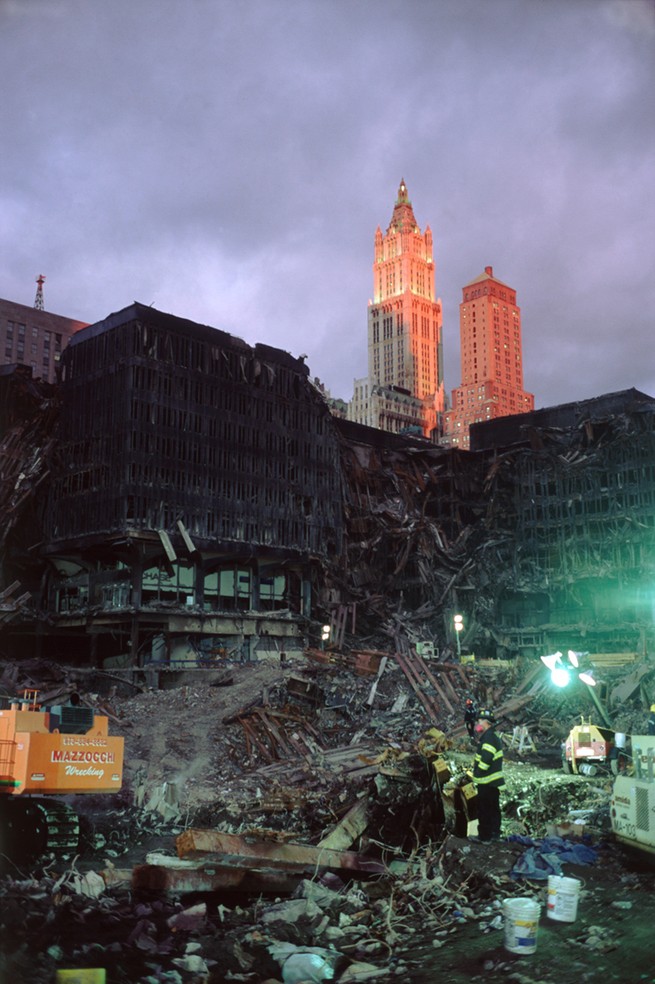
Eight years later, on September 11, Rinaldi’s memory of success informed his reactions during the first hour of the unfolding events, even after the second airplane struck and he knew that the Trade Center was under attack. His confidence was widely shared within the towers themselves, where people on the lower floors were isolated by the size of the structures from the horror overhead. Most knew less than Rinaldi did about what was happening, because of course they were not watching television. More than 15,000 walked out safely, in stairwells that were well lit and smoke-free. In 1993 the mood of the crowd inside the stairwells had been confused and fearful. This time there was little of that. Indeed, the mood was rather too restrained. In the South Tower, before it was struck, a Port Authority man made an announcement on the public address system that the problem was contained to the North Tower, and that people could return to their offices—this despite the fact that jumpers could be seen falling into the plaza just outside. Most people ignored him. But in both towers a strange, Orwellian calm prevailed. People carried their morning coffee into the stairwells. They were not supposed to talk, and generally they did not. Those who tried to move fast or get ahead were reprimanded. But most were well behaved. They stayed obediently in lines to one side, leaving open lanes for the firemen to climb. Those who later believed that they had seen looks of knowing self-sacrifice in the firemen’s eyes were understandably confusing the chronology of events. The looks in the firemen’s eyes came from the extreme fatigue of having to hump heavy loads up so many stairs, as well as from the anxiety of moving into battle—in this case against a dangerous fire that would have to be fought from below. The firemen remembered the successes of 1993 as clearly as anyone, and they were no more prescient than others. But then, at 9:59 A.M., the South Tower made a noise variously heard as a roar, a growl, or distant thunder.
By September of 2001 Rinaldi’s soft-spoken friend Frank Lombardi had risen to become the Port Authority’s chief engineer—an exalted position with ties to monumental public projects of the twentieth century, not the least of which was the World Trade Center itself. Lombardi’s office was grand, It occupied the southwest corner of the North Tower's seventy-second floor, and looked out over New York Harbor to the flats of Staten Island and New Jersey. As elsewhere in the towers, the view was restricted because the windows were only twenty-two inches wide and inset one foot from the exterior—an unfortunate consequence of the close spacing of the external columns and also, apparently, of the discomfort that the principal architect, Minoru Yamasaki, felt with wide-open perspectives from such heights. Nonetheless, for a busy man like Lombardi the view was good enough. It was a backdrop, and he didn’t spend a lot of time looking outside.
In any case, the first airplane came in high and from the other direction—down the Hudson from the north, down Manhattan, and into the North Tower between the ninety-fourth and ninety-eighth floors. It blew fuel and debris straight through the building. Lombardi was at his desk. He heard nothing, but he felt the tower sway, and he saw people in the hallway go airborne before they fell. Lombardi’s first thought was that New York was experiencing an earthquake.
But then, just outside his window, he saw a huge ball of fire followed by a rain of vapor and white paper, and he realized that the building had been hit—though he assumed on the south face, and probably by accident. He went out to check on his staff. He told people to go to the stairwells and leave. Most of them did. He went back into his office and stared at the papers fluttering down, noticing how slowly some were falling, and how close to the window. From the quantity he realized that the building had been badly breached. Right away he got three phone calls. The first was from his secretary’s husband, who was in New Jersey, and had either seen or heard of trouble. Lombardi said, “She’s fine. She’s on her way down.” The second was from the friend of a friend, who asked, “Is he okay?” Lombardi said, “Yes. He’s on the way down.” The third was from a contractor, who said, “Frank, do you need help?”
Lombardi wasn’t sure. He said, “What happened?”
“I don’t know, but something hit you"
“I know, but what?”
The contractor said, “I don’t know.”
It never crossed their minds to consider a hijacked airliner on a suicide flight. Lombardi wanted to verify that the seventy-second floor had been evacuated. With a couple of colleagues he searched the one acre of floor space, mostly cubicles. It was empty. But when they went to the stairwell to leave, they heard shouting behind an elevator door. Two men were trapped in the cab, Lombardi did not think they were in immediate danger, but having gone through his own elevator ordeal in 1993, he wasn’t about to abandon them. The door was jammed, and required about twenty minutes to pry open. During that time one of Lombardi’s colleagues was back in his office, getting tools, when his telephone rang. The man on the line said, “You guys are still up in Tower One? Don’t you realize that Tower Two was hit?” In annoyance, Lombardi’s colleague said, “Will you please stop spreading rumors?” and hung up. It seems surprising now. These were alert people, but they were confused by their proximity to an event too large to imagine.
Lombardi descended the stairwells of the North Tower to the plaza level, where he looked out and saw body parts scattered across the concrete. He went down another level, where all around him crowds were evacuating into West Street. But he was the chief engineer, and he felt a duty to respond—though how and to what he still had no idea. Prompted by memories of 1993, when a command post had been established in the complex’s hotel (World Trade Center Three), he joined a few other Port Authority men and headed there through a passageway. They had assembled for a talk in the hotel bar along with some firemen when the place erupted in a tremendous roar. A pressure wave shattered glass, picked up the men, and threw them to the side. Lombardi thought that terrorists like those of 1993 had bombed the hotel and were maybe coming in through the doors, and he considered the irony that he had survived then only to die now, not 200 feet from where terrorists had hit before. The truth was stranger still: the South Tower had just collapsed over his head, and he had been saved by a few unusually heavy beams used in the structural splinting and patching up that he himself had directed after the earlier bombing. But he knew none of this at the time.
To his surprise, he felt nothing broken and no pain except for a burning in his eyes. That was widely the pattern of the day—survival as an all-or-nothing proposition. The room was dark, and so dusty that he could not breathe. He put a handkerchief to his mouth. Someone yelled to a fireman, “Could you please put on your flashlight?” The fireman did, to little avail. People stood up, saying, “Where are we? What’s going on?” They lifted a steel roll-up door, thinking to get out, and found a group on the other side thinking to get in. The two groups frightened each other. A fireman went out to explore, and with visibility limited to about two feet he nearly fell into a crater. He found a way across it and returned, saying, “Come on, I see a streetlight.” They went out in single file. Lombardi found himself on a sidewalk, but otherwise noticed no change from the conditions that had existed inside. He lost track of his companions and walked down the street in confusion. He remembered the roar, and again thought of the bombing in 1993: had something gone off in the underground? He passed the south pedestrian bridge, which he recognized, and headed south on West Street. He had a scratch on his forehead that was bleeding. People came up to him offering help, and someone gave him some water. Finally he got far enough away to look back. He saw the North Tower standing, but not the South. He thought, “Wait a minute. The North Tower is there. I know the North Tower is there. But what happened to the South?” It was confounding, and he could not conceive of an answer. He was an engineer, but human, too. He walked on for a while, until for the second time that day he heard a roar. He stopped and turned and watched in disbelief as the North Tower fell.
It took distance to sort things out. The technical speculation began right away—on the Internet, in engineering offices, and in universities around the world—and some of it was wild. Among the early embarrassments were statements by Van Romero, an explosives expert and a vice-president of the New Mexico Institute of Mining and Technology, who publicly opined that pre-set explosives could explain the collapses, and implied that the jet impacts were meant as bait for the rescue personnel. He was immediately inundated with e-mail from conspiracy theorists. After only a week he tried to take it all back, publicly renouncing his earlier ideas and signing on to the growing convention that fire and impact damage in combination were responsible for the collapses. Miserably, he said, “I’m very upset …. I’m not trying to say anything did or didn’t happen.”
A Berkeley engineering professor named Abolhassan Astaneh-Asl was more successful. He pulled down an early grant from the National Science Foundation, rushed to New York, checked into the Tribeca Grand Hotel, got The New York Times’s ear, and began to show up on television inspecting twisted steel in the New Jersey scrapyards where it was being collected. Priscilla P. Nelson, of the National Science Foundation helpfully explained, “It is important for engineers to be able to make the observations now that will lead to reduced building vulnerabilities in the future.” A skeptic told me that some of the specimens Astaneh-Asl had identified on camera as bearing sears from the initial impacts were later discovered, from the numbering on them, to have originated much lower in the buildings. If true, however it was hardly the sort of mistake that a man like Astaneh-Asl could have been expected to renounce, or even to mope about. This was a big disaster, with all kinds of impacts, and he had important work to do. In December he announced that he would be collaborating with a programmer from the Lawrence Livermore National Laboratory to build a “full-fledged, realistic model of the whole World Trade Center—including other buildings, not just the towers.” He said, “Then we’ll bring the plane in—to the computer model—and hit the building with various scenarios.” Priscilla P. Nelson helpfully explained that the work “could lead to the generation of new computer models that will really enhance our ability to understand structural response.” Astaneh-Asl may have revealed more than he meant to when he said, “The most important contribution of my career was to go to New York right after the attacks.”
There was a lot of that kind of talk at the time.
But the main investigation had a different tone—cautious, preliminary, and publicity-shy. It was funded with $1 million from the Federal Emergency Management Agency (FEMA), and performed under the auspices of the venerable American Society of Civil Engineers (ASCE). The granting of such public authority to a private professional organization to investigate events potentially related to the competence of its own members would usually have raised legitimate questions about conflict of interest, but in this case it never quite did. Certainly there was an element here of a profession preparing to circle the wagons. The team was headed by an understated midwesterner named W. Gene Corley, who holds a Ph.D. in engineering and is the senior vice-president of a modest research facility north of Chicago. Corley had led the official engineering review of the Oklahoma City bombing of 1995, and had an impeccable reputation as an independent investigator of building failures. He was a steady man, and as close to a disinterested insider as America was likely to produce. But he had limited control over a team that had expanded from a preliminary selection of about a dozen specialists—experts in metallurgy, fire, structural dynamics, and so forth—to an unwieldy group of twenty-two that included some of the profession's biggest names. The expansion was not just due to an urge to contribute, or to an abstract interest in the subject matter. People were also concerned that the investigation not provide ammunition for future lawsuits. The team was set up so that each of the members would be able to influence the contents of the final report. The pattern was exemplified by LERA, where the Trade Center’s original engineer, Leslie E. Robertson, excused himself for obvious reasons of proximity—only to cede his place to his wife, Saw-Teen See, the firm’s managing partner. But these were exceptional times. There was widespread agreement that for the health of the United States as well as the companies involved, it was important to keep the hyenas at bay.
Everyone understood the deal. The attack on the World Trade Center was an act of war. Despite the occasional chatter in the press about shoddy steel or substandard fireproofing, the towers were as well designed, built, and maintained as could have reasonably been expected in America in the late twentieth century. But the context had changed now. The towers fell because they were severely maimed and sprayed with burning jet fuel: they fell as any building will, no matter how resilient, if it is hit by the next bigger missile in the escalating progression of war. In retrospect, their greatest failing was so obvious that it hardly required discussion: the stairwells had been clustered too closely together, and their simultaneous destruction had trapped people above the impact zones, causing more than a thousand unnecessary deaths. This was an error that would have to be avoided in future designs. But there was no point in wishful thinking here. Civilians die in wars, and always will.
Beyond that, however, it was important as much in principle as in practice to make an honest effort to understand the process and mechanisms of each tower’s collapse. This was to be a preliminary investigation only, with an emphasis on going public with the essentials as soon as possible. Corley knew that the effort was never going to be what enthusiasts in Washington were wishing for—something like an airline accident investigation, controlled and contained, with the investigators on top, and the possibility even of a sexy reconstruction in a hangar as a finale. The Trade Center ruins were infinitely too large and chaotic to allow for that—and the emotions there, because of the continual discovery of bodies, were far too intense. The investigators spent some time at the site, but in practice their presence turned out to be of little help in the inquiry. Corley told me that given the weights and quantities involved, even the inspections of the steel that had been sorted at the New Jersey scrapyards proved to be an inefficient means of gathering evidence. This was certainly an argument against the critics who later claimed that all the steel should have been retained. More important were the videos and firsthand accounts from September 11, the original plans that LERA was providing, and the application of methodical science. Corley had confidence that the catastrophe could be reasoned through. It was obvious that critical inner workings of the collapses would remain obscure, and that debates and experiments concerning them would continue for years: indeed, this was an important part of the creative turbulence that followed the attacks, and that in time would lead to improvements in structural design. But as Corley had expected, by spring, as the last remains of the Trade Center were being removed, the essential facts were known.
The death of the South Tower was better understood than that of the North, because its symptoms showed particularly well. The 767 that approached from the south, United Flight 175 was a machine designed for lightness and efficiency, a slick aluminum tube 159 feet long with graceful wings stretching 156 feet from tip to tip, two fuel-efficient engines. and a cockpit that offered the pilots a gorgeous view. It was minimally loaded that morning for the Boston-to-Los Angeles run, with only sixty-five people aboard and about half of the maximum fuel, and as it approached the building it weighed about 137 tons. It was flying at about 586 mph, which was more than 150 mph above the airplane’s designed limit at low altitude. In the cockpit the overspeed warning must have been warbling loudly.
The tower that soared above the cockpit in those last seconds was in its own way designed for lightness and efficiency—and it. too, was essentially a tube, though squared, 1,362 feet tall, and made of steel. Each of its faces was 209 feet wide and consisted of a palisade of aluminum-clad fourteen-inch box columns. which when bolted and welded together and braced by horizontal plates formed the exoskeleton that carried half the building’s weight. and gave it all of its stiffness against side loads. The side loads were expected to come primarily from winds and, at the design limit of 150 mph, to amount to a maximum sustained 13-million-pound push. But the building was more resistant even than that, because the Port Authority, out of conservative impulse, had decided during the construction to go beyond the design and anchor the foundation structure directly into bedrock. Hidden inside the square tube of perimeter columns stood the other half of the support structure: a central core consisting of massive columns arranged in a rectangle much longer than wide. which was aligned in the South Tower on a north-south axis and contained the elevators and emergency stairwells. Though the core was not designed to resist side loads. its alignment meant that the north-south axis was. however marginally. the tower’s strong one. More significant it also meant that the acre of column-free office space on each floor (the goal of this tube-inside-a-tube design) was wider on the east and west sides (think viewless cubicles) and narrower on the north and south. The floors were built on thin steel trusses that bridged between the core and perimeter columns and supported corrugated-metal decks on which concrete was poured. The floors were thin and light. and served as diaphragms to stiffen the exterior columns against buckling forces. Because the vertical load lessened significantly with height. the thickness of the steel in the columns was progressively reduced from the bottom of the tower to the top. But no matter how it was trimmed. the weight added up. Ignoring all the people. furniture. and equipment that the tower contained, its structure alone weighed some 600,000 tons.
By comparison, the oncoming 767 was a mere pebble. But as pilots know, the energy of an impact goes up exponentially by the square of the increase in an airplane’s speed—meaning if you go a little faster, you hit a whole lot harder. And this airplane was moving ferociously fast. The killer at the controls almost missed, and would merely have clipped the left wing, but he hooked his intent last turn like a wolf after prey, and punched hard into the south face of the tower three fourths of the way up on the east side of center. The airplane hit about nine times harder than it would have during a typical accident while on an approach to landing. The building never came close to toppling sideways, but it swayed as much as twelve inches at the top, and endured a violent impulse that ran vertically through it like a rebounding wave. The airplane entered the building with its wings banked left, stretching from the seventy-eighth to the eighty-fourth floor, slicing through half the south-face perimeter columns. Frame by frame. the videos show it heading inside as if intact. An MIT study later estimated that only six percent of the plane’s kinetic energy was expended against the south face. Almost all of the rest of the energy was expended inside—25 percent in tearing up the floors and pushing and piling the cubicles, and another 56 percent in damaging or severing as many as half the columns in the core. Two of the three stairwells were taken out along with the people who were using them to evacuate the building in response to the earlier North Tower attack. The third stairwell was damaged but remained usable. and allowed several brave and desperate people trapped above to escape. A few of the airplane’s heaviest parts—an engine, a piece of landing gear. a wheel—kept right on going, as far as six blocks into the city, and a section of fuselage hit the root of World Trade Center Five. But most of the airplane remained inside the intended victim, piled into a dike of mixed debris against the tower’s north and east perimeter walls.
One of the many astonishments of that day is that the building was able to swallow a whole 767, and to slow it from 586 mph to a stop in merely 209 feet. According to calculations based on photographic evidence of the damaged perimeter. the structure had redistributed the gravity loads so efficiently that only twenty feet from the entry wound the demands being made on intact columns were hardly higher than normal. The building was certainly not safe. It had suffered serious if unknowable damage to the east side of the core. At the same time, for seventy feet along the inside of the south face. and perhaps a short distance along the east face. the floors had been torn loose from the structure, leaving perimeter columns unbraced under the gravity load of the roughly thirty-story building overhead. Still, if not exactly shrugging off the hit, the South Tower had absorbed it well: absent an earthquake or a strong windstorm. the building would have remained standing indefinitely.
But then, of course, there was the fire. As the airplane disintegrated, it released its fuel—roughly 10,000 gallons of volatile “Jet A” kerosene that sprayed and vaporized through the six floors of wreckage. poured into the elevator shafts. shot through broken windows along the north and east faces. and immediately ignited. Apocalyptic though it seemed. the huge fireball that blossomed over the plaza was actually to the building's advantage, because it consumed as much as a third of the available fuel. releasing the heat harmlessly into the air. That left two thirds of the fuel inside the tower, however, and it was widely spread and burning.
The building’s sprinkler system had been destroyed by the impact. but in any case it would have lacked the pressure to operate effectively over such a wide area, More significant, much of the light spray-on fireproofing that coated the structural steel had been knocked away—and precisely in the same east-side areas that had sustained the worst damage and now were threatened by unusual and increased loads. On only one of these floors had a fireproofing upgrade that doubled the thickness of the coating been completed—a circumstance that provided for healthy debates afterward. though there was never direct evidence that the thicker fireproofing would have better endured the impact.
At any thickness, the coating was meant to insulate the steel and prevent it from overheating in a fire for at least two hours (by which time an office fire will typically have burned itself out in any given part of a building). The problem with overheating is that long before steel melts. it weakens, In structural steel like that of the South Tower the weakening begins around 350°. By 1,100° the steel loses about half its strength. Kerosene burns twice that hot inside the carefully crafted furnace of an airliner’s engine. but within the imperfect combustion chambers of the South Tower impact zone it is thought to have reached at most only about 1,500—a temperature unlikely to induce the failure of such a tremendously redundant design, especially on a gentle, windless day. Moreover, the kerosene fire simply did not last long enough at any temperature to overheat the building's massive columns. Corley’s fire specialists believed that the jet fuel never collected into deep. slow-burning pools, and that it burned through entirely within four minutes. They concluded that jet fuel itself did not bring the tower down,
What it did do, however, was set off raging office fires simultaneously on six different floors. It was a conflagration that would have been impossible for the firemen to control, had they gotten to it—a fire large enough to create its own powerful winds. sucking oxygen in through all the perimeter holes and broken windows, generating energy three to five times greater than that of a standard nuclear power plant. and eventually heating the steel to temperatures as high as 2.000°. The fire fed on wrecked office furniture, computers, carpets, and aircraft cargo, but primarily it fed on ordinary paper—an ample supply of the white sheets that were so much a part of the larger battlefield scene. Without that paper, experts believed, the fire might not have achieved the intensity necessary to weaken the steel beyond its critical threshold. It would be simplifying things, but not by much, to conclude that it was paperwork that brought the South Tower down.
On the debris pile in the northeast corner the fire melted the remnants of the shattered airliner, which half an hour after entering the building began to flow in a stream of molten aluminum down the tower's outside. Still the tower endured. But then the southeast corner of the eightieth floor collapsed, triggering the progressive failure of the floor along the entire east side of the building. Dust plumes shot out through the broken windows. The eastern perimeter columns now stood unbraced for the space of at least two floors, adding to the dangers that the building already faced from the unbraced condition of the perimeter on the south side. Shortly afterward, in the southeast corner, near the entry wound, a cluster of exterior columns began to buckle. It was 9:59 exactly, merely fifty-six minutes after the airplane hit. Peter Rinaldi was living the last four seconds of his his earlier life. Frank Lombardi was pushing into the hotel bar somewhere far below. With its support giving way beneath it. the top of the tower tilted east and then south, rotating in a clockwise direction. and suddenly slammed down. Even if it had been felled from below, the tower could not have capsized in a conventional sense, because like most other buildings, it lacked the structure to hang together for more than a few degrees off vertical. But it was not felled from below: it was hammered from above, and it accelerated as it fell, crushing the core and peeling back the exoskeleton with each successive floor. As the external walls peeled, they broke primarily at the bolted connections. allowing welded pre-fabricated sections of the columns to fall free. The upper sections fell east and south, and hit the Bankers Trust building; the lower sections fell north and west, and gave the Marriott hotel the first of its two fatal blows.
The North Tower died a half hour after its twin, but because it showed fewer symptoms. less is known about its end. The attack it suffered was similar. It came from another 767 American Flight 11, which was light on passengers and fuel, and flying about 100 mph slower than the United flight, though still very fast. The initial impact involved a full, clean entry, almost perfectly centered. The airplane sliced through thirty-six of sixty-one columns on the north face, tore through four floors, and slammed squarely against the weak axis of the core. It took out all three stairwells, destroyed the sprinkler system. knocked the fireproofing from the steel and blew a piece of landing gear and a fireball through the far wall. Lifejackets and parts of the seats ended up on the roof of the Bankers Trust building. The North Tower swayed, the jet fuel was rapidly consumed, and a terrible office fire broke out.
There were differences, too. The North Tower had the advantage of getting hit high up, thereby requiring less performance from the weight-bearing steel in the fire zone. This must certainly have saved lives. The external columns held. But by 10:28 their integrity was not enough. In this design of a tube within a tube, both tubes had to stand for either to survive. The North Tower core was aligned on an east-west axis, and it had been severely damaged—probably along its full length—by the airplane’s centered impact. After nearly two hours of progressive weakening by fire, the remaining columns reached their limits. There was no sign of this on the outside. The South Tower of course had already fallen, and smoke was rising from a wound near the North Tower’s top. Nonetheless the building remained a monolith, seemingly as permanent and strong as stone. But then the 351-foot transmission tower on the roof sank a little. The movement was barely perceptible. Half a second later the floors above the impact zone dropped as a unit straight down through the office fire, creating a flare-up and the illusion of a secondary explosion before striking the first blow in the chain of blows that pancaked the monolith to the ground.

Is there any wonder that Frank Lombardi, the Port Authority’s exalted chief engineer, had no understanding of what he had just seen? For the second time in an hour the Trade Center’s dust darkened the sky. Lombardi walked to the Hudson’s edge, where the dust cloud abruptly ended. and after a while he found his way onto a small ferryboat—one of several that had responded to the disaster and were nosing up to the shore. evacuating the shell-shocked survivors. The boat took on a full load of them, and headed across the river for New Jersey. Lombardi stood in the crowd near the stern. and gazed numbly at the receding city. From a hole where the Twin Towers should have been, a column of smoke and dust rose into the blue of the sky and, widening slowly, streamed out toward Brooklyn. This was the view already made famous around the world by television, evoking widespread fear and anger, and in some places celebration. Encountering it in reality on this river, with a warm wind on his face and the sound of the ferry’s engines in his ears, Lombardi found it more than strange. By then he had heard a rumor about the cause—two airliners, it was said, involved in a coordinated attack—but people everywhere were full of frightened chatter, and he had no way to judge it. He may have sensed that he of all people should have been able to reason things through, but he could not. This must have been deeply disturbing to a man who was nothing if not pragmatic.
The ferry kept moving confidently toward New Jersey: that much at least was normal. But then, as it approached the far shore, its engines suddenly idled. and the captain leaned out and called. “Man overboard!” Lombardi checked the wake for the victim, to no avail. Now, instead. there was someone in the water ahead—and he appeared to be swimming toward the Trade Center, The captain slowly brought the boat up beside him. and the crew dropped a ladder. The swimmer was tiring. He reached up. and was about to be helped aboard. when someone shouted. “Don’t let him in! Shoot him. He may be a terrorist!”
This halted the proceedings.
A policeman stepped forward uncertainly. and leaned over the rail. He said. “Excuse me. but what are you doing in the water?”
The swimmer said. “I thought I could swim over to New York to help people”
The policeman brought him up on deck. He said. “Let me get this straight. Let me understand this. We’re bringing people over on a boat from there to here. Right?”
“And you want to swim over there?”
The policeman did what policemen do, maybe for lack of imagination. He said, “You’re under arrest.” He probably figured the man was unbalanced. and dangerous at least to himself. He was still holding him when Lombardi got off the boat.
Lombardi found his way to the Port Authority offices in Jersey City, above a commuter station known as Journal Square. It was there in the early afternoon. when he saw the events replayed on television, that he first was able to understand what had happened to the buildings, and to begin the slow process of acceptance. Two months later, when I met him in midtown Manhattan, he had come a long way but was still not all the way there. He had a manner of talking about the towers as if they had once been alive. He had obviously been thinking heavily about their deaths.
He knew many details of the attacks, and he told me he thought that the terrorist who came in first, against the North Tower (in which Lombardi himself was sitting), had intended to knock it right over—a motive that explained the perfect centering and the high hit against the weak axis of the core. Furthermore, he proposed that the second terrorist, while crossing the Hudson and setting up his own attack. had observed the wounded building still standing, and at the last moment had decided on a strategy of avoiding a direct hit against what he knew was the strong axis of the South Tower’s core, instead choosing to hit the building low and on one side, in an attempt to undercut it and trigger a collapse. If so, he was fantastically nimble. I had another view of the attack—that the terrorists were operating not as engineers but as executioners. that they were imbued with clumsy metaphors of swift swords and decapitation blows, and that the second one had simply missed his stroke by a few feet, as is easy to do with a fast-moving airplane. Lombardi, I thought. was sometimes still thinking like a defeated man, investing too much competence in his enemies.
He was a gentle person. You could see him actively trying to recover his equilibrium—swinging between the old-fashioned Port Authority can-do confidence. which was coming back. and a persistent fatigue, a vagueness that was said by his friends to be something new. In many ways he was the ultimate Port Authority man, and he seemed to embody the organization especially in its ambivalent response to the Trade Center disaster. He rarely came to the site. It was as if the loss there was still too painful to contemplate. But he also told me that he was proud and glad for Peter Rinaldi, his chosen representative. who had seized this chance to take action.
Peter Rinaldi was the lucky one. He worked seven days a week, often fifteen hours a day. His base was the city’s emergency operations center, in the kindergarten rooms of Public School 89. The school occupied the second floor of a new red-brick building just inside the emergency perimeter. two blocks north of the Trade Center site on West Street. It had been safely evacuated on September 11 before the towers fell. When the city’s recovery team set up headquarters there a few days later. there was time only to dump the food from the children’s lunch boxes so that it would not rot. The lunch boxes themselves stayed in the classrooms, piled in rows on the shelves, with the names still displayed: Patrick. Elizabeth, various Jennifers, and all the other children who had fled with their parents to safe havens and new schools elsewhere in the city or beyond. For two months afterward the classrooms remained as they were, with strip posters of the alphabet taped to the chalkboards, and colorful, childish art pinned to the walls.
The inner sanctum was a corner room with cinderblock walls painted creamy white, and linoleum floors now brown with the dirt tracked in from the site. The shelves that lined the walls were still filled with blocks, toys, and plastic crates of Dr. Seuss and other children’s books. At the center stood four folding tables that had been pushed together, along with some folding chairs that had been scavenged from somewhere. When the tables grew crowded. people simply used the kindergarten stulf—pint-sized furniture built low to the ground, which was discovered to be strong enough even for 250-pound construction workers. Visitors often remarked on the strangeness of the scene. in which full-grown men and women, including powerful executives and renowned engineers. sat around as if they were playing at being children again. In fact the stakes were large, and so were many of the egos involved. But the room did not allow for displays. People there dressed alike in dirty boots and rough clothes, and no matter who they were. They had to prove themselves again. Their conversations were held in the open for lack of choice. There was no time for memos, or for chain consultations. The e-mail connection was permanently down. The phones did not work. When problems arose. they were dealt with right away. either in the room or, if more information was needed. with a walk down the street to the pile. and a decision on the spot. This is what Peter Rinaldi encountered when he first arrived. As the operational center of a billion-dollar effort, Public School 89 was a highly unusual place.
Leading the effort was the unlikely duo of Kenneth Holden and his lieutenant. Michael Burton—the two Department of Design and Construction officials who had emerged from bureaucratic obscurity on September 11 to orchestrate an effective response to the disaster. Holden, the DDC’s shrewd and intellectually sophisticated commissioner. was a heavyset man who had grown up in an atmosphere of suburban ease. had worked on a kibbutz in Israel and had studied history at Columbia. Having drifted by chance into a city-government job, he was now, at forty-four, one of the youngest department heads in New York City government. Burton was a slightly younger man, a thirty-nine-year-old marathon runner and construction-industry insider who, having been raised in modest circumstances, had earned a degree in engineering and an M.B.A. from colleges in the Bronx, and was aggressively climbing the ladder of social and material success.
The two men made an awkward pair. Each had rushed independently to City Hall at the first news of the attack, and had been caught on the streets and forced to run when the towers collapsed. By that afternoon they had met up and, with no thought beyond a few hours into the future, had begun to enlist the help of others within the DDC, and to organize the arrival of expert engineers and heavy equipment at the Trade Center site. They did not ask permission to do this—nor, at first, did anyone pay much attention to their work. The DDC was not even mentioned in the city’s official emergency-response plan. The focus over the first few days was mostly on the drama of the bucket brigades. But as is widely known, Mayor Giuliani had smart reactions to the crisis. Later it seemed that one of the smartest was a back-room decision to scrap the organization charts, to finesse the city’s own Office of Emergency Management, and to allow the DDC to proceed. The federal government was poised to intervene, but agreed to hold off. and then to hold off again. The result was the classroom at Public School 89, that strange kindergarten scene through which control of the contractors was exercised and federal funds flowed.
Holden spent months on his cell phone there, marshaling resources for the operation, defending it from political attack. and creating the shelter in which Mike Burton then could operate. Burton’s job was to oversee the practical details of the cleanup. He was tireless: he excused himself from his home life in suburban Westchester County, moved to an empty apartment in Battery Park City, and began spending eighteen hours a day at the site, roaming the pile even late at night. searching for efficiencies. forever urging the crews to work faster. He was not a popular man. He was extremely ambitious. He was determined to finish the project in less than a year. The firemen in particular disdained him for what they saw as his disrespect for their dead. There were days when it became awkward for him to go out onto the pile. because of his sour relations with the men there. Not without irony, people called him the Trade Center Czar. But such a boss was probably needed to get the job done. The scale and complexity of the ruins required it. And on a level just below him there were too many other bosses who did little more than eat and mill around.
Indeed, for the first two months the site’s outer zone was so dense with agencies and their equipment that the debris trucks at times could not get through, and the hauling operation had to shut down. It sometimes seemed that every official with a uniform or a badge within a hundred miles wanted to put in time there. Even the dogcatchers from Long Island showed up. They hauled in a mobile spay-and-neuter clinic to use as a command post. and sat around on lawn chairs for weeks. wearing T-shirts imprinted in block letters with SPCA—LAW ENFORCEMENT. They carried pistols, too—part of the impressive brandishing of weapons all around the ruins. One afternoon, as we walked toward the pile, Pablo Lopez, the indomitable Ecuadorian engineer, said to me. “When you see even guys from the EPA carrying guns, you’ve got to wonder. What’s an environmentalist doing carrying around a Glock? Who's he gonna shoot?” The weaponry made people seem impotent and out of touch, as if they had showed up too late for the fight.
The frustration was that you couldn’t dislodge the debris by shooting it. Because of the bodies that lay there, you couldn’t dynamite it either. Because of New York’s sensitivities to noise and dust, you couldn’t even use small demolition charges to fill dangerous cavities or bring down the skeletal walls. There was no choice but to cut and pull and unbuild the chaos one piece at a time. Burton understood this early. While others stood around with their guns, he and Holden imposed a rough order on the site by dividing it into quadrants, roughly equal zones that he assigned to four large construction companies: Turner, Bovis, AMEC, and Tully. The first three were essentially management teams—multinational corporations in the high-rise construction business, which had little equipment of their own and relied on other contractors to get the work done. The fourth company, Tully, was quite a different thing—a family-owned New York paving contractor with little structural experience but plenty of trucks, heavy equipment, and experienced workers of its own. All four companies had teamed up with the DDC before and were major players in New York.
The quadrants were never as neatly delineated on the ground as on the site maps. but during the critical opening stages of the project they served to concentrate each company on the debris immediately at hand, and to keep people from being overwhelmed by the magnitude of the process that lay ahead. The effect across time was a shaping of the pile according to the respective corporate personalities: Turner in isolation on the ruins of World Trade Center Seven, efficiently disassembling the debris and making almost tidy work of it; AMEC in the northwest corner of the foundation hole, often bumbling, arousing the ire of the DDC, and falling behind; Bovis in the southwest corner, progressing steadily in the difficult area of the Marriott ruins and the south skeletal wall, while playing off its management skills to spread incrementally throughout the site, most significantly by taking on the all-important project to save the foundation hole’s walls; and, finally, Tully, everyone’s favorite, the hardworking red-meat guys. who kept pulling recklessly ahead and devouring the ruins along the entire east side.
These were the forces, roughly 3,000 strong that Ken Holden and Mike Burton unleashed. In a painful and probably necessary process they slowly wrested control from the firemen. In late October the operation became a “joint command” between all the uniformed services and the DDC. Realistically, because the uniformed services were split by long-standing rivalries and had little of technical value to contribute, the joint command left the civilians in charge—a fact that became increasingly obvious at the regularly scheduled “unified” meetings, where the Fire Department retained a functional veto power, but only the DDC seemed capable of moving ahead.
Emotions were raw. One of the unacknowledged aspects of the tragedy was the jealous sense of ownership that it brought about—an unexpected but widespread feeling of something like pride. that “this is our disaster more than yours” The feeling started at large in the United States, and became more acute with proximity to the site—a progression of escalating possessiveness that ran from the halls of Washington through suburban New Jersey to New York, and from there through Lower Manhattan to the pile itself, where it divided the three main groups (fire. police. and construction) and sometimes set them against one another, The firemen in particular felt that they had a special relationship with the site. not only because they had lost 343 people there—out of a force of 14,000—but also because afterward their survivors, along with their dead, had been idolized as national heroes. and subjected to the full force of modern publicity. A few of them reacted embarrassingly. by grandstanding on television and at public events, striking tragic poses and playing themselves up. Even at the site, where people generally disliked such behavior, you would sometimes find firemen signing autographs at the perimeter gates or after the public viewing stand was built, drifting over to work the crowds. Most of them behaved more soberly, no matter what pride they may secretly have felt, if for no other reason than that their firehouse culture frowned on self-aggrandizement. Still, there was resentment by the police. who had lost plenty of their own people, and by the construction crews, who took it upon themselves to remember the far greater number of civilian dead. These tensions flared especially over the differing treatment of human remains—on the one extreme, the elaborate flag-draped ceremonials that the firemen accorded their own dead, and on the other, the jaded “bag ’em and tag ’em” approach that they took to civilians. A strange blindness caused them to persist with this behavior despite the ease with which it could have been remedied. Even Sam Melisi participated in it, for instance once bemoaning a “drought” to me when the remains being uncovered were merely those of civilians. It was a surprisingly ganglike view, and it encouraged a gang mentality among others on the pile.
Still, most people at the site understood that the loss the firemen felt was real. One morning in October, I accompanied Ken Holden into the expanding valley at the center of the pile, where a temporary access road of ground-asphalt millings was being built. A fire chief came up and said, “You gotta give us time. You gotta get these guys to stop covering up the debris. burying us with dirt.”
Before Holden could answer, another fireman, an older man in filthy clothes and a scarred helmet, rushed up and said, “You stop these guys from pushing dirt in here!” He had a weathered face and heavy sweat on his upper lip. His eyes were wild. He said. “I’ve got two friends out there. And I’ve got my son buried right in here.” Holden put a calming hand on his shoulder, but to no effect. The fireman wandered off with his shovel, a short entrenching tool bent 90 degrees, and climbed down into a hole in the rubble. The chief repeated almost apologetically, “He lost his son in there.”
Holden said, “How much time do you need? A day? Two days?”
The chief swept his hand wide. “They’re buried all through.” Holden went off to find Burton and tell him to stop the road for now. When he came back, the old fireman was down on his knees, probing loose debris and sniffing shovelfuls for the scent of death.
For most of the men on the pile, the loss was less acute. Even if these were fellow firemen who had died, and even if they were close friends and even if people used the word “brother” to describe them, it was not the same as losing a son. Still, over the first few months there was a lot of sadness at the site. Away from the photographers and TV cameras, the depth of it was not always obvious. The Fire Department search parties operated on a regularized schedule in small groups beside the diesel excavators, and they sifted through the fresh debris with workmanlike efficiency. But they also took risks for no obvious reasons—jumping suddenly into newly opened debris holes, climbing on the unstable cliffs, and, especially, standing for hours in the heaviest smoke and dust, refusing as a matter of pride to wear the respirators that dangled around their necks. They seemed to have surrendered to an attitude of reckless self-abandonment. To varying degrees the police and construction workers had surrendered to it too. In one of the Salvation Army feeding tents I talked to a psychologist who blamed the risk-taking on “survivor guilt,” which he called a common reaction to disaster. To me, however, it looked like a simpler form of grief.
But the risk-taking was also the expression of a more creative and courageous impulse, linked to the need for action and improvisation, and part of the personal freedom that was unexpectedly emerging at the Trade Center site. It was a response as well to the sheer magnitude of this calamity, the hijackings, the killings, the collapses—events so extreme that they required extreme actions in return. Despite all the divisions at the site, this was the fundamental understanding that people shared—and, indeed, that the culture at the site demanded.
This article originally stated that Peter Rinaldi and Frank Lombardi escaped into the offices of Brown & Root after the 1993 World Trade Center parking-lot bombing. In fact, it was the the law firm of Brown & Wood.
Photographs, in the order that they appear in the article: The beginning of the demolition of the North Tower shroud, New York City, 2001; Workers at facade, 2001; The Banker’s Trust, 2001; A man basket descending into the North Tower, near the north wall, New York City, 2001; Crumbled Building, 2001; Smoke Rising in Sunlight, New York City, 2001