Trade: The World According to Ohmae
A noted Japanese analyst takes an unconventional look at the U.S. trade deficit
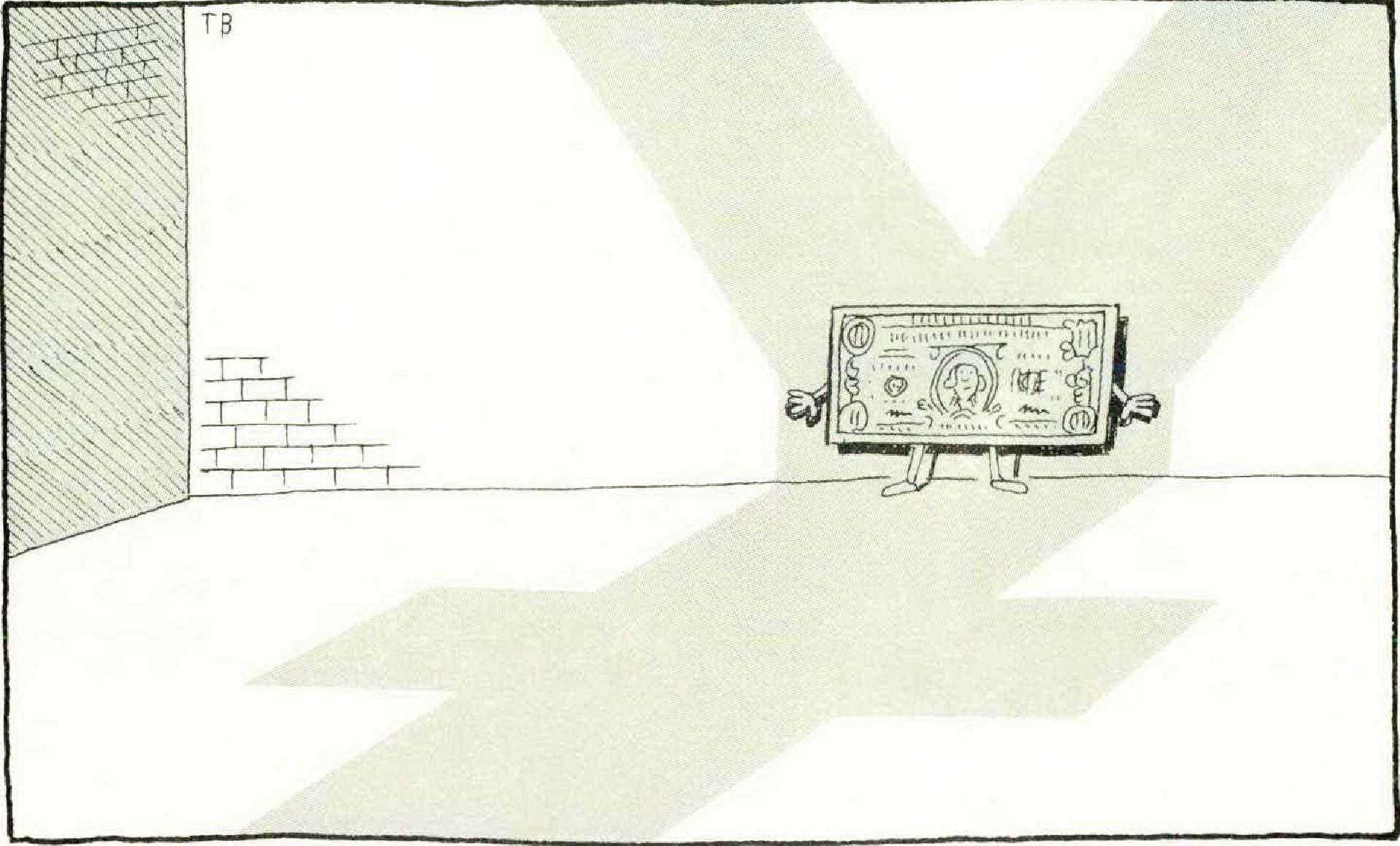
THE LONG DECLINE of the dollar may not be a fascinating subject, but at least the plot line seems clear. America keeps having big, ugly, evil trade deficits. If the deficits won’t go down, then the dollar must. The process is usually referred to as if it were either a law of physics or God’s judgment on a sinning tribe. (“For seven years shall your currency rise, then for seven years shall it fall and a plague of yen shall be upon you. . . . ”)
But on a recent, bankrupting trip to Tokyo, I saw a report that put the dollar’s changes in a less moralistic yet weirdly more alarming perspective. Unfortunately, the analysis was prepared by Kenichi Ohmae, the director of the Tokyo office of McKinsey and Company, a consulting firm, along with Akira Kameyama and Toshiki Sumitani, also of McKinsey. Ohmae has become about the most quoted man in Japan, and I feel sheepish cribbing from his work again. But Ohmae has a knack for dramatizing tired economic questions—it was he, for example, who popularized the notion that the inefficient-though-much-revered Japanese rice farmer, by using up so much of the country’s scarce flatland, was condemning everybody else in Japan to life in miserable little “rabbit hutches.” He’s done something similar with the dollar and the yen.
Ohmae’s main point is that what we’re seeing on the currency markets is not a market phenomenon—or, more precisely, not one based on market pressures in the “real” economy. Neither the wild week-to-week fluctuations in the dollar’s value nor its overall stonelike descent against the yen (and deutsche mark) can be explained by developments in the American or the Japanese (or the German) economy, he says.
The standard, Ec. 101 interpretation of the dollar’s descent is based on trade flows—in particular, on the U.S. trade deficit. Everyone can understand the basic logic. The Japanese sell more to America than they buy; they wind up with extra dollars; and when they take those surplus dollars to the bank to trade them in for yen, the pressures of supply and demand push the dollar down. (To spell out what happens in the supply-demand stage: Lots of people worldwide are trying to trade in dollars, because so many have earned dollars through exports to the United States. Few have yen to trade, because so few have managed to export to Japan. To clear the market, people must offer more and more dollars for fewer and fewer yen.)
This sounds commonsensical, Ohmae concedes, but it cannot possibly be the reason for what has happened to the dollar. Over the past two and a half years America’s trade deficit with Japan has averaged about $5 billion a month. This would presumably leave the Japanese with 60 billion extra dollars a year to trade back for yen, assuming (incorrectly) that they did not hold on to any of those dollars to invest in American bonds or real estate. This $60 billion overhang, in turn, is presumably the main force that has pushed the yen up and the dollar down—it would have to be, if trade deficits really were setting currency values.
The problem with the trade-deficit theory is that $60 billion is simply not enough money to have changed the supply-demand equation. The foreign-exchange markets in London. Tokyo, and New York aren’t processing a mere $60 billion a year; they handle an average of $200 billion a day. Ohmae estimates that of this total, at most one tenth, or $20 billion a day, might be necessary to finance all the “real” transactions among the United States, Europe, and Japan. Imports, exports, investments, dividends, loans, SONYs, Porsches, Boeings, wheat, tuna, wine, tourism, T-bills, troops, mergers, takeovers, acquisitions—everything that international economics is supposed to be about might together come to $20 billion a day. The other 90 percent, Ohmae says, is purely speculative trading, driven not by deficits or changes in “competitiveness” but strictly by hopes of profit on the endless shifts in currency rates. Ohmae says that changes in the real economy of trade and investment might have been enough to push the dollar down from its overvalued starting point of more than 250 yen in 1985. It’s the other nine tenths of the daily trading that turned a gradual descent into a rout, pushing the dollar to 120 yen late in 1987 before it momentarily “recovered” to 130. But what stimulated all that speculation? Why was everyone betting against the dollar all at once?
CONCEIVABLY, ANOTHER force from the real economy could have convinced speculators that the dollar had to fall: the production-cost gap between America and Japan. Japanese factories have modernized, robotized, and economized, as everyone knows. If it costs “too much” to make a ton of steel in America (compared with what it costs in Japan), a weaker dollar will make it cost less. So perhaps the dollar’s fall has been a natural, inevitable, evening-out process, an homage to Japan’s faster-growing productivity.
But this explanation doesn’t stand up either, Ohmae says. An endaka (“highyen”) exchange rate, 120 or 130 to the dollar, might equalize Japanese and American production costs for a few items in which Japan is the miles-ahead leader, such as fax machines and compact-disk players. But for a much larger number of products this rate makes Japanese costs unrealistically high. The U.S.-Japan “equilibrium” rate for producing cars is probably about 180 yen to the dollar, Ohmae says. For beef, in which Japanese production is absurdly inefficient, 320 yen. For tires or engines, 200 or more. When Ohmae released an early version of his paper, last summer, the dollar was worth 140 yen. By that stage, Ohmae said, the yen was already overvalued for Japanese production as a whole. It already cost “too much” to make TVs, pianos, and a host of other products in Japan. Ohmae said that if you averaged out the equilibrium rates for a variety of products, weighted for importance, you’d conclude that the dollar should have been worth 170 to 180 yen at the end of last year. But the dollar didn’t bounce back once it hit 140. It kept heading down.
What about the remaining candidates from the realm of real economics—purchasing power and standard of living? Exchange rates constantly flex to offset inflation and keep living standards in perspective. The average Mexican may be earning twice as many pesos as he did last year, but he’s not twice as well off. As Mexican inflation goes up, the peso goes down, and through the exchange rates we end up with a realistic idea of how Mexico is faring. Maybe something similar has happened to America and the dollar.
But in fact “purchasing power” does even less than “production costs” to explain why the dollar is so weak against the yen. As the dollar falls, Americans automatically look poorer relative to Japanese. When the dollar is valued at anything under about 160 yen, Japan’s per capita income, converted into dollars, works out to be higher than America’s. On paper, then, the average Japanese is now much better off than the average American. But of course that’s only on paper. In the real world of houses, food, cars, clothes, the average Japanese is obviously much worse off than the average American. Because land and housing prices have shot up so much faster than income, he’s worse off than he was before the age of the mighty yen.
The “right” rate for the dollar, based on production costs, might be 170 to 180 yen, but the right rate based on purchasing power would be even higher, Ohmae says. If you wanted the price of a large, American-style refrigerator to be the same in the United States and Japan, you’d have to value each dollar at 335 yen. (To put it another way: with the dollar worth about 125 yen, as it was this spring, a $500 refrigerator would cost almost $1,300 in Japan.) To equalize the price of housing, a dollar should be worth 260 yen, of electricity 198 yen, of (made-in-Japan) color TVs 181 yen. In fact, every consumer item Ohmae studied indicated that the yen should be weaker than it now is, and the dollar stronger, to make living costs in the two countries comparable.
There is a lot more in Ohmae’s paper. In addition to discussing what he calls the “trading fundamentals”—purchasing power and production costs—he shows why the “financial fundamentals,” especially interest-rate spreads between one country and another, shouldn’t have pushed the dollar down so far. His argument, though, can be boiled down to this: the real economics of trade, productivity, and purchasing power can explain why the dollar is no longer worth 259 yen, its peak in 1985, but it cannot explain why the dollar ever went below 170 to 180 yen. It crossed that threshold in the late spring of 1986 and, with bliplike exceptions, has been falling ever since. Nor can the real economy explain why the change was so sudden. Calculating in dollars (which is how most international comparisons are, for the moment, carried out), Japan in 1988 is twice as valuable as it was in 1985. Its factories have twice the output, its people have twice the wealth, its banks have twice the assets, items in its stores command twice the price. Of course, nothing real in Japan has changed that much, that fast. Japan’s banks, for instance, have “surged” to international eminence largely because their holdings are now converted to dollars at 120 to 130 yen, rather than at 250.
“The two countries’ ‘fundamentals’ obviously do not switch position so dramatically in such a short term,” Ohmae writes in his paper. “What has changed 180 degrees during the recent period is the American government’s fundamental belief.” And this, Ohmae says, is the only plausible explanation for what has happened to the dollar and the yen.
THROUGH THE FIRST five years of the Reagan Administration the United States embraced what Ohmae calls the “strong dollar-strong America” policy. The government wanted to keep the dollar strong and stable. The dollar’s strength helped kill inflation, by making imports cheap, and its stability attracted the foreign investment America needed to cover its budget deficit and other capital needs. The policy worked, but its side effect was the enormous trade deficit. To deal with that, the United States switched late in 1985 to the “weak dollar-competitive America” policy. American officials began “talking down the dollar,” to make American-made products more attractive. Ever since then, Ohmae argues (using evidence too complicated to go into here), political pressures from the United States, rather than real economic developments anywhere in the world, have made it safe to bet on a falling dollar.
Without the force that Ohmae calls the “political paradigm”—the U.S. government’s clear desire for a weaker dollar and thus (it hopes) a smaller trade deficit—speculation could never have taken the dollar so far beyond what real economic forces dictate, Ohmae says. In ordinary circumstances the foreign-exchange market is a ruthless zero-sum game. When the stock market rises, everyone can (on paper) get richer at the same time, but in foreign exchange every pfennig someone gains someone else must have lost. The brutal simplicity of this process keeps exchange rates relatively honest. “It is the fear of losing that makes the market recover its sense of balance,” Ohmae says.
But because of the political paradigm, some of the normal, chastening fear has been removed from the currency market. As long as the U.S. government sees trade deficits as an urgent problem and a cheap dollar as the solution, it’s safe for everyone else to ignore economic fundamentals and bet on a falling dollar. Whenever the monthly U.S. trade figures fail to show that the deficit is shrinking, the market goes into a tizzy of dollar-selling. That is not because of the deficit itself, Ohmae argues (reminding us that the surplus dollars America emits because of its trade deficit amount to less in a full year than one day’s trading on the currency exchange), but because of the purely political impact in the United States. If next month’s deficit looks “bad,” American politicians will want the dollar to keep going down. Anybody with a brain will sell dollars and buy yen.
At this point I should mention the part of Ohmae’s argument least likely to persuade the average American. Ohmae says that the political paradigm that persuaded speculators to keep betting against the dollar never had to exist. The U.S. government did not have to talk the dollar down, he says, because American trade deficits are not in themselves a problem—and even if they were, a cheap dollar wouldn’t fix them.
Ohmae’s deficits-don’t-matter argument is not incompatible with the view, frequently expressed in these pages, that Japan tends naturally toward big, protectionist trade surpluses because of the way its government acts and the way its people are. He agrees that in countless ways Japan artificially discourages imports and makes the Japanese consumer live a needlessly grim, austere life. But, Ohmae says, Americans should view this as Japan’s problem, not America’s. Both countries would benefit from becoming one integrated economic unit, he says—and Americans are better off because more of them act as if the merger were already complete. American consumers buy Japanese products, and American companies set up subcontracting plants in Japan. This is America’s glory, Ohmae says, not its shame. So long as Americans are employed and their incomes are rising, the U.S. government shouldn’t fret over monthly deficits any more than it worries about “deficits” between California and Colorado. And the flood of money into the United States, under Japan’s “Buy America!” campaign, can be good for both sides, he says. It links the two countries in an economic and strategic partnership, by far the strongest in the world.
From what I’ve seen of Ohmae since first meeting him three years ago, I don’t think he’s just trying to lull America into false complacency (as if the real kind weren’t enough) with this argument. He believes it and asserts it sincerely. (He hews to the conventional wisdom in saying that the U.S. federal budget deficit is a problem and needs to be controlled.) But suppose he’s totally wrong. Suppose that his idealistic “beyond national borders” argument falls apart because most Japanese are nowhere near as broad-minded as Ohmae and will never willingly let foreigners share power in their companies, universities, society. Suppose, therefore, that trade deficits and foreign debt really are problems for America. Even then, Ohmae says, an extremely weak dollar is the wrong solution. It doesn’t fix what’s broken, and it makes new troubles we could otherwise avoid.
If exchange rates were a good answer to modern trade imbalances, presumably things should have started improving when the dollar sank below the production equilibrium level of about 180 yen—which it did almost two years ago. But in fact the U.S. deficit with Japan was still rising when the dollar was bumping around between 120 and 130 yen. The rate has finally gone.w low that it is having some brute-force effect, but Ohmae staunchly maintains that it will never be as effective as many Americans hope. The American companies that took their plants overseas have been very slow to bring production back, despite the cheap dollar (and the influx of Japanese investment). After all, the rate might change next year—and in any case, the Korean won, the Malaysian ringgit, the Thai bhat, and the Mexican peso (the currencies in places where American corporations are putting new production plants) are still very cheap. “Industries tend to cluster to gain competitiveness and flourish as a whole, as in the case of aerospace in the U.S., chemicals in Germany, and cameras and consumer electronics in Japan,” Ohmae says. “It takes decades to build up the infrastructure. . . . [Currencies] seem to hit the highs (or lows) every two years. Plants can’t be moved around at this pace.”
That is, if the United States is really worried about trade deficits, as Ohmae says it should not be, by his logic it will have to do something much more direct than just jimmying the exchange rates. It will have to match the Japanese by behaving like them: limiting foreign investment, setting up domestic cartels, gumming up the distribution system so that foreigners have a harder time penetrating it, and, of course, training a whole new cadre of people who want to manage manufacturing plants. Otherwise, a weak dollar may drive industries out of Japan but it won’t bring them back home, Ohmae contends. We have to decide which worries us more: the debts we’re building up now or the steps we’d have to take to reduce our debts.
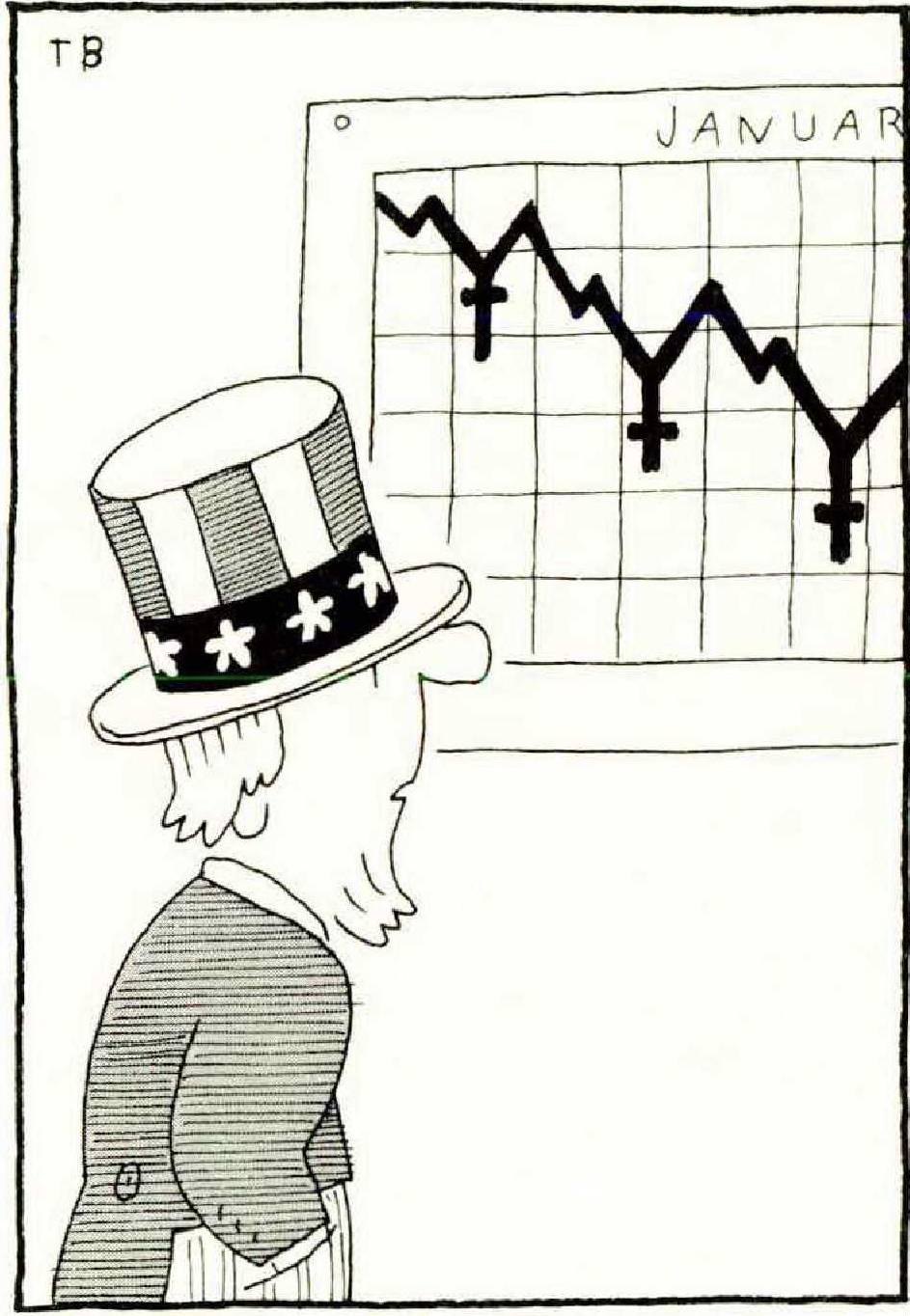
Even if Americans don’t buy Ohmae’s “Please calm down” analysis of U.S. trade deficits, his argument that the dollar has fallen much too far seems very powerful. Ohmae goes on to emphasize in his report the damage the cheap-doilar policy has done the United States. The risk of huge currency losses scares off foreigners who otherwise would be happy to keep investing in the United States—and fear that the Japanese will pull out their money gives American investors a hair-trigger outlook on the U.S. stock market. At the same time, the cheapened dollar offers Japanese and Germans a half-price sale on existing American companies and assets. The wild swings in exchange rates make currency speculation potentially far more profitable than real investment. A Japanese investor could have made six percent, in dollars, during 1987 if he’d put his money in an American bank, and maybe 15 or 20 percent if he’d chosen a good real-estate investment. If he’d kept his money in yen and stuck it in his futon, he’d have earned a dollar profit of 40 percent. The wild swings also leave governments helpless to control exchange rates through “normal” means. The United States has put an armlock on Germany to reduce its banks’ interest rates, so that money will flow into American banks, which offer a better return, and therefore into dollars. At one extreme moment last year some American interest rates were six points higher than those in Japan. That was an enormous spread, but even it did not draw enough money into American banks to stop the dollar’s collapse. “Profit-making opportunities on the exchange itself could be at over 50 percent per year,”Ohmae says. “Interest is not interesting any longer, and central banks are becoming irrelevant.”
Ohmae’s prescription for these ills is a happy change from most save-the-economv manifestos. He says that governments, especially America’s, can bring currency rates back to sanity only by resolutely doing nothing. In saying so, Ohmae is not recommending that governments stick to their current policies— not even the policy that “the dollar has fallen far enough,” which the United States switched to early this year. From now on, he says, governments, policymakers, and frequently quoted scholars should volunteer no opinion whatsoever about proper exchange rates. Then and only then, he says, will the speculative frenzv end.
The money traders are basically cowardly people by virtue of the fact that it is a high-risk, zero-sum game. They can be likened to a scared swimmer whose toe must touch the bottom of the river bed. However, if experts and authorities say that he can go deeper and enjoy a faster flow without fear, he’d be tempted. The lack of such advice, on the other hand, will scare him enormously, and he, as well as his colleagues, will tend to swim back to the shoreline.
Back at the shoreline, according to Ohmae’s logic, the dollar should have been worth 170 to 180 yen at the beginning of this year. (The longer it stays at depressed rates, he says, the lower the real rate becomes, because that many more plans, investments, and trades have been made at the cheap rate. This spring he said that months of trading at 120 to 130 yen might have pushed the real rate to 160 or so.) But nobody in the government should say that the dollar is too low, Ohmae says. Governments shouldn’t say anything when asked about their currencies. They should let the traders make the decisions and take the risks. When that happens, the real economy wall start to matter again.
—James Fallows