
Never Call Retreat
“Battle Hymn of the Republic,” first published in The Atlantic in 1862, still endures as a sacred national song, Jake Lundberg argued in the July issue. To mark the 250th anniversary of America’s founding, we featured the poem on that issue’s cover.

Explore the November 2026 Issue
Check out more from this issue and find your next story to read.
Sometimes it’s the cover of the magazine that gets me. The July issue, featuring the music for “Battle Hymn of the Republic” on the cover, sat on my piano and was played loudly and often.
Laura Cardinal
Hereford, Ariz.
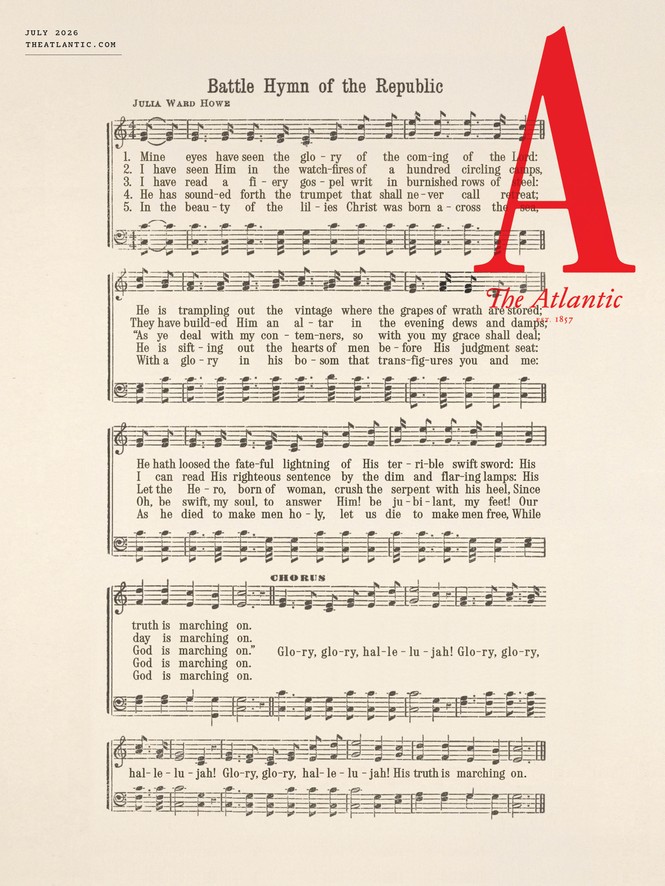
“Battle Hymn of the Republic” is a fitting choice for a celebration of America’s 250th anniversary. The literary scholar Elaine Showalter wrote a comprehensive biography of its author, The Civil Wars of Julia Ward Howe. The title is a reminder that Howe fought her own battle for equality and a public voice even as she gave the nation its most enduring hymn. In inscribing my copy of the book, Showalter wrote: “Julia’s motto was ‘Up to Date!’ Good words for us as well.” That The Atlantic has chosen to celebrate her again, 164 years after first publishing her poem, suggests that the motto belongs to this magazine as much as it did to her.
Sandy Shapiro
Washington, D.C.
Jake Lundberg’s story, “Never Call Retreat,” about the history and endurance of “Battle Hymn of the Republic,” begins with the observation that we seem to have two national anthems: not only “The Star-Spangled Banner,” but also the “Battle Hymn.” To my mind, we actually have three, and I was surprised by the omission of “Lift Every Voice and Sing,” often called the Black national anthem. It was composed in 1900 as a poem by James Weldon Johnson, and his brother, J. Rosamond Johnson, set it to music. The song, unlike the other two, makes no reference to war and embraces both the sorrow and the majesty of our shared life as Americans. In my church, we sing this beloved anthem as our opening hymn once a month.
Donna Jane Krupkin
Nashville, Tenn.
Jake Lundberg argues that the United States has two national anthems—one official, “The Star-Spangled Banner,” and another unofficial but sacred, Julia Ward Howe’s “Battle Hymn of the Republic.” I would add a third: John Newton’s “Amazing Grace,” a hymn that serves as a spiritual national anthem and provokes deeper introspection into our country’s struggle to abolish slavery.
Newton wrote the words to “Amazing Grace” in 1772, 42 years before Francis Scott Key wrote “The Star-Spangled Banner.” Whereas I see the “Battle Hymn” as the battle cry for action in the abolitionist cause, “Amazing Grace” was and remains the soulful anthem for those seeking freedom.
I pray that a resurgence of “Amazing Grace” and the “Battle Hymn” over the airwaves and in our communities may lead our nation down a new path toward real freedom for all Americans.
Jerry Albritton
Brandenburg, Ky.
“Never Call Retreat” provides interesting historical background on the origins of “Battle Hymn of the Republic” and the song’s enduring place in American life. But I take issue with the suggestion that the “Battle Hymn” should be regarded as an unofficial national anthem.
Our official national anthem is already battle-themed. Do we need yet another war-inspired song, especially one that implies a specifically Christian God?
I would argue that “America the Beautiful,” which celebrates the grandeur of our country and evokes the principles of our founding documents, ought to be our national anthem.
Owen Jansson
Ann Arbor, Mich.
The “Battle Hymn of the Republic” has been sung at many solemn occasions. I was introduced to it as a 15-year-old while watching Winston Churchill’s funeral on television on January 30, 1965, at St. Paul’s Cathedral in London. During the service, mourners listened to the glorious sound of the “Battle Hymn,” projected by a huge choir. It was a truly moving experience, and one I won’t forget. The hymn, I later learned, had been performed at Churchill’s request.
Nigel Clements
Mississauga, Canada
My father, Richard P. Condie, directed the Mormon Tabernacle Choir from 1957 to 1974. “Battle Hymn of the Republic” always reminds me of his collaboration with Eugene Ormandy and the Philadelphia Orchestra. While my father was preparing for a recording with the orchestra for Columbia Records, he called Ormandy at 2 a.m. and asked him to look at the score of the “Battle Hymn.” Days later, Ormandy called back and said he wasn’t “excited” by the idea and wasn’t sure it would be good. However, at my father’s insistence, Ormandy relented and agreed to include the song on the recording.
In 1959, the Mormon Tabernacle Choir’s “Battle Hymn of the Republic” became an unlikely hit, reaching No. 13 on the Billboard Hot 100, where it remained for 16 weeks. My father won a Grammy for the performance the following year. The recording catapulted the choir and orchestra to prominence and forged a lifelong collaboration and friendship between my father and Ormandy.
The lyrics of the “Battle Hymn” speak to the eternal truths of the human soul. Perhaps that’s what my father realized when he called Ormandy that night. If only we as a nation would take Julia Ward Howe’s words to heart: Be transfigured; overcome hatred, evil, and vengeance with forgiveness, love, and charity; and embrace the divine potential of the human soul. Then, I think, we could say with confidence that “His truth is marching on.”
Jeanette Condie Pearson
Salt Lake City, Utah
Jake Lundberg replies:
I want to thank our readers for this thoughtful collection of letters. “Battle Hymn of the Republic” addressed the gravest crisis in our history in the dire biblical idiom that was familiar to many northern tongues when Howe wrote it at the end of 1861, and to which Abraham Lincoln would give fullest expression in his second inaugural address four years later. In its many afterlives since its publication, the “Battle Hymn” has proved to be a capacious vessel for arguments over the American idea. It’s true: Its imagery is stark and violent, and some of its strains through time have been dark. But in their best application, Julia Ward Howe’s words—set to the thumping tune of a marching song about the militant abolitionist John Brown—call on us to stand up for our highest ideals, all the more so in moments of crisis.
Behind the Cover
In this month’s cover story, “Choose Your Overlord,” Josh Tyrangiel reports on the race between Jeff Bezos and Elon Musk to shape humanity’s future beyond Earth. Because of their immense wealth, Tyrangiel writes, the two mercurial billionaires now wield a degree of power traditionally reserved for nation-states. For our cover image, the artist Thomas Burden rendered Bezos and Musk as dueling action figures hurtling into space.
— Colin Hunter, Art Director

This article appears in the November 2026 print edition with the headline “The Commons.” When you buy a book using a link on this page, we receive a commission. Thank you for supporting The Atlantic.