The Oscars Have Never Ended Like This
Moonlight won Best Picture, but only after La La Land was mistakenly announced as the winner.
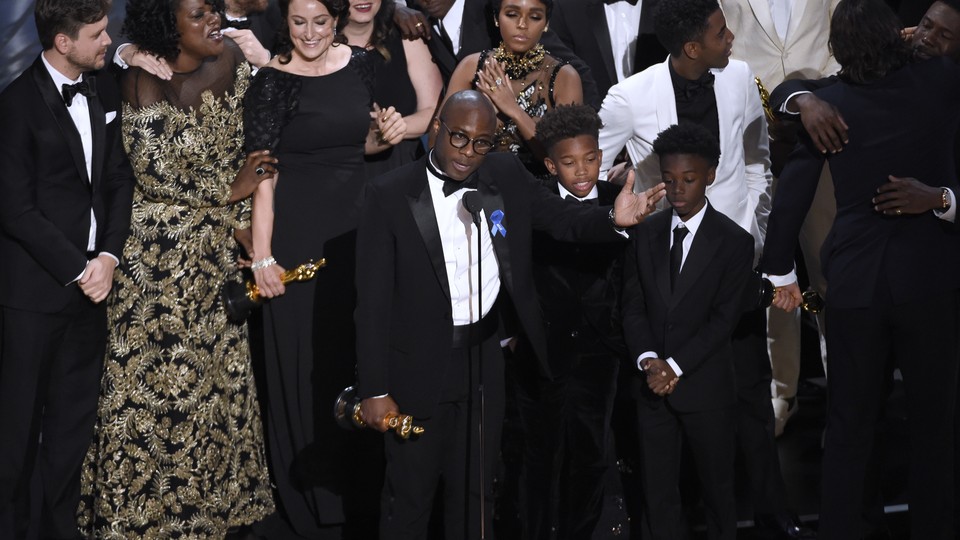
A largely predictable Oscars ceremony ended in the most stunning way possible, as Moonlight was named Best Picture—but only after the producers of La La Land took the stage, gave their speeches, and then were interrupted with the news that the wrong envelope had been opened. The final moments of the 89th Academy Awards are likely to be pulled apart and obsessed over for generations; it was the epitome of live television, the kind of epic screw-up that dreams are made of. Perhaps it was fitting for such a surprising win: For most of the night, La La Land’s victory seemed obvious as it collected six trophies, including Best Director.
But it was Moonlight that won the final trophy of the evening, snagging three Oscars in all (including Best Supporting Actor for Mahershala Ali and Best Adapted Screenplay). Its victory represents a hugely unexpected triumph for the writer/director Barry Jenkins, and the indie studio A24. That a film about a young gay African-American boy growing up in Miami, made for $1.5 million by a filmmaker with only one minor feature to his name, could break through over a throwback showbiz musical that has grossed $140 million and counting at the box office was unanticipated, to say the least.
Some analysts will surely argue that Moonlight’s triumph speaks to the efforts of Academy President Cheryl Boone Isaacs to diversify the Oscar voting body, after controversy erupted over its all-white acting nominee slate last year. But though Isaacs has enacted serious reforms at the AMPAS, the voter makeup did not significantly shift this year (only growing younger and more diverse by a few percentage points); her efforts were focused on longer-term changes. La La Land was probably done in by fatigue over the perception that it would sweep, not helped by its record-tying 14 nominations; that was the same expectation that undid Saving Private Ryan at the 1999 ceremony (it lost to Shakespeare in Love).
La La Land was still the night’s big winner with six trophies (Best Director, Best Actress for Emma Stone, Best Cinematography, Best Score, Best Song, and Best Production Design). World War II drama Hacksaw Ridge won for Best Editing and Best Sound Mixing, Kenneth Lonergan’s dark drama Manchester by the Sea took Best Actor and Best Original Screenplay, and Viola Davis was named Best Supporting Actress for her work in Fences, giving one of the night’s most memorable speeches. In the end, though, this ceremony won’t be defined by that, or by Jimmy Kimmel’s performance as host, or even (as some expected) by the barrage of political speeches and jokes aimed at the Trump presidency. It’ll be remembered for that final, far-out moment, and its awkward, but unexpectedly heartwarming, conclusion.