Donald Trump's Disastrous Debate
The Republican nominee needed to turn around his campaign. Instead, he threatened to jail his opponent.
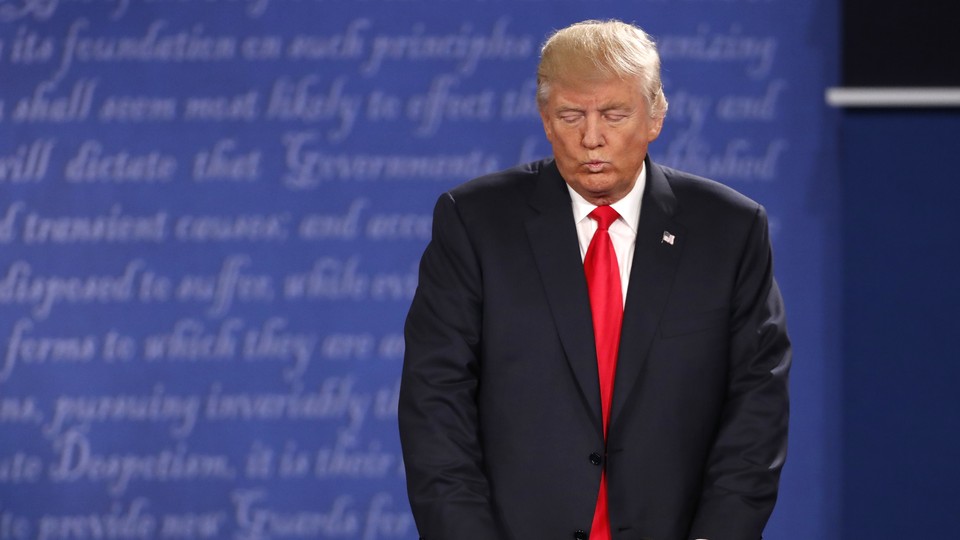
Throughout his presidential race, Donald Trump has been the NASCAR candidate: The press and voters seem riveted by his campaign because there’s no telling when there might be a dramatic crash.
For anyone tuning in for that reason, Sunday night’s second presidential debate was just the ticket: a fiery, multi-car pileup. Trump meandered around the stage restlessly, delivered long strings of misleading statements, feuded with the moderators, and promised to prosecute a political rival if he won the race. He openly slapped down his running mate, Mike Pence, over Syria policy, saying, “He and I haven't spoken and I disagree.” In perhaps the most surreal moment of a surreal evening, moderator Anderson Cooper had to tell a major-party nominee for president, “You bragged that you had sexually assaulted women. Do you understand that?”
The Republican candidate, in the middle of the worst stretch of an often-turbulent campaign, was peevish and erratic, frequently interrupting his opponent. He seemed even more ill at ease than he had during the first debate. Once again, he inhaled noisily over the microphone. And once again, he delivered a string of inaccurate statements. With Republicans abandoning Trump in droves just 29 days before the election, Trump seemed content to drive all of them off—perhaps even his own running mate.
And that doesn’t even get to Trump’s bizarre pre-debate press conference with three women who accused former President Bill Clinton, Hillary Clinton’s husband, of sexual misconduct, as well as a fourth woman whose rapist Hillary Clinton represented in court. The four women also attended the debate and sat with the Trump family.
In a highly unusual breach of protocol—if not a great shock—Trump and Clinton did not shake hands at the start of the debate, and the mood only got more acrimonious from there. The first question to the candidates, from a teacher, was about whether the candidates were setting an example they would want American schoolchildren to emulate. Clinton, starting off, answered the question with an anodyne statement of positivity. She did not bring up the recently released video of Trump bragging about sexually assaulting women. Trump, answering second, offered a quick litany of ills he said were plaguing the nation.
Only then did the video come up. Trump offered no apology for his remarks, continuing to insist they were little more than “locker room” conversation. Cooper had to ask Trump five times whether or not he had actually sexually assaulted women before Trump denied it.
Clinton pounced. “With prior Republican nominees for president, I disagreed with them, politics, policies, principles, but I never questioned their fitness to serve. Donald Trump is different,” she said. “What we all saw and heard on Friday was Donald talking about women, what he thinks about women, what he does to women, what, and he has said that the video doesn't represent who he is. But I think it's clear to anyone who heard it that it represents exactly who he is because we've seen this throughout the campaign.” She also brought up remarks Trump had made about Muslims, African Americans, immigrants, and others.
Trump, for his part, tried to deflect attention away from himself and toward Clinton’s husband. “If you look at Bill Clinton, mine are words and his were actions,” Trump said. “There's never been anybody in the history of politics in this nation that's been so abusive to women.” Hillary Clinton mostly declined to take the bait, quoting Michelle Obama’s maxim that “When they go low, you go high.” She demanded that Trump apologize to Khizr and Ghazala Khan, Judge Gonazlo Curiel, disabled reporter Serge Kovaleski, and President Obama, for “the racist lie” that he was not born in the United States. Trump insisted that the slur had originated with Clinton’s 2008 campaign, a claim that has been debunked, and is also largely beside the point.
That exchange set the tone for the rest of the night. The two rivals took opposite approaches. Clinton dredged up Trump’s prior comments in strategic strikes. Trump, meanwhile, paced the stage, irritated, interrupting her. Clinton made an effort to address the audience, both at home and at Washington University in St. Louis, while Trump spent much of the night addressing Clinton directly. His approach was one of quantity, throwing as many attacks against Clinton as possible. During a discussion of tax policy, Trump demanded to know why she had not closed the carried-interest loophole while serving as a senator from New York. A grinning Clinton delivered a zinger straight out of Schoolhouse Rock: “You know, under our Constitution, the president has something called veto power.”
A few minutes into the debate, discussing Clinton’s use of a private email server while secretary of state, Trump promised, “If I win, I am going to instruct my attorney general to get a special prosecutor to look into your situation,” adding that if he were in charge, “you would be in jail.” While the campaign has seen numerous incidents of Trump aides suggesting the sort of political retribution more common in banana republics, the specter of one candidate promising the prosecution of the other was unprecedented.
Several questions later, Trump took the opportunity to prove Clinton’s point about Muslims. When a Muslim woman stood up and asked the candidates what they would do about Islamophobia, Trump promptly turned the question around, blaming American Muslims for not informing law enforcement about potential terrorist activity in their midst. In other words, asked about Islamophobia, Trump blamed Muslims. Of refugees, he added, “This is going to be the great Trojan horse of all time.” But Trump said he no longer supports a blanket ban on Muslims entering the country, replacing it with a nebulous idea of “extreme vetting.” Trump has not explained how his new vetting would differ from the existing process of screening refugees.
The debate was not long on policy, as questions about the Affordable Care Act and the war in Syria demonstrated. Clinton said that while the country might have been better off with non-employer-backed health insurance, she preferred to fix flaws in the law that President Obama signed, and she recited its most popular provisions. She did not specify what her fixes might be. Then Trump came up. His answer was a meandering mess. Asked how he would guarantee coverage for people with preexisting conditions, he promised to allow the sale of insurance across state lines and block-grant Medicaid to states. Both proposals are popular among conservatives, but he was unable to say what they had to do with guaranteeing coverage to people with preexisting conditions.
Syria wasn’t much better. Clinton’s main answer to a question about how she’d act proceed than President Obama was to institute a no-fly zone. If her answer was vague, Trump’s answer was nonsense. He assailed Clinton and Obama, but couldn’t say what he’d do differently. Moderator Martha Raddatz repeatedly pushed Trump to answer what his own strategy would be. “I want to remind you what your running mate said,” she said. “He said provocations by Russia need to be met with American strength.” That’s when Trump answered that he had not discussed the matter with Pence and did not agree.
Trump once again refused to release his tax returns until an audit is completed, and he insisted he had paid taxes. But he also appeared to confirm that he had used a $916 million loss in the 1990s to avoid paying personal income taxes. "Of course I did," Trump said. He added, of another way real-estate investors can reduce their tax bill, “I love depreciation.”
Trump’s dizzying performance overshadowed several perilous moments for Clinton. The email issue continues to be a weakness, and she apologized once again on Sunday for using it. (Trump, apparently forgetting that this was a town-hall debate, sniped at Cooper, asking why he didn’t bring it up.) She also had to answer questions about what appear to be excerpts from paid speeches she made to banks, released by WikiLeaks in apparently hacked emails. Clinton has refused to release the speeches. In one excerpt, she said that “you need both a public and a private position.” During the debate, Clinton claimed that she was referring to the portrayal of Abraham Lincoln in Steven Spielberg’s biopic of the 16th president, and in particular the way he used different messaging in different ways to convince Congress to pass the 13th Amendment. Trump, meanwhile, mused nonsensically, “Maybe there is no hacking,” and said, “I know nothing about Russia.”
It was a microcosm of the campaign: Clinton is a weak candidate, with a train car’s worth of luggage trailing behind her. But Trump is weaker still, and at every turn, he seems to overshadow her problems with much deeper problems of his own—much louder gaffes, much more serious political errors. That has been a rather depressing spectacle for the nation. In the last question of the evening, a citizen asked earnestly if either could say what they respected about the other. It wasn’t pretty. Clinton deflected, a little. “I respect his children. His children are incredibly able and devoted, and I think that says a lot about Donald. I don't agree with nearly anything else he says or does, but I do respect that,” she said.
Trump wasn’t sure whether to be grateful. “I consider her statement about my children a very nice compliment. I don't know if it was meant to be a compliment,” he said. Then he offered his own backhanded compliment. “I will say this about Hillary: She doesn't quit. She doesn't give up. I respect that. I tell it like it is,” Trump said. “She is a fighter. I disagree with much of what she is fighting for. I do disagree with her judgment in many cases, but she does fight hard and she doesn't quit and she doesn't give up and I consider that to be a very good trait.”
And with that, it was, blessedly, over.
What does this fiery crash of a debate mean for the final month of the campaign? Trump is in deep trouble. His polling was already falling before the Friday release of the 11-year-old lewd video, and since then, dozens of leading Republicans have withdrawn their endorsements and called on him to leave the race. During the debate on Sunday, he was erratic, failed to land many blows, and humiliated his running mate on the Syria question. As for Clinton, her performance may not go down in the history books as one of the most sparkling debates, but it didn’t need to. She managed to remain above the fray, seeming calm, presidential, and poised as her rival roamed the stage and interrupted. Trump’s pugilistic performance may serve as a rallying point for his key supporters, but the Republican’s task right now is to staunch the bleeding and start winning over new voters, since he doesn’t currently have enough to win. There’s practically no prospect he made progress on that goal Sunday night.
—David A. Graham