The 2016 Emmy Awards Point to TV's Power
The ceremony’s nods to Donald Trump, O.J. Simpson, and diversity in Hollywood shone light on an industry that’s taking its influence seriously.
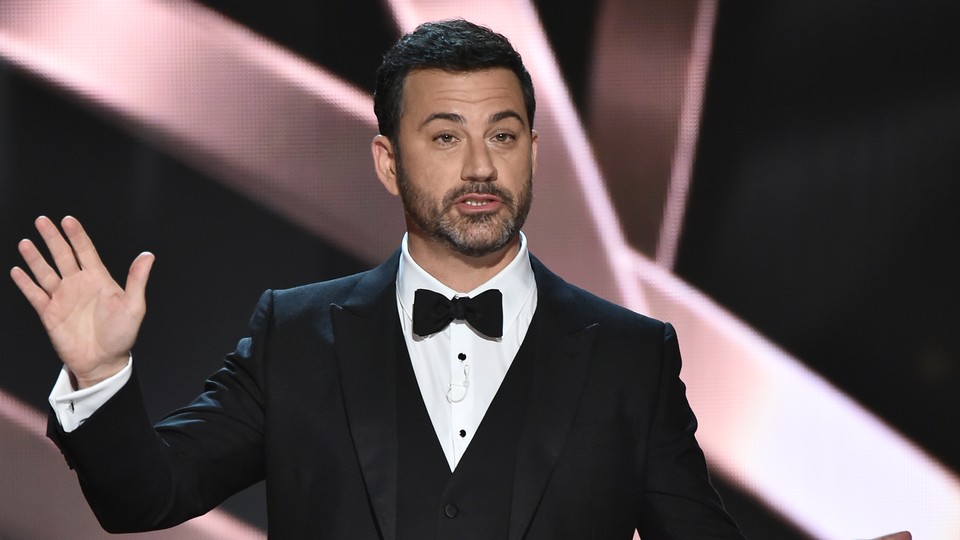
Jimmy Kimmel has cracked one of the great political questions of our time. “Many have asked, who is to blame for Donald Trump?” he said during his opening monologue for this year’s Emmy Awards. “And I’ll tell you who. He’s sitting right there. That guy. Mark Burnett, the man who brought us Celebrity Apprentice.”
Yes, Mark Burnett: the Hollywood super-producer responsible not only for Celebrity Apprentice but Survivor, Shark Tank, and The Voice. “Thanks to Mark Burnett, we don’t have to watch reality shows because we’re living in one,” Kimmel said. “If Donald Trump gets elected, and he builds that wall, the first person we’re throwing over is Mark Burnett.” Kimmel continued in that vein for a surprising amount of time, speculating that Burnett had been enacting a secret British plan to destroy America by giving Trump a platform.
It was all-in-good-fun taunting—albeit the kind that kind that can only happen in a room where overwhelming anti-Trump sentiment can be assumed. But it also gave voice to one of the underlying themes of this year’s Emmys: TV doesn’t want to think of itself as escapist, not right now. As the industry celebrated itself in a reasonably entertaining ceremony without too many gimmicks, gaffes, or upsets, it asserted that works of entertainment really can change the world.
Accepting the award for best actress in a comedy for the fifth year in a row, Julia Louis-Dreyfus made her own memorable reference to Trump—and to TV’s power. “I think that Veep has torn down the wall between comedy and politics,” she said. “Our show started out as a political satire, but it now feels like a sobering documentary. So I certainly do promise to rebuild that wall and make Mexico pay for it.” The line was delivered in a knowing tone, but all appearance of fantasy soon disappeared as Louis-Dreyfus stifled sobs and trembled while talking about her father, who died two days earlier. Veep would later win for best comedy.
The breakout newcomer television show of the year, FX’s The People v O.J. Simpson, picked up five awards, including best limited series. The fact that its star Sarah Paulson brought Marcia Clark as her date underlined the show’s of-the-moment interest in how media and entertainment influence the wider world and vice versa. Accepting the award for outstanding lead actress in a miniseries or movie, Paulson issued Clark a public apology on behalf of America:
The more I learned about the real Marcia Clark, not the two-dimensional cardboard cutout I saw on the news but the complicated, whip-smart, giant-hearted mother of two who woke up every day, put both feet on the floor and dedicated herself to righting an unconscionable wrong, the loss of two innocents—Ron Goldman and Nicole Brown—the more I had to recognize that I, along with the rest of the world, had been superficial and careless in my judgment. I'm glad to be able to stand here today in front of everyone and tell you: I'm sorry.
The most indelible moments surrounding comedies weren’t very comedic at all, coming in the form of hearty political speeches from Transparent’s creator, Jill Soloway (accepting a directing award), and Jeffrey Tambor (outstanding lead actor). Tambor said he’d be glad if he was the last cisgender man to play a transgender woman on TV, and that casting agents should be hiring far more trans actors. Soloway put forth similar ideas but also spoke of yet-grander ambitions. “When you take women, people of color, trans people, queer people, and you put them at the center of the story, the subjects instead of the objects, you change the world, we found out,” she said. The speech culminated with Soloway chanting, “Topple the patriarchy! Topple the patriarchy!”
Kimmel followed her by openly wondering whether toppling the patriarchy would be a good thing for him. This was his role throughout the night: lightly deflating the pretensions in the room, but ultimately focused on entertainment, moving things along, and making fun of himself (as in one bit where Matt Damon mocked Kimmel for losing in the variety talk category to John Oliver). His main mission seemed to be to make Maggie Smith feel bad for not attending the Emmys, despite having been nominated nine times (she won tonight, supporting actress in a drama for Downton Abbey).
While a few juggernaut shows commanded the largest share of attention, there were signs of vitality for the industry in the range of winners. The champion lead performers in dramas were both relatively new and exciting talents, Mr. Robot’s Rami Malek and Orphan Black’s Tatiana Maslany. The People v O.J.’s Sterling K. Brown taking a supporting actor prize over some bigger names from his own show (John Travolta and David Schwimmer) made for a warm-fuzzy moment, as did Courtney B. Vance getting recognized for his forceful turn as Johnnie Cochran. The sketch show Key & Peele grabbed accolades for its final season, and Kate McKinnion won a supporting-actress award, which felt like coronation for her as the current powerhouse of SNL.
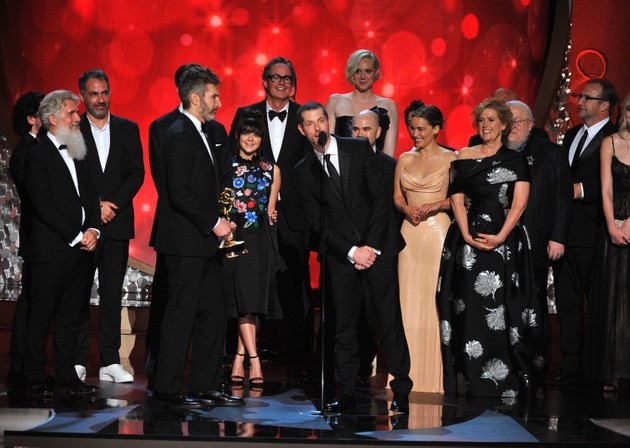
If The People vs. OJ and all the talk of Trump at times made the lines between real life and TV seem blurrier than ever, there was one inescapable presence reminding that fantasy still does have its place: Game of Thrones continued its reign of dominance, garnering writing and directing awards for its episode “The Battle of the Bastards,” not to mention taking home the top drama prize for the second year in a row.