'I Am Your Voice'
Donald Trump accepted the Republican presidential nomination and spoke of a dark, troubled, crime-riddled nation—that only he could heal.
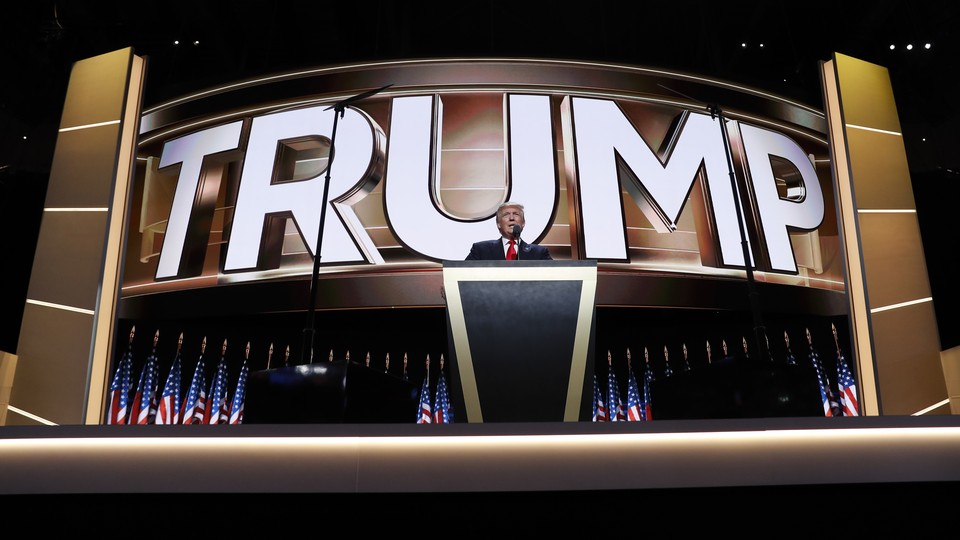
CLEVELAND—“I am your voice,” Donald Trump declared Thursday night, accepting the Republican nomination for president while describing a dark and dire vision of a troubled, crumbling, and crime-riddled nation whose problems only he could fix.
Speaking to a party feeling discouraged, angry, and disenfranchised by Barack Obama’s presidency; a party terrified of Hillary Clinton succeeding him; and a party that revolted against its leaders and political class to select the entertainer and developer as its nominee, Trump declared himself “the law-and-order candidate,” the latest in a series of borrowed slogans from the phrasebook of Richard Nixon, and he spoke with the ominous tones of the 37th president.
“Americans watching this address tonight have seen the recent images of violence in our streets and the chaos in our communities,” Trump told attendees at the Republican National Convention in Cleveland. “It is finally time for a straightforward assessment of the state of our nation. I will present the facts plainly and honestly.”
Trump, who uncharacteristically spoke from a teleprompter, seldom straying from the script with his trademark asides, argued that his own wealth and role inside the firmament of the American elite make him especially qualified to fix what ails the nation—in fact, uniquely qualified.
“I have joined the political arena so that the powerful can no longer beat up on people that cannot defend themselves,” he said, casting himself as a defender of downtrodden ordinary Americans. “Nobody knows the system better than me, which is why I alone can fix it.” He accused the business, media, and financial elite of lining up behind Clinton in order to “keep our rigged system in place.” And he sweepingly rejected the identity politics that the American left has adopted in recent years, promising to end the era of “political correctness.”
On foreign policy, Trump offered a message of strength through retrenchment, insisting that America must both project power on the world stage but also draw down on global commitments, making allies in NATO and other alliances contribute more to their own defense. “Americanism, not globalism, will be our credo,” he said.
Fittingly for a campaign driven more by personality than by policy, Trump’s speech Thursday was singularly—and perhaps excessively—focused on himself as a messianic figure. He said that “there can be no prosperity without law and order,” but he did not provide any specific policy prescriptions, saying only that problems “can be fixed so easily.” He offered very few specific policy ideas, namely building a wall on the U.S. border with Mexico and suspending “immigration from any nation that has been compromised by terrorism” until new vetting procedures are in place. That proposal notably omitted any mention of Islam, although previous iterations of the idea have specified barring Muslims.
Trump strongly assailed his opponent, Clinton, the presumptive Democratic nominee. He painted her as the architect of chaos overseas and proponent of failed policies stateside. But when the crowd in the Quicken Loans Arena began to chant, “Lock her up!” as they have many times throughout the convention, Trump waved them off. “Let’s defeat her in November,” he said.
The evening was the high point of a surreal journey that began more than a year ago when, against the expectations of nearly every observer and the counsel of nearly every poll, Trump entered the Republican race for president, throwing his lot in against the largest and reputedly most talented GOP field in decades. Sequentially knocking those rivals out one by one, he overcame massive resistance from the party’s establishment to become its standard-bearer.
In the Quicken Loans Arena, a sea of Republicans cheered and waved signs. Full for the first time in four nights, the hall was dotted with the now-iconic red and white Make America Great hats and Day-Glo yellow RNC 2016 caps. Some delegates wore “No 3rd term” pins on their lapels, a nod to the talking point that a Clinton presidency would represent a continuation of the much-loathed Obama years. On the packed convention floor, nearly every attendee sported a sticker reading, “Defeat Hillary—Vote Trump.”
The order of those priorities was telling. Trump’s speech aside, the convention has focused heavily on the universal dislike that attendees felt for Clinton—a useful rallying point for a convention that was otherwise riven with disagreement and recrimination. Other speakers Thursday kept their focus on Clinton, and when businessman Tom Barrack announced, “I have nothing negative to say about Hillary. I have only amazing things to say about Donald,” the applause was merely polite.
Amid the dark tones of Trump’s speech, however, there were signs of a softer Trump aiming to widen his appeal in a general election. Although the convention’s platform committee declined to include a plank declaring LGBTQ people the victims of radical Islamic terror, Trump vowed to protect them, and when the statement was met with warm applause, he told attendees, “As a Republican, it is so nice to hear you cheering for what I just said.”
Trump’s eldest daughter, Ivanka Trump, introduced him, and she too struck a moderate line. She called her father “color-blind and gender-neutral” (a statement somewhat at odds with his campaign statements about minorities and his own history with women) and promised he would pursue equal pay, affordable child care, and paid family leave. That’s likely an attempt to strengthen Donald Trump’s support among women, which has sagged deeply in the polls, weakened by both his own personality and the fact that his opponent would be the first female president. All three of those policies are also standard Democratic priorities typically dismissed by the Republican Party—another sign of how Trump, an unorthodox candidate, has changed the GOP. He continued to question NATO’s relevance, a day after giving an interview to The New York Times suggesting he saw treaty obligations as dubious. In other ways, however, he stuck close to Republican dogma, vowing to repeal and replace Obamacare, cut taxes, strengthen the military, and stand with Israel. In a nod to Christian conservatives, he vowed to repeal a law that bars religious institutions from political advocacy, on pain of losing tax-exempt status.
The convention seemed to hit its stride on its fourth, final, and most important night. Though more smoothly orchestrated and paced than the first three evenings of the RNC, it was not without some trouble. In the latest miscue of a star-crossed convention, Trump’s speech leaked around 6 p.m., some four hours before he hit the stage. Even more strangely, one of the first outlets to get its hands on the text—and distribute it to reporters—was Correct the Record, a liberal advocacy group dedicated to boosting Clinton. A few minutes later, the Trump campaign sent out haphazardly formatted excerpts.
Trump’s speech ran more than 75 minutes, making it the longest nomination acceptance speech on record. After he concluded, his family and the family of his running mate, Indiana Governor Mike Pence, joined him on stage as balloons fell. It was a tableau of unity and comity at a convention where both have been in short supply. The formal phase of the general election is now under way, as Trump faces off against Clinton, a battle between two nominees with historically poor popularity. So far, polls and prognosticators have labeled the Republican the underdog in the race. Will Trump’s bumpy convention in Cleveland give him the lift he needs to build up a lead over Clinton? As delegates celebrated the close of the convention, the speakers blasted a Rolling Stones classic that’s been a staple of Trump rallies. In six months, voters will decide whether Trump and his Republican Party can get what they want.