The Heresies of Donald Trump
The Republican frontrunner repudiated a long litany of party orthodoxies in a contentious debate—but will that hurt his candidacy, or help it?
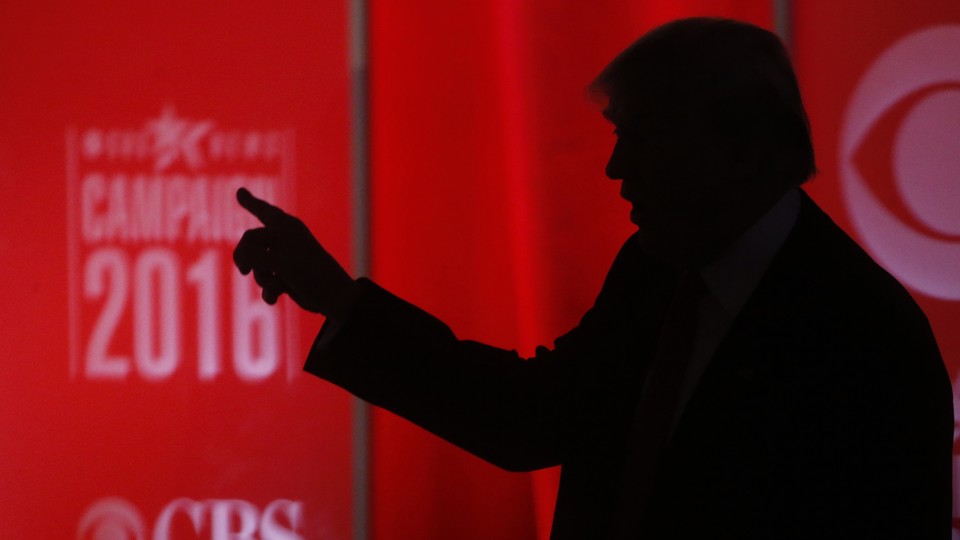
Donald Trump blamed the Bush administration for failing to heed CIA warnings before 9/11; denounced the Iraq War for destabilizing the Middle East; defended the use of eminent domain; promised to save Social Security without trimming benefits; and credited Planned Parenthood for “wonderful things having to do with women's health.”
He’s fresh off a crushing victory in New Hampshire, and the prohibitive favorite in the polls in South Carolina. Will his flouting of Republican orthodoxy sink his chances—or is it his very willingness to embrace these heterodox stances that has fueled his rise?
Even his rivals no longer seem certain of the answer. Jeb Bush, at one point, called Trump “a man who insults his way to the nomination.” He sounded like a man ruing a race that has run away from him.
If Donald Trump willingly raised his own heresies, the rest of the candidates spent their nights gleefully pointing out each other’s divergences from standard conservative positions. Ted Cruz, Marco Rubio, and Jeb Bush again mixed it up on immigration. Bush attacked John Kasich for supporting Obamacare’s expansion of Medicaid. Rubio had to defend using the tax code to accomplish social-policy objectives. Only Ben Carson stayed clear of the fray, but that only served to underline his increasing irrelevance to the race.
Despite the venue’s name—the Peace Center—the debate was the nastiest and most acrimonious of the cycle. (The auditorium takes its name from its generous donors, the Peace family, a fact that hardly diminishes the irony.) The candidates talked over each other and the moderators, hurled charges, traded insults, and made no effort to disguise their mutual contempt.
Looming over the debate was the death of Justice Antonin Scalia earlier on Saturday—a man who reshaped America’s understanding of its Constitution, and whose passing has now reshaped the political landscape. The debate opened with a moment of silence, and the moderators lost no time in asking the candidates for their views on how his seat on the Supreme Court should be filled.
Not by President Obama, it seems. “I think it’s up to Mitch McConnell and everybody else to stop it,” said Trump. “It’s called delay, delay, delay.” One by one, the others voiced their assent. John Kasich decried partisanship, and then called for a partisan delay. Rubio agreed. “We have 80 years of precedent of not confirming Supreme Court justices in an election year,” thundered Cruz. He was brought up short by the moderator, John Dickerson, who pointed out that Anthony Kennedy was confirmed in 1988—an election year. Cruz pointed out that Kennedy was nominated in 1987, although that was still less then 12 months before the election.
If the candidates agreed that one of them, and not Obama, should have the chance to choose Scalia’s successor, it was a rare moment of accord on the stage. They clashed on other issues, from tax plans to immigration to foreign policy—to Donald Trump’s business record.
In a week, voters in South Carolina will head to the polls. It will be a clarifying moment for the Republican Party. Donald Trump is gambling that enough of them will endorse his challenge to the policy establishment’s consensus—or at least, his willingness to offer straight talk—to allow him to add the state to his column. Jeb Bush hopes that enough South Carolinians retain a fondness for his brother, and for the family legacy he represents, to allow him to beat out Kasich and Rubio. Those two candidates are looking to South Carolina to tip the race in their favor, after mixed results in Iowa and New Hampshire. And Ted Cruz is trying to turn this into a two-man race, take down Trump, and wrest control of the Republican Party from the establishment.
If Trump can replicate the results in New Hampshire—as the polls presently suggest he may—it will be more than a personal victory. It would require a plurality of Republican voters in a deeply conservative state to embrace a candidate who has repudiated many of their party’s signature stances. Whatever his showing in the primary, Donald Trump has already shifted the terms of the debate in ways that will long outlast him.
—Yoni Appelbaum
