The Vaccine-Hesitant Man of Europe
Large swaths of the French population say they will not get a COVID-19 vaccine. Will the government be able to persuade them to change their mind?
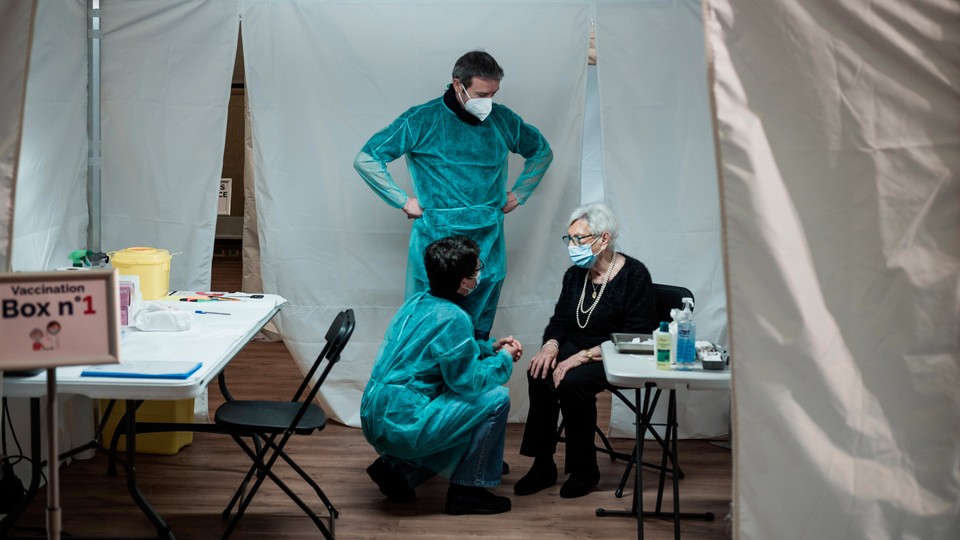
If certain corners of the French internet are anything to go by, COVID-19 vaccines are unsafe, those who refuse them risk becoming “second-class citizens,” and the country has turned into a “health dictatorship.” That such claims have gained currency in France—home to Louis Pasteur, a robust welfare state, and a universal-health-care system—would have been far-fetched 25 years ago. But the country that helped develop the rabies and anthrax vaccines is now one of the most vaccine-hesitant nations on the planet. A December survey by the pollster Ipsos MORI and the World Economic Forum estimated that as little as 40 percent of the French public intends to receive a COVID-19 vaccine—the lowest percentage of any of the 15 countries surveyed, including Brazil (78 percent), Japan (60 percent), and Russia (43 percent). Another study concluded that nearly a third of France’s working-age population might refuse a vaccine.
This puts France in the peculiar position of being among the wealthy countries with an ample supply of vaccines yet with a large swath of its population unwilling to get them. Recent history offers clues about how the country came to be this way. What’s less clear, and more urgent, is what the government is doing about it.
Decades ago, the French public was overwhelmingly supportive of vaccination. But a series of health controversies in the 1990s began to chip away at its trust in vaccines and the health officials who promote them. The first consumed the public’s attention for years. The government, a journalist revealed, had knowingly distributed transfusions of blood contaminated with HIV, which resulted in hundreds of deaths; several ministers were charged with manslaughter (only one, the health minister, was convicted). The second concerned a rise in multiple-sclerosis cases, which some in the population feared was linked to the government’s hepatitis B vaccination program. Although no evidence supported this claim, the government sent opposing messages—one minister approved the program, another suspended it—that undermined public confidence.
But the government’s 2009 response to the swine-flu outbreak made vaccine safety a matter of national debate. France embarked on a mass-vaccination campaign to stem the virus’s spread, purchasing more than enough doses to cover its population of 65 million. The problem was that barely anyone was willing to take them. “The French didn’t want to be vaccinated against an illness that didn’t really affect France,” said Laurent-Henri Vignaud, a co-author of a recent history of anti-vaccine sentiment in France. With fewer than 325 swine-flu-related deaths in the country, many resented the government for spending funds on expensive and unnecessary vaccines; pharmaceutical companies, critics pointed out, were the campaign’s prime beneficiaries. “Doubts about the government’s vaccine policy turned into doubts about vaccination itself,” Vignaud told me. In the end, less than 10 percent of the population got a jab.
By the following year, a national survey found that 38.2 percent of the public held an unfavorable view of vaccination in general, up from 8.5 percent in 2000. It was a significant shift, but one that could be misread: Of those who held an unfavorable view of vaccines, just 5 percent said they opposed getting any. The rest cited specific vaccines, including those for hepatitis B (12 percent) and swine flu (50 percent).
Researchers say this distinction is important because not every person who expresses hesitancy about vaccines is necessarily an anti-vaxxer. “Hesitation, by definition, is kind of an undecided state,” Heidi Larson, the director of the Vaccine Confidence Project at the London School of Hygiene and Tropical Medicine, told me. In France, vaccine hesitancy is highest among women, young people, those who are less educated, and those who vote on the political extremes. Common reasons include concerns about vaccine safety and effectiveness, but the biggest predictor of vaccine hesitancy is a lack of confidence in the state. “Trust in government is such a strong variable,” said Larson, “and that’s wobbly in France.”
A survey published last month by the French university Sciences Po showed that confidence in the government hasn’t exceeded 35 percent in more than a decade. This antipathy was on full display in 2017, when the French repudiated the country’s mainstream parties and narrowed the presidential race to the far-right candidate Marine Le Pen and the self-avowed outsider Emmanuel Macron. That dissatisfaction returned in force a year later with the rise of the gilets jaunes, or “yellow vests,” the grassroots movement born out of anger at the Macron government’s proposed fuel tax, which quickly evolved into a wider protest over economic inequality and the self-dealing of the political class.
Opposition to vaccines doesn’t feature in the rhetoric of the yellow vests. But researchers and disinformation experts I spoke with noted a strong correlation between those who identify with the yellow vests and those who espouse anti-vaccine sentiments online. Both groups have lost faith in the French state: The former tends to regard Macron as a technocrat whose loyalties lie with the metropolitan elite; the latter is more likely to disapprove of his handling of COVID-19. Yellow-vest protesters “already had a lot of grievances against this government,” Cooper Gatewood, a senior digital-research manager at the Institute for Strategic Dialogue, a London-based think tank, told me. “If they’re hearing from whatever conspiracy or unreliable source that COVID is exaggerated, that it’s not really that big of a deal, that it’s a hoax, then it’s easy to use that as justification for opposition to further action taken by the government. So the narrative aligns quite well.”
The French government hasn’t done itself many favors. Its shambolic handling of the AstraZeneca vaccine has seen the country reverse course twice. In January, Macron erroneously declared that the jab was “quasi-ineffective” for people over the age of 65. After studies debunked the claim, the government announced the elderly could receive the vaccine. This week, France changed its policy again, when it joined more than a dozen European countries in suspending its AstraZeneca rollout. The reason for the halt was that 37 out of more than 17 million AstraZeneca recipients had developed blood clots. But now that the European Medicines Agency has concluded its investigation determining that the vaccine is “safe and effective,” the French government is likely to reverse itself once again.
The damage done to AstraZeneca’s vaccine, though, might prove irreversible: A recent poll found that more than half of the French public no longer trusts the AstraZeneca vaccine, up from just 22 percent earlier this month. “We absolutely need this vaccine to get our non-at-risk population vaccinated,” Mélanie Heard, a member of the committee advising the government on its vaccine communication strategy, told me, prior to the blood-clot investigation. “We can’t do it without AstraZeneca.”
The government’s immediate focus is on vaccinating its most at-risk populations, including the elderly and health-care workers (many of whom have refused to get a jab, citing among their concerns a lack of confidence in vaccine safety). As a result, vaccination has been promoted not as a social benefit but rather as a way for the country’s most vulnerable to protect themselves. “This choice, I think, also explains why younger people at the moment aren’t fully convinced with the vaccine,” Heard said. As more evidence supports vaccination’s ability to reduce transmission, she added, “that should change.”
France’s prime minister announced this month that the country would open more centers, with the aim of vaccinating 30 million people, or roughly two-thirds of the adult population, by the summer. That’s an ambitious jump from the country’s current pace, which has seen 5 million people vaccinated since January. But ramping up France’s rollout won’t solve its hesitancy problem. To do that, the government has begun to enlist primary-care doctors and pharmacists, who tend to be more trusted than the state, to help distribute vaccines. It has also begun promoting a series of advertisements aimed at encouraging the public to get a jab. The first, which was shared by the country’s health minister, focuses on the elderly. Heard said future ads will feature the country’s younger populations.
The question is whether relying on family physicians and nostalgic ads will be enough. When I asked public-health experts, none was convinced. “We won’t get to herd immunity with vaccination,” Michaël Schwarzinger, a researcher at Bordeaux University Hospital and the lead author of a recent study on vaccine hesitancy in France, told me. “There’s only one alternative—and if it’s not with a vaccine, it’s by infection.”
