Defeating Netanyahu Means Solving a Math Problem
No one will be able to form a government without the help of either the ultra-Orthodox or the Arab Israeli parties.
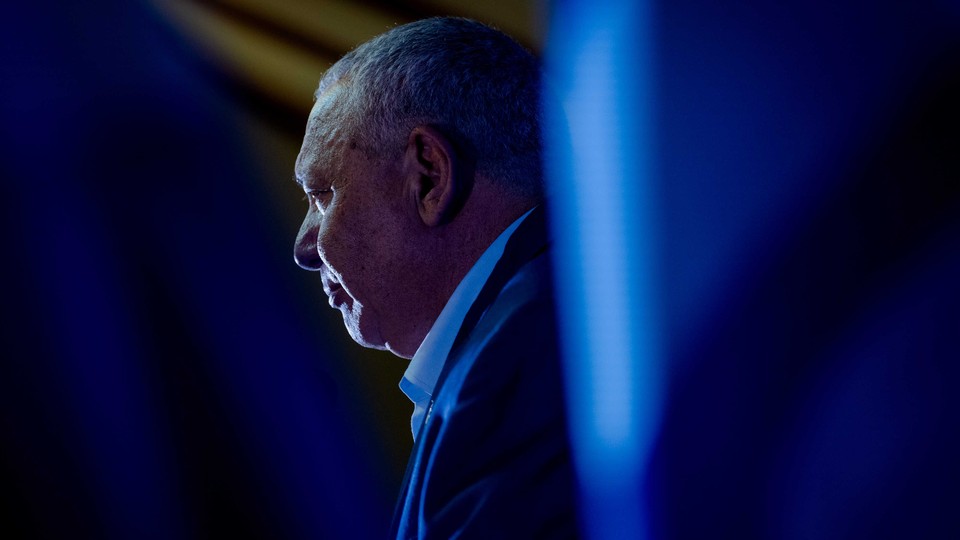
On paper, Gadi Eisenkot seems like an ideal leader for Israel’s right wing. He grew up far from the Tel Aviv establishment, in the Red Sea town of Eilat, at the country’s southern tip. He spent more than four decades in uniform, starting as an infantryman in the Golani Brigade, the army’s gritty, working-class core. And he is Mizrahi: His family came to Israel not from Europe but from Morocco. His father adapted the European-sounding family name from Azancot, a Berber word meaning “gazelle.”
The Likud party has long claimed just this sort of biography for its own. But Eisenkot is not Benjamin Netanyahu’s heir apparent. Rather, this soft-spoken military man with a boyish face is the prime minister’s most dangerous political enemy.
A year ago, that distinction would have belonged to Benny Gantz, the former army chief whom admirers once cast as the next Yitzhak Rabin. Eisenkot broke with Gantz over an array of disagreements, including many about Netanyahu, and founded his own party, called Yashar—Hebrew for “straight,” as in honest. To the surprise of even his closest aides, Eisenkot now leads the polls, and Gantz’s party fails to clear the electoral threshold in almost every projection.
In Israel, however, leading the polls and becoming prime minister are two very different things. Israelis don’t vote for a prime minister. They vote for parties. The Knesset has 120 seats, and whoever can assemble a coalition of 61 governs. That sounds manageable, but since October 7, 2023, it has become nearly impossible.
The math has been complicated by the unequal burdens of Israel’s multifront war. For the past three years, the Israel Defense Forces have been fighting on virtually every front, seemingly without end—in Gaza, the West Bank, Lebanon, Syria, Iran. The military has called up reservists again and again, for months at a time. Many have lost jobs, businesses, and marriages. Some reservists took their own life. Such sacrifices have forced a national reckoning with the exemption of the ultra-Orthodox, or Haredim, from military service. Israelis overwhelmingly want to see ultra-Orthodox young men share the military load. But the ultra-Orthodox parties refuse this, and Netanyahu’s coalition depends on them.
For Eisenkot, the issue has become personal. One of his sons, Gal, was called up for duty and died on a mission in Gaza to extract one of the dead hostages. After that, Eisenkot decided that he needed to be more active on the matter of the Haredi exemption. He and nearly every other opposition leader have pledged not to govern with the ultra-Orthodox parties. Complicating matters, many of the same leaders, including Eisenkot, have also ruled out governing with Israel’s Arab parties since October 7—even though Hamas gunmen murdered and kidnapped Arab citizens that day, and Arab Israeli paramedics and EMTs risked their lives to treat and evacuate many victims. Some party leaders have stipulated that they will partner only with parties whose communities serve in the army.
This stance may be all that stands between Eisenkot and Netanyahu’s job. Most polls give the “change camp”—shorthand for the anti-Netanyahu bloc, which stretches from the left to the nationalist right—no path to 61 without either the Haredi or the Arab parties. Its leaders face a choice: break a promise or risk failing to form a government, which would send Israel to yet another election. In the meantime, Netanyahu and his hard-right government would stay in office.
There is a third scenario. If Eisenkot’s bloc outpolls Netanyahu’s but still falls short of 61, he could form a minority government—one that survives on outside support from Arab parties without giving them seats in the cabinet. That backing would allow the bloc to get some things done, including replacing the Knesset speaker.
Israel has done this before. Rabin’s second government spent its final years relying on the votes of Arab lawmakers. The right complained that the Oslo II agreement, in 1995, approved by a 61–59 vote in the Knesset, lacked a “Jewish majority,” a charge that has hung over every such arrangement since. Eisenkot’s critics warn that repeating this experiment would provoke a backlash and hand Netanyahu a landslide the next time Israelis vote.
Eisenkot has been circumspect in what he has and hasn’t promised. He has told interviewers that Ra’am, the Islamist party led by Mansour Abbas, cannot be part of his government. But being part of the government is not the same as being part of a coalition, and neither is the same as supporting from outside. Abbas has added to his Islamist party a Jewish politician who is a former police officer, likely to make Ra’am a more attractive eventual partner.
No one is enjoying this mess more than Netanyahu. His opponents are many, and each believes that he could be the next prime minister. Netanyahu’s camp is disciplined, and it has one leader.
Discipline, however, will not get this group to 61. Every major poll except those on Channel 14, the network that functions as Netanyahu’s house broadcaster, shows that his bloc cannot form a coalition either. And questions about October 7 are closing in on him, including from reporting in both this magazine and The Wall Street Journal that Egyptian intelligence warned Israel about the coming assault just ahead of time. Netanyahu’s office denies that he received any alert, calling the story old news recycled to manipulate Israeli voters. He is even suing Israeli outlets in part for amplifying those scoops.
Netanyahu’s best scenario, Israeli analysts say, is a stalemate: No bloc reaches 61, and the country goes to another election. Netanyahu would then remain at the head of a caretaker government, in power without a new mandate. He did that during a previous political deadlock in 2019—one that broke only when Naftali Bennett went back on his earlier promise not to form a coalition with Ra’am.
Many Israelis see this election as the most consequential since the state’s founding, in 1948—so much so that some citizens living overseas have vowed to fly home to cast their ballot on October 27. The votes will be tallied that night, but the results may take weeks to determine, if this election determines anything at all.
One thing is already clear: Whoever becomes Israel’s next prime minister will have to break a promise or two to get there. It may be the hardest decision of that person’s career. Unless that person is Netanyahu, whose political career is on the verge of ending: He will do anything, and that means anything, to save it.