The Stunning Rise of Single-Payer Health Care
How a socialist-seeming health-care policy became a rallying cry in the Democratic mainstream
If you want to understand why Rebecca Wood supports Medicare for All, you have to understand the story of her mouth. In 2015, Wood cracked a tooth. Around the same time, her daughter, Charlie, began to speak. Charlie was already 3 years old, but her premature birth had left her with delayed speech and in need of extensive therapies. When a payment for Charlie’s speech therapy came due, Wood, who had stopped working so she could take care of her daughter, had to make a choice. Should she pay for a root canal and crown for herself, or pay for Charlie’s therapy?
Wood could only afford one, she told me recently. Deciding not to risk losing momentum on Charlie’s language skills, she opted to postpone the root canal. But before she could get the procedure done, she developed an infection that spread throughout her entire mouth and jaw. A dentist had to drain her infection and scrape away part of her jaw under local anesthesia; Wood could not afford to be put completely under. The dentist also pulled every one of her teeth. “I told myself, This is the price of a miracle,” Wood said of her daughter.
The choice she was forced to make still stings—sometimes literally. Wood now has dentures, and they fit poorly. Her dental insurance only covers a new pair every five years. Throughout this saga, Wood was frustrated that her health insurance didn’t protect her from staggering bills and difficult choices. It felt like politicians didn’t care. She decided that “the only way we’re going to ever have health-care justice is if the guys writing the policies have to live by it.” That would mean everyone would have the same health-insurance plan. Which would mean Medicare for All.
In 2017, Wood spoke at a Bernie Sanders press conference on universal health care. This past June, she testified at a congressional hearing on universal health coverage. She now works full-time for Mass-Care, a Massachusetts-based nonprofit advocating for Medicare for All.
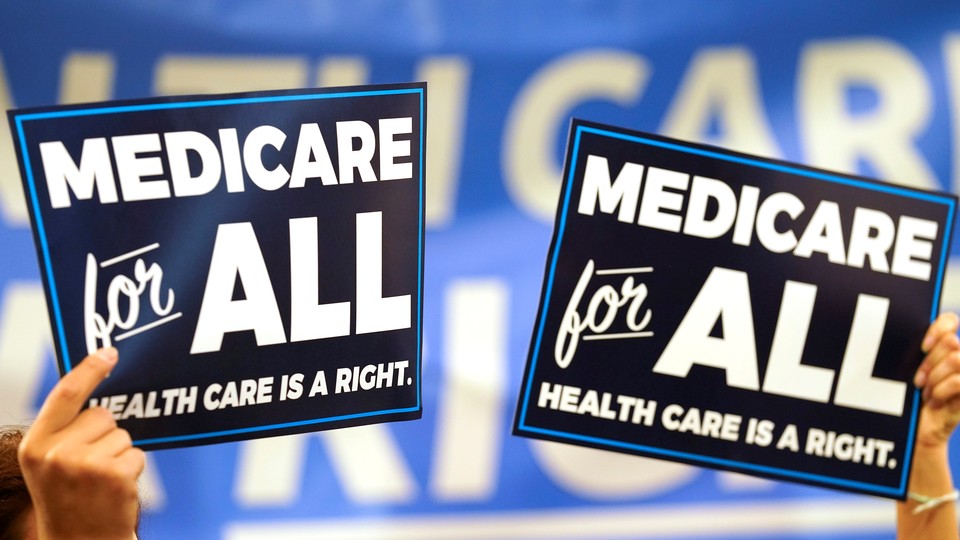
Not every single-payer advocate’s story is as heartbreaking as Wood’s. But Medicare for All—otherwise known as single-payer health care—has taken on an astonishing popularity among Democrats and independents in recent years, rising from a fringe, socialist hobbyhorse to a policy seriously and frequently considered during the Democratic primary debates. In 2016, it was the special quirk of Sanders’s candidacy; now 11 candidates support some version of it. Single-payer health care, the kind that exists in Canada and some European countries, would make medical care free or nearly free for all Americans. Under some versions of these plans, private insurance would be eliminated, and all Americans would be covered under one, government-run plan, similar to Medicare.
Wood and a half-dozen other supporters of Medicare for All told me about the deep physical and emotional wounds that brought them into the fold. Most either have or recently had health insurance, but they say it wasn’t enough to protect them or their family members from death, illness, or debt. Medicare for All strikes many as the easiest way to stop the health-care madness, even if the political path to it isn’t yet clear. They’ve grown disgusted with the American health-care system and reached the conclusion that blowing up the system is the only way forward.
In a way, the rallying cry of single-payer harkens back to President Barack Obama’s use of, in the dark days of the 2008 recession, uplifting slogans like “Hope,” “Change,” and “Yes, we can.” Most people didn’t know exactly how “hope” would lead us out of economic gloom. But just as with health care today, they were pretty sure it couldn’t get any worse.
Though the exact number depends on the poll and the way the question is asked, a slim majority of Americans—51 percent—now support Medicare for All, according to a Kaiser Family Foundation poll. Many moderate Democrats and most conservatives remain staunchly opposed to any kind of single-payer plan. Former Vice President Joe Biden, who supports more incremental health reforms, has said Medicare for All would raise taxes on the middle class. Many Democrats are uneasy about dismantling the private health-insurance market, and they worry about how such a sweeping program would be funded. Instead of premiums and deductibles, under Medicare for All Americans would pay for their health care through taxes—although who would pay and how much are matters of great dispute.
Marie Fishpaw, the director of domestic-policy studies at the Heritage Foundation, a conservative think tank, disputes that Medicare for All is even all that popular. (Support for Medicare for All has declined somewhat since 2017.) “While polls show initial support for Medicare for All, there is a remarkable drop in support when people learn more about the details,” she told me via email. “Any program that is going to create more taxes, take away health-care choices, or outlaw private health coverage entirely becomes a nonstarter.”
The main proponents of single-payer in the Democratic race, Senators Bernie Sanders and Elizabeth Warren, have defended their plans against these attacks and more. And the fact is, many supporters of this plan don’t need all the details. The horrors of American health care have become so clear that Medicare for All feels, to many, like a refreshing breeze of simplicity.
Medicare for All is easy to understand and promote on social media. The idea is hashtag-friendly—#Medicare4All or #singlepayernow—in a way that “create a Medicaid buy-in” or “add ACA subsidies for people making more than 400 percent of the federal poverty level” are not. Medicare for All is “short and catchy,” says Adam Hodges, a linguist at the University of Colorado at Boulder who specializes in political slogans. And employing Medicare, a system that most Americans are familiar with, makes the concept seem less complex and unknown.
Still, it’s a bit surprising that single-payer is gaining speed now, because Physicians for a National Health Program, the main American organization dedicated to the single-payer issue, was formed in the late ’80s. Before that, Americans could have looked abroad for inspiration: England’s National Health Service came into being in the ’40s. Adam Gaffney, the president of PNHP, told me he attributes the popularity of single-payer to advocacy by his and other groups, to the continuing high cost of medical care, and to the rise of politicians who are willing to be out and proud about government-run health care.
Most of the people I interviewed either had heard about Medicare for All through Sanders’s 2016 candidacy for president, or said his campaign was when they became truly fired up about the issue. Jessica Neeley, of Veneta, Oregon, was a bookkeeper for the United Brotherhood of Carpenters and Joiners of America for four years before a pulmonary embolism and Addison’s disease left her unable to work last year. She said when she first heard about Medicare for All, during the 2016 campaign, her ears “perked up.” Even with excellent union insurance, she was still paying more than $1,000 a month in prescriptions and treatments. She said she’s now uninsured and in debt.“Why should I suffer more than the millionaire?” she asked. “We have the same condition, but I just can’t afford to take my medication.”
Some support for single-payer is based not on personal experience, but that of others. Ashley Hudson’s family was so poor when she was growing up that her parents could rarely afford to see a doctor. When she was 14, her father was diagnosed with cirrhosis and died three weeks later. Today, the 32-year-old Hudson, who has worked for local Democratic political campaigns, thinks that if the disease had been caught earlier, her father might have lived. Hudson’s mother, who recently had to quit her job at McDonald’s because of poor health, now relies on a GoFundMe campaign to pay for her medical care. “My heart is constantly pounding, just kind of waiting for the other shoe to drop,” Hudson said—meaning, she’s dreading the day her mother gets sicker and dies.
The single-payer fans I spoke with are skeptical that making small fixes to the Affordable Care Act—such as adding a public option or increasing its subsidies—would suffice. A decade of brawling over Obamacare has left some Democrats with private-health-insurance PTSD. A guaranteed, free system, some say, is the only way to ensure that everyone would be taken care of, forever. Hudson worries that even a small out-of-pocket cost could lead to more deaths like her father’s. Even if the ACA were more robust, Neeley argued, there would still be a chance that infighting among politicians would lead to “taking stuff off of it, putting stuff on it.”
Others’ trust in private insurance companies has completely evaporated. Liz Deere, a clinical social worker and co-chair of the Central Arkansas DSA, worried that if private insurers still existed, they could kick sick patients off their plans. (They can’t currently do this.) Ben Fong, who is on the executive committee of the Phoenix DSA as well as the steering committee of the Democratic Socialists of America’s national Medicare for All campaign, thinks insurers’ profits are to blame. “What the ACA has failed to deal with is the profit motive,” Fong told me. “The fact that a lot of people are becoming enormously rich off of our lives.”
The animosity toward corporations—insurance corporations—fits with the growing acceptability of various permutations of socialism in the U.S. (One interviewee even told me he was “a socialist.”) After years of being told that socialism is evil, and that socialized medicine is therefore evil, too, some Democrats are reclaiming the word. Medicare for All is an easy-to-understand, decisive departure from what Sanders calls a “cruel and dysfunctional” health-care system. So what if it’s socialist?
True believers of Medicare for All don’t want to hear that single-payer health care will be very difficult to achieve in the U.S. Entrenched medical interests will lobby against it; Congress may never have the votes. If it ever does come to pass, hospitals may close. But the committed are not daunted by these obstacles. To them, there’s only one response to the question, “Can we really do single-payer here?” Yes, we can.