Conversations With College Students on a Politically Divided Campus
At Central Michigan University, a group of college students from across the political spectrum meets every week to talk through their differences.
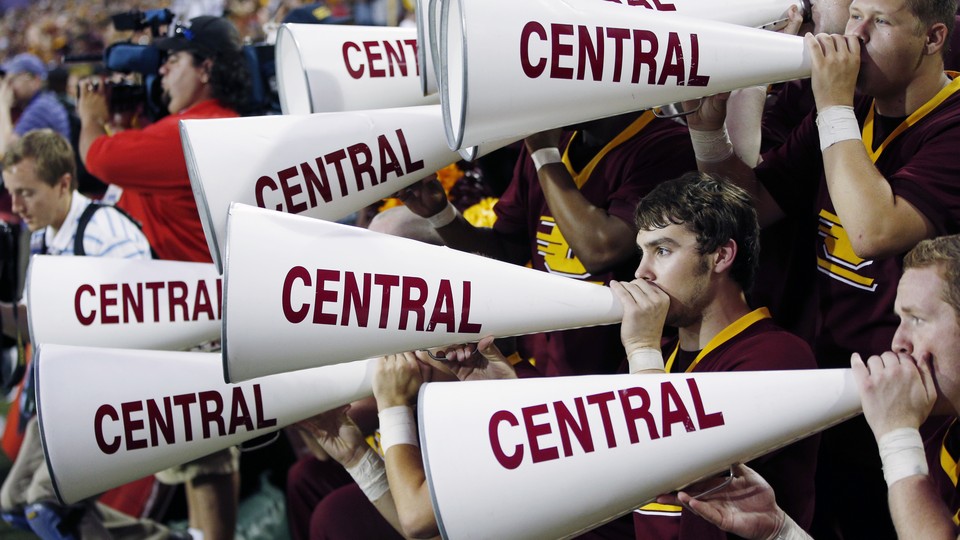
MOUNT PLEASANT, Mich.—The Civil Discourse Society meets every Tuesday evening at 7p.m. Started last year by a few undergraduates at Central Michigan University who just wanted a place on campus for open, respectful conversations about politics, the club feels more relevant than ever. And each week, a few more students trickle through the door.
“We need to make it more of a point to get people to talk,” said Jackie Smith, the organization’s president. Students at the college, which is located in the center of the state as the name implies, say they also feel stuck in the middle of a contentious political climate where no one wants to listen to anyone else. Students are pretty evenly split, politically. And in 2016, Isabella County, where the school is located, went for now-President Donald Trump after going for Barack Obama in both 2008 and 2012. That’s made for some tense interactions.
“I just cannot express how stressful it is to care about politics,” Maggie Lenard, a 20-year-old sophomore, groaned. Lenard cast her ballot for Donald Trump but says she now regrets it. She’s lost friends over that vote.
The day after the election, some students walked around campus crying. “I was just kind of, like, ‘It’s Friday, nothing has changed yet,’” said Mackenzie McMahon, a 21-year-old senior who identifies as conservative. But Smith, who is more liberal, said she sympathized with people who were upset.
Regardless, “campus has not been too great lately,” said McMahon, who was wearing a shirt with the phrase “A Woman’s Place Is in the House and the Senate” emblazoned across it. “I’ve felt uncomfortable.” So have other people on campus, on both sides of the political spectrum, and sometimes it’s been easier to just keep quiet.
But not on Tuesday evenings. On Tuesdays, the group arranges a few desks in an unlocked classroom in a circle, sits down, and talks. It can get tense, but no one yells, no one storms out, and everyone has a chance to explain why they feel the way they do. Afterward, they sometimes go for drinks and late-night snacks at the Applebee’s nearby. The society is one example of how, at a time when Washington and much of the rest of the country is gripped by political polarization that can make substantive conversations about policy differences difficult, college students on politically divided campuses, who are part of a generation many older Americans expect to be apathetic, have found a way to have those conversations in a productive way.
During a recent meeting, conversation turned to the president’s comments about groping women. Most of the female students in the room, conservative and liberal alike, said they were disgusted. Bennett James, a 21-year-old junior, wasn’t too bothered and argued that just because someone says something terrible doesn’t mean he should be judged on it. “You can choose to be offended,” he said.
That didn’t sit right with Smith, who said she thought his view came from a position of white male privilege. “Men and women are always going to be at odds over this,” he replied. Besides, he argued, politics and emotion should be separate things.
Back and forth the conversation went for more than an hour. For me, as an observer (a good portion of the conversation that night revolved around questions I posed to the students about reaction to the election on campus), it was exhausting, refreshing, and, frankly, not something I see all that often.
Joseph Krinke, a 20-year-old sophomore, thinks social media has a lot to do with what seems like a rise in hostility. People can hide behind a “cloak of anonymity,” he said. And in the wake of the election, instead of talking to each other, people are finding their own echo chambers.
The Central Michigan University political-science professors Jayne Cherie Strachan and Ted Clayton see that in class, too. In some ways, things have been shifting for years. Interest among young people in running for office and participating in the political process has atrophied. People are turned off, Strachan said; they want to go be entrepreneurs instead. And with the internet and social media, everyone can find news that fits their beliefs, however inaccurate. “This is the problem,” Clayton, said. “We’re not arguing about interpretation of fact [anymore], we’re arguing over what is a fact.”
In response, the school, and Strachan in particular, has developed what amounts to a slightly more formal version of the Civil Discourse Society. About 700 students have taken the course this year. Research suggests, Strachan said over lunch at a café downtown, that when people deliberate with their peers, that process shapes a person’s intrinsic identity and turns them into someone who will be civically engaged.
This semester, the course is called “From Ferguson to Baltimore and Beyond: Issues in Policing.” During one evening seminar recently, two graduate students led about eight undergraduates in a conversation about the use of body cameras. Pretty much all students have to do is talk, civilly, to each other for a little more than an hour. One time, a guy lost points for lobbing the phrase “you people” at a classmate. But usually things go smoothly. On this particular night, the graduate students asked the group to come up with a better alternative to body cameras. Some students suggested sensitivity training. Others pitched community events. After about 45 minutes, one participant in the group, whose members all appeared to be white, posited diversifying the police force so that members of the community see themselves represented among the officers who patrol their streets.
Would the conversation have gone differently if the class itself had been more diverse? Probably; perhaps someone would have suggested diversifying the police force much earlier. But it’s a work in progress. Schools in this part of the state have seen an uptick in the number of black and Hispanic students enrolling. In some cases, that’s fostered richer conversations in class and on campus, but in others, it’s caused friction.
Maham Khan is a 19-year-old student from Wisconsin on a full scholarship in the honors program at Central Michigan who wants to be a doctor like her dad. After Trump announced the initial immigration order barring people from seven majority-Muslim countries from entering the United States, Khan, who is Muslim and wears a headscarf, decided to organize a protest rally. Someone messaged her and told her she was wrong and the ban was right. A friend who was walking past the library talking to her mom on her phone was interrupted by a couple of guys in a white pickup truck who rolled down their window to yell, “Go back to your country; Trump’s president.” Another classmate defended an anti-Semitic Valentine that made national headlines by saying that people have a right to make jokes. “You’re a straight, white male,” Khan, who isn’t a member of the Civil Discourse Society, wanted to say. “No offense, but you can’t talk.”
That’s not to say she’s not happy to lend what to many people on campus are new perspectives on issues like Islam. But it’s only rewarding if people are receptive and not hostile, she said. Questions about whether she has an arranged marriage, for instance, sting. (No, for the record, and neither did her parents.)
Portia Brown, a senior studying broadcast journalism, knows what it’s like to receive uncomfortable questions. The school recently won an award for increasing diversity and she’s proud of its progress, but “it’s not a comfortable place for everyone,” said Brown, who isn’t in the Civil Discourse Society. Her friend’s roommate in the dorms was a white person who’d never had a black friend. Brown, who is also black, has fielded awkward questions about her hair and skin and what sport she plays (because of course, people assume, she must).
These types of comments predated the election, of course. But students who opposed Trump’s victory said his tumultuous first months in office have only increased polarization and added to the tension, while some who supported his election say they’ve faced backlash for supporting him. Mallory Walton was one of the graduate students moderating the body-camera discussion. She grew up in the area and says Trump has a way of talking that appeals to people around here. The fact that the county voted for Obama surprised her more than the fact that it went for Trump last November. “He says things that people have been thinking their whole lives,” she said. Brown put it this way: It’s a quiet little nostalgic town without enough diversity to see the outside issues.
Except, as she and others have noted, the issues aren’t so “outside” anymore. Schools and the towns that host them are becoming more racially and politically diverse. Nationally, children of color make up more than half of all K-12 students. More minorities are enrolling in college, and not just along the coasts, but in central Michigan, too. Brown knew not all of the tensions around race and criminal justice and diversity on campus would be solved by the time she got ready to graduate. And they’re not. But the school seems to be moving forward, however slowly. Sometimes that means simply gathering some desks in a circle and listening.
