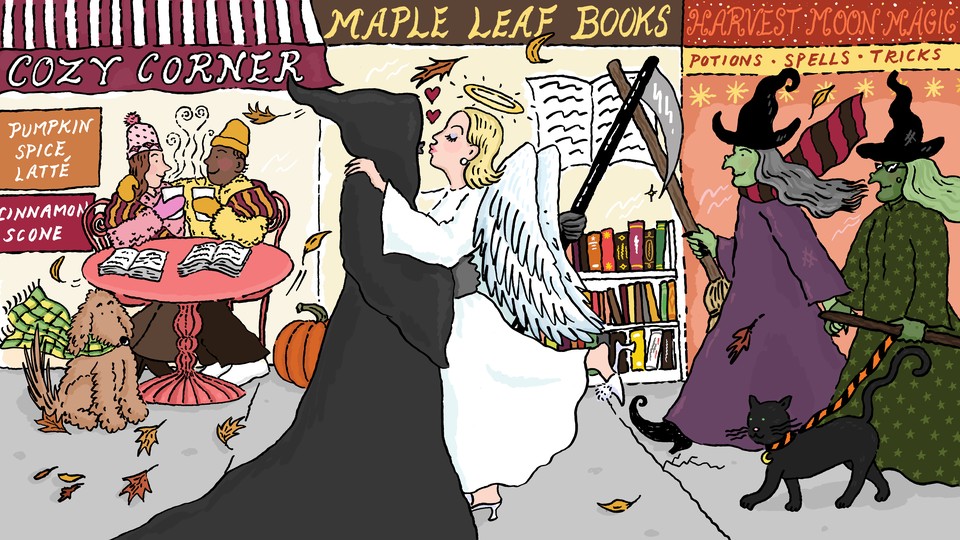
Unto every season is given a certain kind of book. When the new year beckons a new you, self-help thrives. Breezy beach reads rule the summer. Cookbook recommendations abound in the lead-up to Thanksgiving. Curiously, publishers told me, Easter is big for picture books (which are easy to stick in a basket next to the chocolate bunny). And Halloween is for horror. Time to bust out some Shirley Jackson (or perhaps some Stephen King or Edgar Allan Poe).
Yet the days of decorative gourds and darkening evenings have also become a boom season for romance novels—not just any romance novels, but ones targeted at both Halloween and fall more broadly. These books exist on a spectrum of snuggly to spooky: on one end, crispy foliage and adorable bookshops; on the other, the growing subgenre of horror romance. In the middle lie Halloweeny but still-sweet stories of witches brewing love potions, grim reapers falling for guardian angels, and regular old humans getting entangled with creatures of all kinds. This trend results from a brew of ingredients that include market forces, social-media trends, and readers yearning to escape the real world for a cozier one with more regular seasons.
Autumnal romances are not an entirely new phenomenon, but they have really taken off in the past two to five years. Winter-holiday-themed romances used to be published around the end of September, according to Leah Hultenschmidt, the publisher of Hachette Book Group’s romance-focused Forever imprint. “People talk about the Christmas creep. But we were really creeping it,” she told me. Now, she said, holiday books are being pushed back because “fall has become its own selling season.”
Taylor Capizola, the general manager of the romance bookstore The Ripped Bodice in Los Angeles, told me that The Ex Hex by Erin Stirling was the first “overtly autumnal, overtly Halloweeny” book she noticed catching on. That book—about a witch who curses her ex-boyfriend—came out in 2021. That same year, Jeannie Chin released the small-town romance novel The Inn on Sweetbriar Lane. It’s set in fall, and features a pumpkin festival. But Chin told me that at the time, she wasn’t thinking of it as a seasonal romance, and her publisher wasn’t really planning to market it that way. (The cover, with its pink flowers, actually looks pretty spring-y.) “As it came out, I think, is sort of when this ‘fall is the new Christmas’ thing started,” she said. “So we sort of pivoted with the marketing a little bit to take advantage of the fact that it absolutely is a fall book.”
Interest has escalated since then. Whereas in the early part of this decade, Capizola might have seen five or so Halloweeny books come into the shop in the fall, by last year The Ripped Bodice was unpacking “boxes and boxes and boxes,” she said. “Just a massive amount.” One of the fall-themed novels that came out this year was Chin’s. With The Cozy Nook Bookshop, “the idea of putting that fall cozy piece front and center was there from the beginning,” Chin said. This time, it has pumpkins on the cover.
To be fair to fall, it is very romantic. The leaves, the chill, the steamy beverages, and the beckoning of the fireplace all set the mood for what many hopeful singles call “cuffing season.” The beloved rom-com You’ve Got Mail famously takes place in fall, with Tom Hanks rhapsodizing about “a bouquet of newly sharpened pencils”—a quote that makes the rounds on social media every autumn.
But there’s romance set in the fall, and then there’s fall romance. “We are giving them something seasonal on purpose,” Hultenschmidt said of her publishing imprint. And seasonal romances can be very on the nose. Take Emily Henry’s 2020 romance, a beach read titled Beach Read, that is set at a lakeside beach town and stars an author who writes beach reads. Cindy Hwang, the editorial director at Berkley, which publishes Henry, told me she thinks that the popularity of Beach Read helped launch the trend of highly literal seasonal romances. Some of these fall books practically grab you by the collar, shove a pointy hat on your head, and pour a pumpkin-spice latte down your throat. For instance, last September, Amazon published a collection of short stories for Kindle and audiobook called Scared Sexy, one of which is about a sexy sleep-paralysis demon. All of the stories feature creatures, and most mention Halloween in some way. A couple of these stories were among Kindle’s most-purchased romance books of 2025, according to the blog Romancing the Data, which tracks romance best sellers.
For the same reason someone might watch scary movies or carve a pumpkin, they pick up sexy Halloween books to get into the spirit of the season. But why is seasonality something readers are particularly craving now? It may partly follow from the rise of “spooky season” as a concept. The phrase doesn’t seem to have been used much before 2018 or so, according to Google Trends. It’s invoked as a way of extending the playfully scary energy of Halloween throughout the fall, and giving adults an excuse to partake in seasonal delights along with kids.
Hultenschmidt suggested that the whole snuggly-to-spooky spectrum could be explained by the sense of uncertainty and instability pervading the culture right now. In the face of economic anxiety and political tension, people may seek safety in the comfort of a romance novel and its guaranteed happily-ever-after. Or “they want the terror of a horror novel to be like ‘Oh, well thank God it’s not this bad,’” she said. This might also explain the appeal of hybrid horror-romance books like this year’s Kiss Slay Replay by Rachel Harrison, about a woman trapped in a time loop at her best friend’s wedding, with a masked killer on the rampage and a handsome wedding guest to help her fight back.
I also wonder if some of the appeal is a result of climate change. Seasons other than summer are getting shorter, and all seasons are becoming more unpredictable. When I spoke with Hwang earlier this month, the high in our respective East Coast cities (D.C. and New York) was nearly 80 degrees. If I wanted to catch that classic fall feeling in mid-October this year, I would’ve been better served by cracking open a book than by going outside.
In addition to the comfort and the spookiness, all of the attention on fall stems from one more thing: marketing. Romance and autumn may go together these days like apple cider and cinnamon sticks, but that’s in part because each is having a moment that businesses have seized on.
Retailers have greatly expanded their lines of fall-coded decor, food, candles, and more. Cozy as a marketing aesthetic caught on during the pandemic and never quite left. Seasonal swag is a built-in yearly sales opportunity, no less so in publishing than in any other business.
At the same time, romance has become so successful that it could be said to be propping up the entire publishing industry. The genre is also a particularly fast-paced business. Many romance readers read a lot—Capizola told me some of her customers can read two novels in a day—and romance writers oblige their fans’ appetites with a regular supply of new books. Take Christina Lauren, the pen name of two best friends who co-write their books. Some years they have released two or even three full-length novels. This pace may make it easier to jump on trends relatively quickly, compared with genres where longer lead times are the standard. “Romance as a genre is currently driven in many ways by online trends,” Jamie Fortin, the founder of Friends to Lovers bookstore in Alexandria, Virginia, told me. (The exploding category of romantasy—romance plus fantasy—owes a lot to social-media hype, as well.)
It certainly helps that a seasonal read lends itself well to social media. TikTok and Instagram often favor books that evoke a recognizable aesthetic. On book covers, “you see the palettes are orange and yellow and purple,” Hultenschmidt said, in part so that everything looks “harmonious and beautiful” in recommendation-roundup posts. Some of these books seem to be aimed directly at the “cozy, witchy reads for fall” videos that pop up on BookTok. And when they hit their mark, they really hit it.
The Pumpkin Spice Café by Laurie Gilmore won the TikTok Shop Book of the Year award in 2024, seemingly on the sheer strength of its autumn aura. (Having read it, I don’t think it could have been on the strength of the prose, plot, or characters.) On StoryGraph and Goodreads, many readers proclaim they read it “for the vibes.” And it does check just about every trope box: pumpkin-spice lattes, a small-town “fall festival” complete with a Halloween costume contest, a possible haunting, a sexy, flannel-wearing farmer.
The danger of the fall-book boom (insofar as comfort reads can possibly be dangerous) is that chasing trends can lead to shallower art. Capizola put it diplomatically: “It becomes something more like a collectible than it is actually just about the content within the book itself.” But the best seasonal romances are more than a jumble of poorly executed tropes in a trench coat—they manage to fuse vibes with craft and heart.
A good example is Sangu Mandanna’s The Very Secret Society of Irregular Witches, which was originally published in the lead-up to spooky season 2022. It’s the story of a witch who is lonely by occupation—witches aren’t supposed to gather for fear of attracting unwanted attention. Nonetheless, she takes a job as a tutor to three charming, rambunctious young witches who are illicitly living together at an enchanted estate in the English countryside. She bands together with the quirky caretakers of the home—including a grumpy, hot librarian—to protect the children from impending disaster. It’s totally charming.
This book seems to be living the dream of any seasonal romance—I’ve noticed it bubbling back up on social media and StoryGraph’s most popular list every fall since it was published. When something is pegged to fall, it has a short retail window, “but you have the opportunity to promote year after year,” Hultenschmidt said. But to become a perennial, a title needs to be pretty special, or at least lucky enough to capture attention quickly, because these books’ time in the waning fall sunlight is limited. By just a couple of weeks ago, when I was doing interviews for this story, Christmas romances were already hitting the shelves.