China: The Year in Smog
2013 will be remembered as the year that the country's air pollution problem went mainstream.

This wasn’t the first year that smog blackened Chinese cities with appalling frequency, closed airports and roads, and sent children to hospitals with pollution-filled lungs. Though labored breathing and chronic hacking have long been a fact of life for most Chinese people, something in the awareness of the problem shifted this year—2013 will be remembered as the year that China’s struggle with air pollution went mainstream.
On the first day of the year, the Chinese government began publishing the air quality index (AQI), which measures fine particulate matter (PM2.5) per cubic meter, in real-time in 74 cities throughout the country. That made the worsening pollution quantifiable—and undeniable.
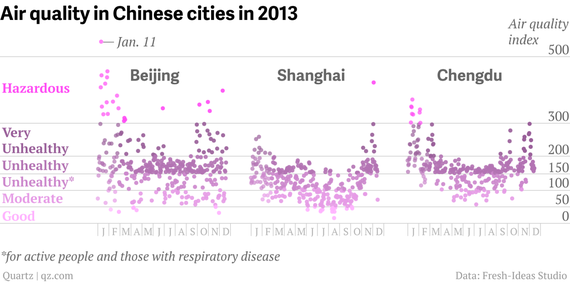
Shortly thereafter, Beijing and surrounding regions were hit by pollution of “unimaginable levels,” as The Atlantic's James Fallows put it. At one point in mid-January, AQI in Beijing soared as high as 993, far beyond levels health officials deem extremely dangerous. (Here’s the health impact based on AQI, for reference.) For comparison, on the same day in New York, the AQI was 19.
Beijing’s “airpocalypse” attracted global media attention and sparked outrage among the Chinese public. And it was just the start. Here are other ways that 2013 changed how China confronted its air pollution crisis:
Organizing Life Around PM2.5 Went Mainstream
Throughout the year, PM2.5 was so consistently high that the measurement “entered into mainstream Chinese life,” as Angela Hsu, a doctoral candidate at Yale University, told The Guardian. Hsu’s research of Chinese social media site Sina Weibo found that the term “PM 2.5″ went from 200 mentions in January 2011 to 3 million in January 2013. It became fashionable for Sina Weibo users to share photos of themselves protecting their lungs:

But foiling PM2.5 was more than just a meme; it was also part of the calculus that people living in China face each day. The New York Times’ Didi Kirsten Tatlow, who lives in Beijing, shared rules for the activities she allows her children to participate in based on air quality. “[A]bove 100, and the air purifiers—all four of them—go on. Above 200, we wear face masks outdoors. Above 300 and no one exercises or plays outside, even with a face mask on. Above 500 and we try not to go out at all,” she explained. And it wasn’t just Tatlow; the share prices of Chinese makers of air purifiers surged in January along with pollution levels.
Air Pollution Caused Medical Emergencies
At one point in January, Beijing Children’s Hospital was treating more than 7,000 patients a day, a five-year high for children with respiratory ailments. Chinese researchers later reported that the Winter 2013 smog crisis affected 800 million people over a span of 1.4 million square kilometers (540,000 square miles). When a severe spate of toxic air hit Harbin, a northern city, in October, hospital admissions surged by 30 percent. During the same month, an 8-year-old girl in Jiangsu became China’s youngest lung cancer patient, a condition blamed on pollution.


Buildings Disappeared—and Photo Evidence Traveled Around the World
Countless photos captured the haunting cityscapes. Even a 1,000-foot skyscraper had trouble sticking out in the Beijing smog, as you can see in this picture snapped by Sinocism’s Bill Bishop:


Chinese People Tried Everything To Fight the Pollution
Some enterprising Chinese people responded to the noxious air conditions with their own inventions.

-
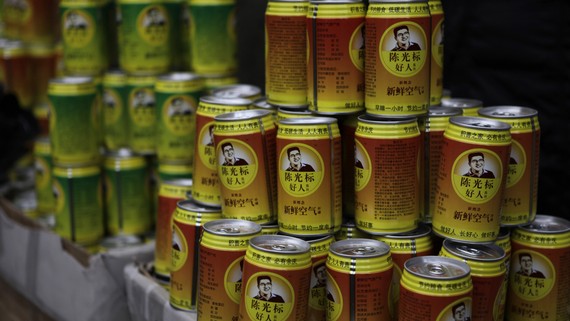
An entrepreneur gave out cans of air in an anti-pollution stunt. (Barry Huang/Reuters) And anti-haze martial arts were supposed to strengthen the lungs of schoolchildren.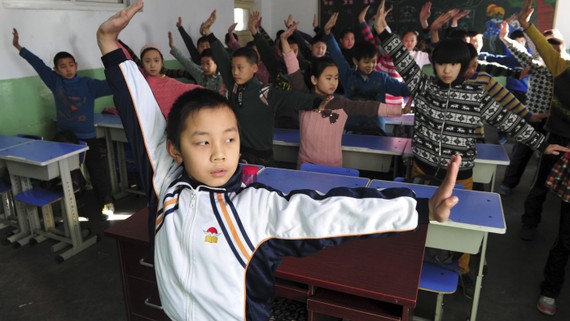
Chinese students use physical fitness to protect themselves. (Reuters) -
It wasn’t just the locals, though. The International School of Beijing built a $5.7 million dome for their athletic field to ensure healthy breathing.
BUBBLE: Beijing pollution forces students to play under dome http://t.co/a45ZKVXFBp - @CBSTopNews pic.twitter.com/KCuI4rZ6PC
— NewsBreaker (@NewsBreaker) July 18, 2013Apple, JPMorgan and Honda all gave their Beijing employees face masks. And when the LPGA came to Beijing, the world’s top female golfers did as the Beijingers do.
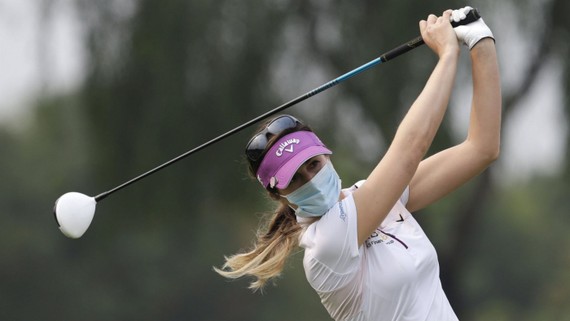
Golfers practicing for a tournament in Beijing wore masks to guard against the air pollution. (Alexander F. Yuan/AP)
In the past, the World Bank has projected that China loses 4.3 percent of GDP to health costs associated with air and water pollution. But that’s always been abstract. This year, China’s economy took a hit on numerous fronts due to air pollution. Tourism, for instance, has begun to suffer, as Beijing saw a 15 percent decline in overseas visitors in the first half of the year.
Air Pollution’s Economic Toll Became More Obvious
-

Tourists climb the Great Wall on a hazy day. (Stefano Rellandini/Reuters) In October, a blinding layer of pollution—so bad “you can’t see your fingers in front of you”—forced the city of Harbin to close schools, roads, and the airport, and its 11 million residents were told to stay home.
-
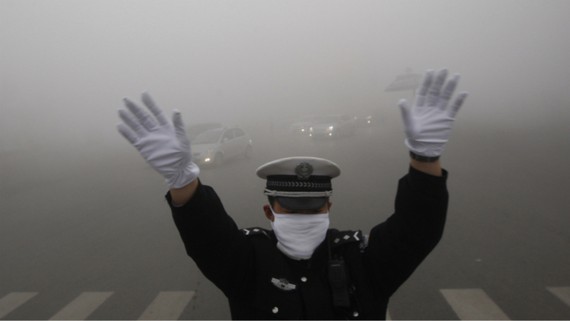
A cop braves Harbin’s October smog. (China Daily/Reuters) Pollution caused hundreds of flight cancellations around the country. The aviation regulator instituted new rules requiring senior pilots on flights into and out of Beijing to be able to land in low visibility.
An aircraft parks in heavy haze at Beijing airport. (Jason Lee/Reuters)
The Government Finally Decided To Do Something About the SmogDuring Chinese New Years, Beijing encouraged residents to lay off the holiday tradition of launching fireworks, causing a 37 percent drop in fireworks sales from the previous year. The government also made the questionable move of cracking down on Beijing’s outdoor barbecues.
But the government finally made a move to address the real culprit. The government announced in September a 1.7 trillion yuan ($277 billion) plan to reduce the smog by cutting the use of coal and decreasing emissions from cars, with Beijing aiming to lower PM2.5 levels by 25 percent by 2017.
-
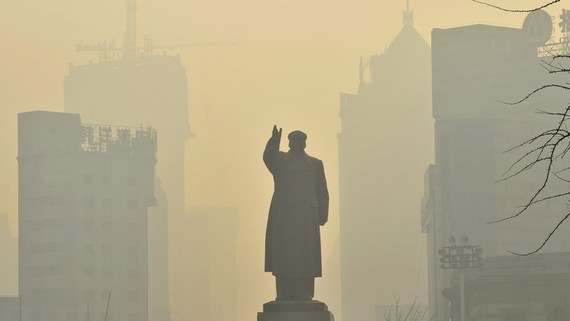
A statue of China’s late Chairman Mao Zedong in front of buildings during a hazy day in Shenyang, Liaoning province (Reuters)
This post originally appeared at our sister site Quartz.